LoL side-lane assignments without losing the next objective
Treat every side wave as a timed task connected to the next neutral objective.

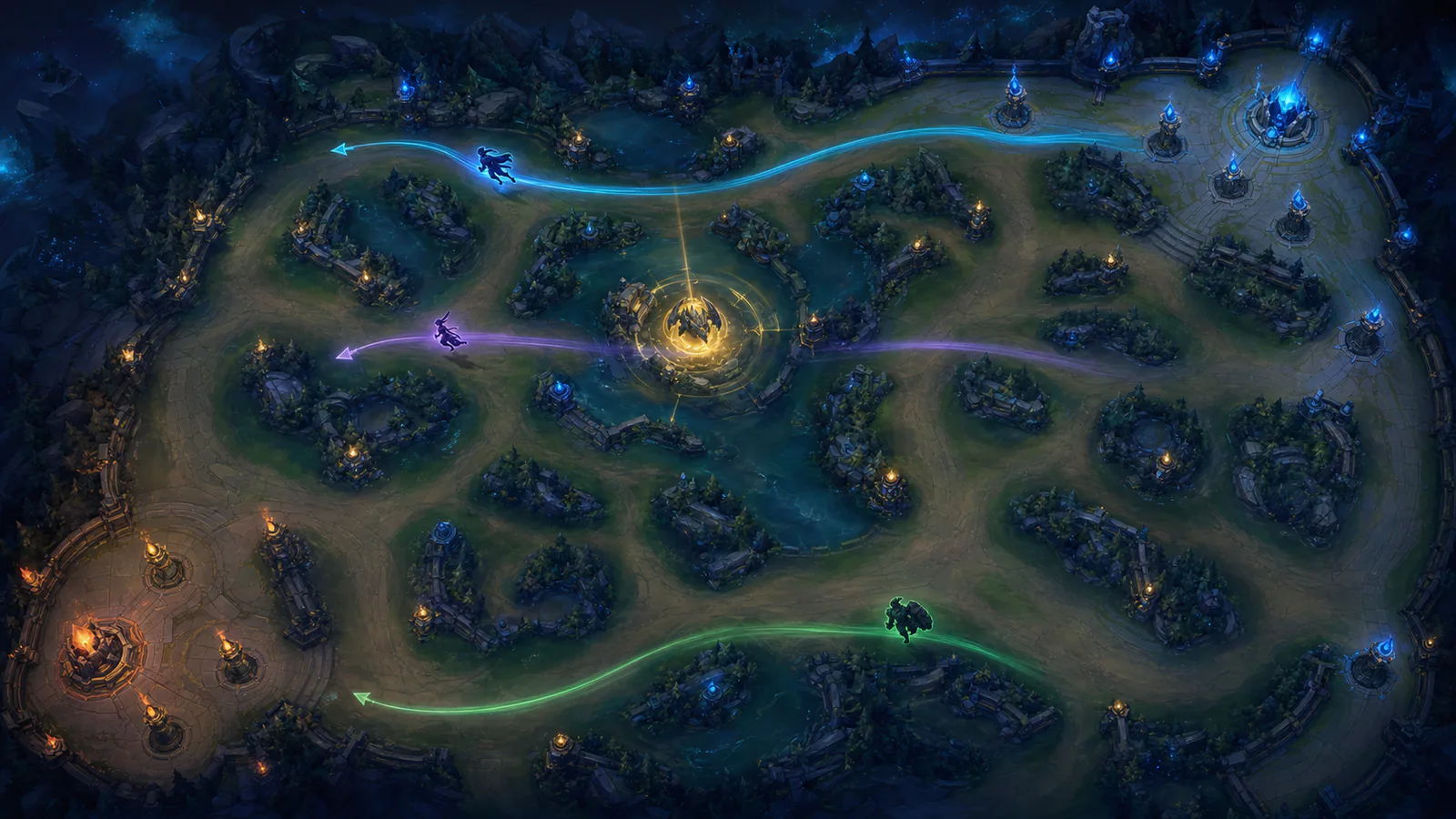
Side-lane assignments in League of Legends are not a permanent statement about which champion belongs in which lane. They are timed tasks shaped by the next objective, available teleports, wave distance and enemy threat. A team loses the map when one player collects a reasonable wave at an unreasonable time. This guide builds assignments backward from the next contest.
Start with the objective clock
Name the next objective the team intends to contest and how early the composition needs to arrive. A team that relies on traps and flank vision may need more setup time than one comfortable entering through a narrow front. Subtract recall and travel time to create a deadline for the side-lane player.
If no objective is contestable, define another meeting point: a tower siege, a vision reset or the next item completion. Without a shared clock, “push one more wave” has no stable meaning.
Match the wave to the safest collector
Choose the player by survival tools, duel threat and ability to join—not simply by role label. A carry without teleport may take the lane closer to the coming objective, while a mobile solo laner manages the distant wave. Check which opponents are missing and what engage range they possess.
The collector should state the maximum line they will cross. Teammates then know whether to hold mid pressure, shadow the lane or concede vision temporarily. Silence makes every side wave look equally safe from four different perspectives.
Create pressure before walking away
A side-lane assignment is valuable when the wave forces an answer at a useful time. Clear too early and the opponent collects it before the objective matters. Clear too late and your own team starts vision control four versus five. Aim for the wave to threaten a structure as the opposing team must choose its route.
Do not remain hidden without purpose. Showing briefly can communicate pressure and reveal the opponent sent to answer. Disappearing afterward creates more uncertainty than hiding for the entire sequence.
Set the join condition
Teleport availability does not mean a player can join any fight. Identify a protected ward or structure and the event that triggers the move: the opponent crossing river, a major cooldown used or the objective reaching a health threshold. The four-player group must avoid committing before that trigger.
For the complete setup timeline, use our 90-second objective guide. Draft considerations are covered in the team identity draft guide.
Review the first broken promise
When a side-lane play fails, rewind before the final fight. Did the collector cross the agreed line? Did the four-player group reveal itself too early? Was the join ward cleared without replacement? Find the first broken promise rather than blaming the player furthest from the objective.
In practice, call the clock, collector, limit and join condition before every major wave. The language may feel formal at first, but repetition makes it short. Strong side-lane play is not lonely farming. It is five players using one wave to ask the opponent a timed question.
Editorial note
Macro guide reviewed against the current League of Legends ruleset.
This article was reviewed on July 31, 2026.

Related stories
League top-lane freeze guide for patch 26.15
A top-lane freeze is controlled wave imbalance, not simply refusing to attack. Patch 26.15 is the reference version. Keep a small enemy minion advantage.
Thresh support guide for League patch 26.15
This Thresh support guide treats the champion as a decision maker, not a hook lottery. Patch 26.15 is the reference version. Your lane plan should combine.
League patch 26.15 jungle objective trading guide
Objective trading means accepting that the enemy will finish one play and converting the time somewhere else. In patch 26.15, the principle is unchanged by.
Community channel
Join the discussion
Start a thoughtful, specific conversation about this story.
Verified readers only
Continue with Google to comment.
Your Google account creates a reader-only Kaizensclan profile. Your first comment is reviewed before publication.