Avowed review: flexible combat in a compact fantasy RPG
Our Avowed review examines Obsidian’s combat, companion writing, exploration, PC performance and upgrade systems in the Living Lands. Analysis. Details.

 8.0
8.0 Kaizensclan verdict
Our Avowed review examines Obsidian’s combat, companion writing, exploration, PC performance and upgrade systems in the Living Lands. Analysis. Details.
Review basis: five hours of play supported by official documentation and public technical coverage. Hours played: 5. The score reflects the systems, presentation and release state observed within that review window rather than a completionist playthrough.
This Avowed review finds a focused action RPG that trades an enormous seamless world for a set of dense regions, expressive combat builds and companion-led storytelling. Obsidian’s return to Eora is most convincing when a fight lets the player change tools on the fly or a conversation turns political history into a personal conflict.
Avowed launched on February 18, 2025 for PC and Xbox Series X|S. It is a single-player game set in the Living Lands, a frontier region of the Pillars of Eternity universe, but it is designed to be approachable without prior knowledge of the series.
Gameplay rewards switching tools, not one perfect build
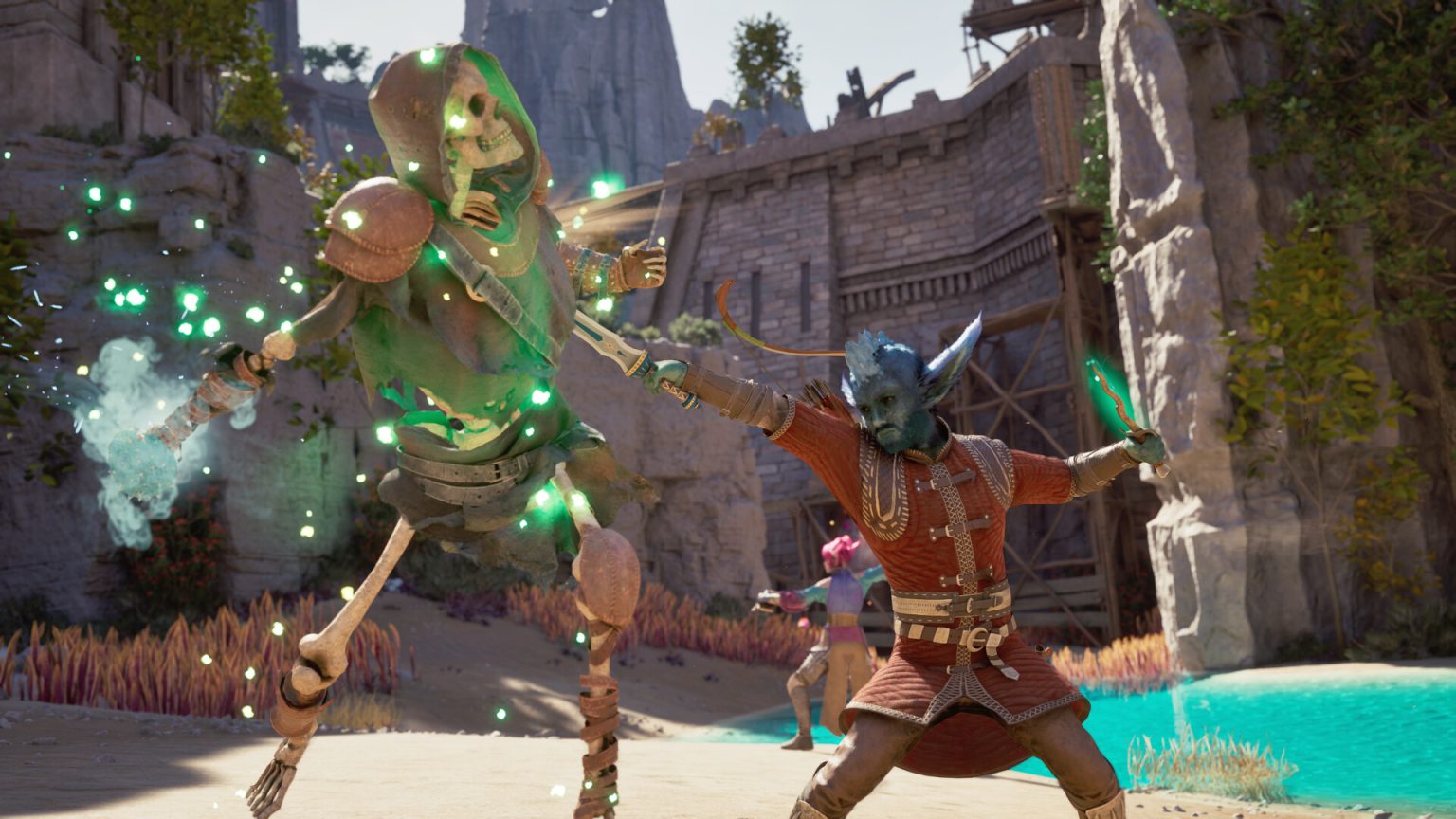
Combat supports swords, shields, axes, bows, guns, wands, grimoires and class abilities. Two configurable loadouts allow fast switching, so a character can open with a firearm, control space with a spell and move into shielded melee without visiting a menu. That flexibility is the game’s clearest identity.
The first-person perspective gives blocks, parries and spell impacts useful immediacy. A third-person option broadens accessibility, but encounter design still reflects the close spatial reading of a first-person action game. Enemies pressure positioning, and elemental interactions encourage the player to consider terrain and status effects rather than only damage numbers.
Progression is classless enough to support hybrid characters. Fighter, Ranger and Wizard trees provide recognizable directions without permanently locking the player into one. Companion abilities add another tactical layer, and their cooldowns make them dependable tools rather than consumable emergencies.
The weaker side is loot cadence. Many weapons feed an upgrade ladder whose numerical improvements can feel more administrative than transformative. Unique items and enchantments add character, yet material requirements can encourage the player to keep a familiar weapon longer than the volume of pickups suggests.
Exploration is dense and deliberately bounded
The Living Lands are divided into large regions instead of one uninterrupted open world. Each area contains side paths, vertical routes, ruins, settlements and environmental puzzles. The structure makes landmarks legible and reduces the empty travel that can dilute larger RPG maps.
Movement abilities and careful observation are regularly rewarded. A ledge, breakable barrier or elemental obstacle may conceal equipment or a short narrative scene. The result is closer to a series of authored adventure spaces than a simulation of an entire continent.
That choice has a cost. Zone boundaries can make the world feel constructed, and players seeking a fully systemic sandbox will notice that stealth and theft are not as deep as the combat toolkit. Avowed is generous about routes, but it is still directing the player through curated content.
The quest design benefits from the tighter scale. Decisions can alter local outcomes, companion reactions and later dialogue without requiring every branch to become a separate campaign. Obsidian’s strength remains the ability to make an apparently practical choice reveal an ideological consequence.
Companions carry the story’s best arguments
The player is an envoy of the Aedyran emperor investigating the Dreamscourge, a spreading affliction in the Living Lands. That position creates immediate tension: the protagonist has institutional authority in a region suspicious of imperial motives.
Companions do more than provide combat cooldowns. Their camp conversations and interjections turn broad themes—colonial power, faith, responsibility and belonging—into disputes between people with specific histories. The writing works best when no response can preserve every relationship or principle.
The main plot occasionally leans on familiar chosen-protagonist imagery, but the surrounding political context keeps it from becoming purely generic fantasy. Prior Pillars knowledge adds texture to gods and nations; it is not required to understand the immediate stakes.
Visual and audio design prioritize readability
Avowed uses saturated plants, luminous fungi and dramatic skies to distinguish the Living Lands from muted medieval fantasy. Regions communicate climate and culture through color before the player reads a codex entry. Interiors are smaller but use strong lighting and material contrast to keep routes clear.
Character animation is less lavish than the environments, especially outside major conversations. Facial work communicates intent, but it does not always match the nuance of the dialogue. Spell effects and weapon impacts are more consistent: silhouettes remain readable even when several abilities overlap.
The score supports exploration without over-signalling every discovery. Combat audio gives blocks, gunshots and elemental effects distinct weight, which matters because players often decide the next action from sound while facing another target.
Technical state and accessibility
The PC release supports keyboard and mouse, controllers, ultrawide displays and modern upscaling options. As with any PC RPG, performance depends on hardware, resolution and the current patch; readers should consult the official requirements and recent platform-specific reports before purchasing.
Obsidian provides adjustable difficulty and interface options that help separate narrative interest from action execution. The ability to change perspective is particularly useful for motion comfort, although first- and third-person modes do not feel identical in close combat.
The five-hour review window cannot verify late-game quest stability, and performance on one setup cannot represent every PC. That limitation prevents a stronger technical conclusion and is included in the score. The official Steam page remains the source for current requirements and supported features.
Monetization and value
Avowed is sold as a premium single-player RPG rather than a live-service progression system. Storefront editions and availability can change, so buyers should compare the current contents instead of assuming an older launch package is still active.
Value depends less on raw map size than on tolerance for authored zones, dialogue and optional exploration. Players who measure an RPG by systemic simulation may find the boundaries restrictive. Those who prefer a concentrated campaign with build experimentation receive a more coherent proposition.
Avowed review verdict
Avowed succeeds by choosing density over scale. Its loadout switching and hybrid progression make combat expressive, while companions give the political story a human centre. Incremental loot and limited stealth keep it below the best systemic RPGs, and the limited review window requires caution on late-game performance.
Score: 8.0/10. Recommended for players who want a story-driven first-person RPG with flexible combat and manageable exploration zones. For another combat-focused RPG assessment, see our Path of Exile 2 review.
Who will enjoy Avowed most?
Avowed is best suited to players who like changing tactics without rebuilding an entire character. Its zones support curiosity, but they do not ask for the time commitment of a continent-sized checklist. Dialogue choices matter most to readers comfortable with imperfect political outcomes rather than a simple heroic route.
Players seeking immersive-sim stealth, a fully reactive crime system or unrestricted world simulation should adjust expectations. The game offers alternate paths and elemental interactions, but its deepest systemic investment is combat. Starting on a moderate difficulty and testing two complementary loadouts is a better introduction than copying a specialized late-game build.
Practical buying checklist
Before purchase, check the current platform patch, hardware requirements, language support and edition contents. Watch unedited combat that includes inventory management and ordinary exploration, not only story trailers. Those moments reveal whether the first-person rhythm and loot cadence match your preferences.
A final comparison point is combat communication. Avowed is single-player, yet its companion cooldowns still reward the same clear ownership discussed in our utility handoff analysis: know which tool solves the next problem before spending it. The genres differ, but readable resource sequencing improves both.
Editorial note: The Avowed review score uses a half-point scale and accounts for the five-hour review window. A complete campaign test could change the late-game assessment, but it would not erase the design strengths and limitations observed above.
Editorial note
Five-hour review window, supported by official documentation and public technical coverage.
This article was reviewed on August 6, 2026.

Related stories

Metaphor: ReFantazio review: politics through turn-based combat
Metaphor: ReFantazio carries familiar Atlus structures into a new fantasy world, then gives them a sharper public purpose. The calendar no longer tracks only.
Minishoot’ Adventures review: exploration under fire
This Minishoot Adventures review finds a small ship leaving its village to free captured friends and confront corrupted machines. SoulGame Studio combines an.
Mouthwashing review: horror after the crash
This Mouthwashing review enters the Tulpar after a crash leaves five crew members with dwindling supplies and no credible rescue. Wrong Organ shifts between.
Community channel
Join the discussion
Start a thoughtful, specific conversation about this story.
Verified readers only
Continue with Google to comment.
Your Google account creates a reader-only Kaizensclan profile. Your first comment is reviewed before publication.