Tainted Grail: The Fall of Avalon Review
Our Tainted Grail: The Fall of Avalon review covers nine hours of first-person combat, exploration and difficult choices in its Arthurian world. Read the.

 8.0
8.0 Kaizensclan verdict
Our Tainted Grail: The Fall of Avalon review covers nine hours of first-person combat, exploration and difficult choices in its Arthurian world. Read the.
Tainted Grail: The Fall of Avalon reworks Arthurian legend into a land trapped in decay, political failure and supernatural pressure. It is a first-person open-world RPG built around exploration, quests, character builds and choices rather than a direct retelling of heroic myth.
What the first 9 hours cover
Nine hours covered the opening region, several main and side quests, melee and ranged experimentation, crafting, dialogue checks and enough exploration to judge how the world rewards leaving the road. The campaign is much larger, so late regions and final build balance remain outside this verdict.
The game begins in confinement and quickly frames Avalon as a place where every institution has compromised. Early escape and settlement quests introduce combat, inventory and dialogue without making the player a chosen saviour immediately. The writing establishes moral discomfort before the map becomes broad.
Core loop and decision-making
Exploration reveals shrines, caves, characters and quests that often connect back to local conflicts. Combat supplies equipment and resources, but discovery is the stronger reason to move. A distant ruin can contain narrative evidence rather than another interchangeable chest, which gives wandering a sense of authored purpose.
Dialogue and quest outcomes regularly ask what cost is acceptable rather than presenting a clean heroic answer. Skill and attribute checks make the character build part of conversation. The strongest choices remain understandable even when their consequences are uncertain; weaker ones can hide important information behind wording that feels less precise.
Progression and structure
Attributes, skills, equipment, consumables and crafting support recognisable archetypes without locking the player to one class. Early points produce visible changes in access or combat rhythm. Inventory comparison is functional but dense, and collecting every object can turn exploration into weight management rather than curiosity.
The opening region mixes a directed main thread with side stories that explain factions and ordinary survival. Quests often lead through the same geography from different motives, helping the world feel connected. Long dialogue and environmental reading slow the pace deliberately, which suits role-playing more than constant action.
Controls and difficulty
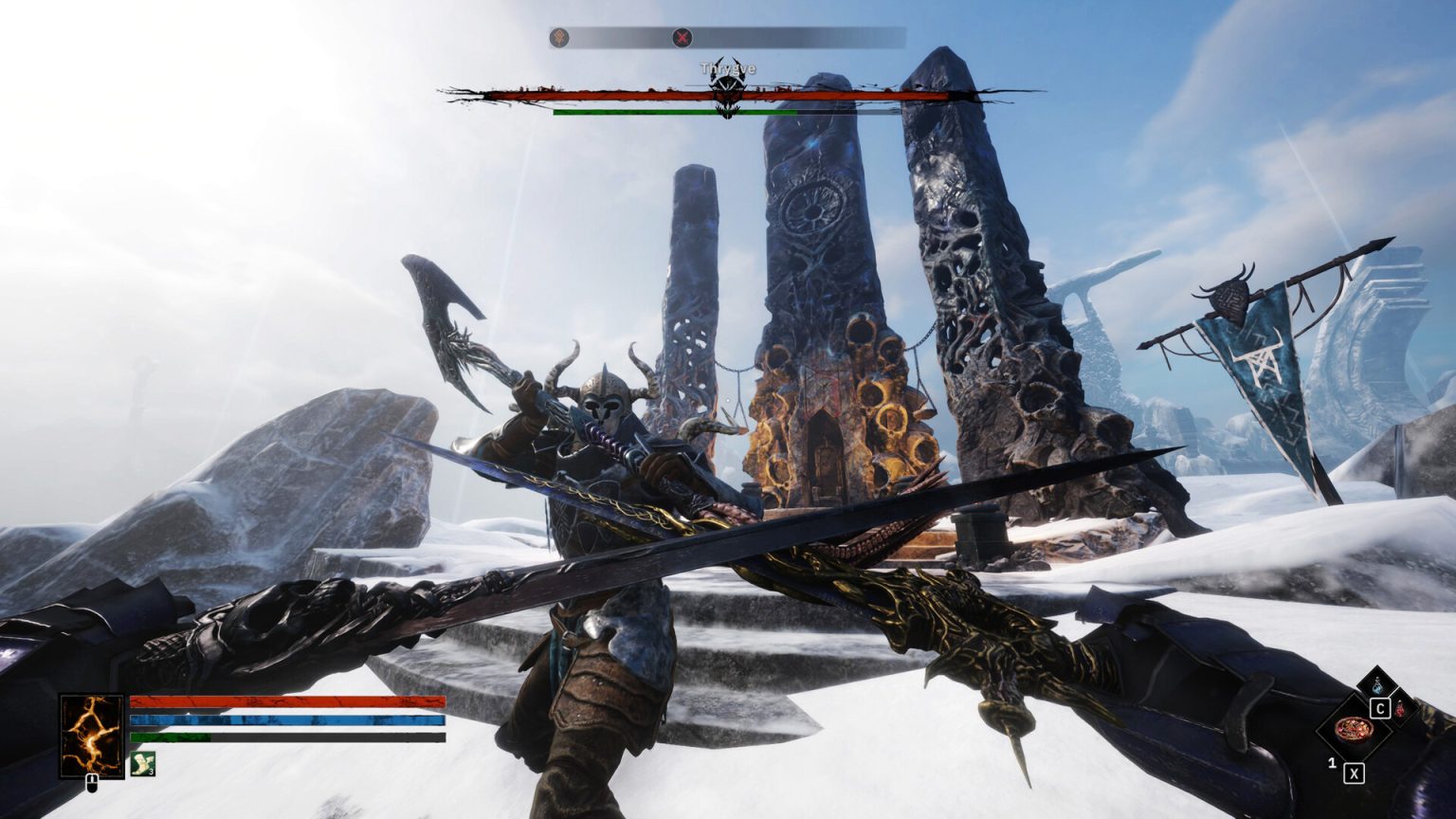
First-person movement is familiar, and melee supports blocking, dodging and stamina management. Impact can feel inconsistent when animation, sound and enemy reaction do not communicate the same weight. Ranged and magic options widen the toolkit, though switching through equipment under pressure exposes interface friction.
Enemies punish careless stamina use and poor preparation more than pure reaction speed. Build choices, consumables and route knowledge can reduce a difficult fight. Occasional encounter placement creates abrupt spikes, but the open structure usually allows the player to leave, improve and return.
Art, sound and world-building
Everlasting autumn, ruined stone and distorted Arthurian symbols give Avalon a coherent identity. The art avoids making every dark-fantasy location uniformly black, using sickly colour and fog to separate regions. Music is restrained, allowing voices and environmental unease to lead.
Quest writing is the game’s strongest asset. Characters have practical needs, loyalties and ugly compromises, and legends feel like political material rather than museum lore. Exploration works because locations usually belong to those conflicts instead of existing only to hold combat.
Performance and interface
The PC build was playable during testing but showed occasional animation, collision and interface roughness. Performance depends heavily on hardware and settings, so the official requirements remain the right starting point. Technical imperfections are visible, though they did not erase quest progress in the review window.
Session rhythm and replay value
A good review window needs to distinguish novelty from a loop that remains interesting after its rules are familiar. We therefore returned to ordinary activities after their first tutorial and compared how much attention the repeated version demanded. Repetition is not automatically a weakness: it can create mastery, comfort or strategic planning. It becomes friction when the same input produces no new information, meaningful execution or useful choice.
Replay value depends on the structure of Tainted Grail: The Fall of Avalon Review. Alternate routes, builds, procedural incidents, job combinations or simply a strong authored atmosphere can all support another session, but they are not interchangeable. This review credits the forms of replay visible during testing and does not assume that unseen endgame content will solve an early limitation. A future patch may expand the game, yet the score belongs to the released experience played here.
Narrative, agency and consequences
Story was evaluated by how well it motivates the next action and whether characters respond consistently to the world around them. Agency does not require every scene to branch. A linear game can still make the player responsible for observation and execution, while an open game can offer many icons without meaningful decisions. The relevant question is whether the structure clearly communicates what the player controls and then gives those choices an appropriate consequence.
This review was completed across more than one session so that the score did not depend on the excitement of a single opening hour. Repeated actions were checked for consistency, feedback and recovery cost. A system earned credit when it created a meaningful choice after the tutorial had ended, not simply because its menu contained many options.
The stated playtime is enough to evaluate the opening contract, several repeated loops and the reliability of the basic controls. It is not enough to claim complete knowledge of every late-game build, route or ending. Where a system was visible but not properly tested, it was excluded from the verdict instead of being treated as guaranteed depth.
Difficulty was judged through clarity as well as challenge. A demanding encounter can be fair when the game communicates cause and consequence, while an easy sequence can still be frustrating when objectives or controls are inconsistent. Previous experience with the genre changes the learning curve, so the audience description should be read beside the numerical score.
Accessibility and comfort settings were considered within the tested PC build, but individual needs differ. Players who require a specific subtitle, colour, remapping, field-of-view or motion option should check the current official store information before buying. Patches can improve technical behaviour after this review date.
Price, discounts and online population are intentionally not used as permanent facts. Those values change. The durable question is whether the released mechanics and authored content support the kind of play the reader wants. Roadmaps were not scored; only features present in the tested build affected the verdict.
Who will enjoy it
It is best for players who value written quests, wandering and flexible character growth more than perfectly tuned first-person combat. Anyone expecting the physical polish of a dedicated action game should lower that expectation, while RPG players willing to accept rough edges will find substantial authored depth.
Pros and cons
Pros
- Strong quest writing and moral choices
- Exploration regularly finds authored stories
- Flexible character development
Cons
- Combat feedback can feel uneven
- Inventory and equipment handling are dense
- Visible technical roughness
Verdict after 9 hours
Tainted Grail earns its place through the specificity of Avalon and the quality of the conflicts placed inside it. Combat is competent rather than exceptional, and technical roughness remains part of the experience. Nine hours nevertheless reveal a thoughtful RPG where wandering produces stories and character choices affect more than damage numbers.
This assessment covers 9 hours on PC. Release facts and advertised features were checked against the publisher’s official store materials; the score reflects the experience inside that declared window.
Source: official release information.
Read more in our practical guides and browse the Kaizensclan article archive.
Editorial note
Hands-on review window recorded in the article metadata, supported by official documentation and public technical coverage.
This article was reviewed on August 7, 2026.

Related stories
Metaphor: ReFantazio review: politics through turn-based combat
Metaphor: ReFantazio carries familiar Atlus structures into a new fantasy world, then gives them a sharper public purpose. The calendar no longer tracks only.
Minishoot’ Adventures review: exploration under fire
This Minishoot Adventures review finds a small ship leaving its village to free captured friends and confront corrupted machines. SoulGame Studio combines an.
Mouthwashing review: horror after the crash
This Mouthwashing review enters the Tulpar after a crash leaves five crew members with dwindling supplies and no credible rescue. Wrong Organ shifts between.
Community channel
Join the discussion
Start a thoughtful, specific conversation about this story.
Verified readers only
Continue with Google to comment.
Your Google account creates a reader-only Kaizensclan profile. Your first comment is reviewed before publication.