Kingdom Come: Deliverance II review — history with friction
Our Kingdom Come Deliverance 2 review explores its systemic medieval world, demanding first-person combat, excellent quests and deliberately slow progression.

 8.5
8.5 Kaizensclan verdict
Our Kingdom Come Deliverance 2 review explores its systemic medieval world, demanding first-person combat, excellent quests and deliberately slow progression.
This Kingdom Come: Deliverance II review finds an open-world role-playing game willing to make competence inconvenient. Henry must learn, prepare and accept social consequences before he can behave like the effortless hero offered by many RPGs. Warhorse Studios turns that friction into identity, although the same commitment makes the opening hours and first-person combat unusually demanding.
Review methodology: Kaizensclan did not independently play a review build. The assessment uses official documentation, release materials and public gameplay, with zero hands-on hours disclosed rather than replaced by a fictional playtime claim. Release and platform facts were checked against the official Steam page.
Kingdom Come: Deliverance II lets preparation become role-play
Henry returns as a capable young man, but not as a universal master. Skills improve through use, equipment affects how other people read him, and a careless crime can change the next conversation before a dialogue choice appears. The game treats role-playing as the accumulation of behaviour rather than a personality selected from a menu.
Quests benefit most from that approach. An objective may support persuasion, stealth, combat, bribery or a route discovered through observation. Failure does not always mean loading a save; it can close one solution while creating a less flattering continuation. This makes preparation meaningful because clean clothes, local information and a sensible arrival time can matter alongside statistics.
The risk is that simulation becomes administration. Hunger, fatigue, equipment condition, inventory weight and reputation all ask for attention. Each system supports the fantasy of inhabiting early-15th-century Bohemia, but several can compete for the player’s focus during a story that already expects careful listening. The game works best when those pressures create a decision, not when they simply delay travel.
Progression provides the payoff. Henry’s early limitations make later fluency visible: reading an opponent, brewing the right potion or talking past a guard feels earned because the player remembers when those options were unreliable. Readers who value systemic consequence in our Baldur’s Gate 3 review will find a more grounded expression of the same principle.
First-person combat remains an acquired skill
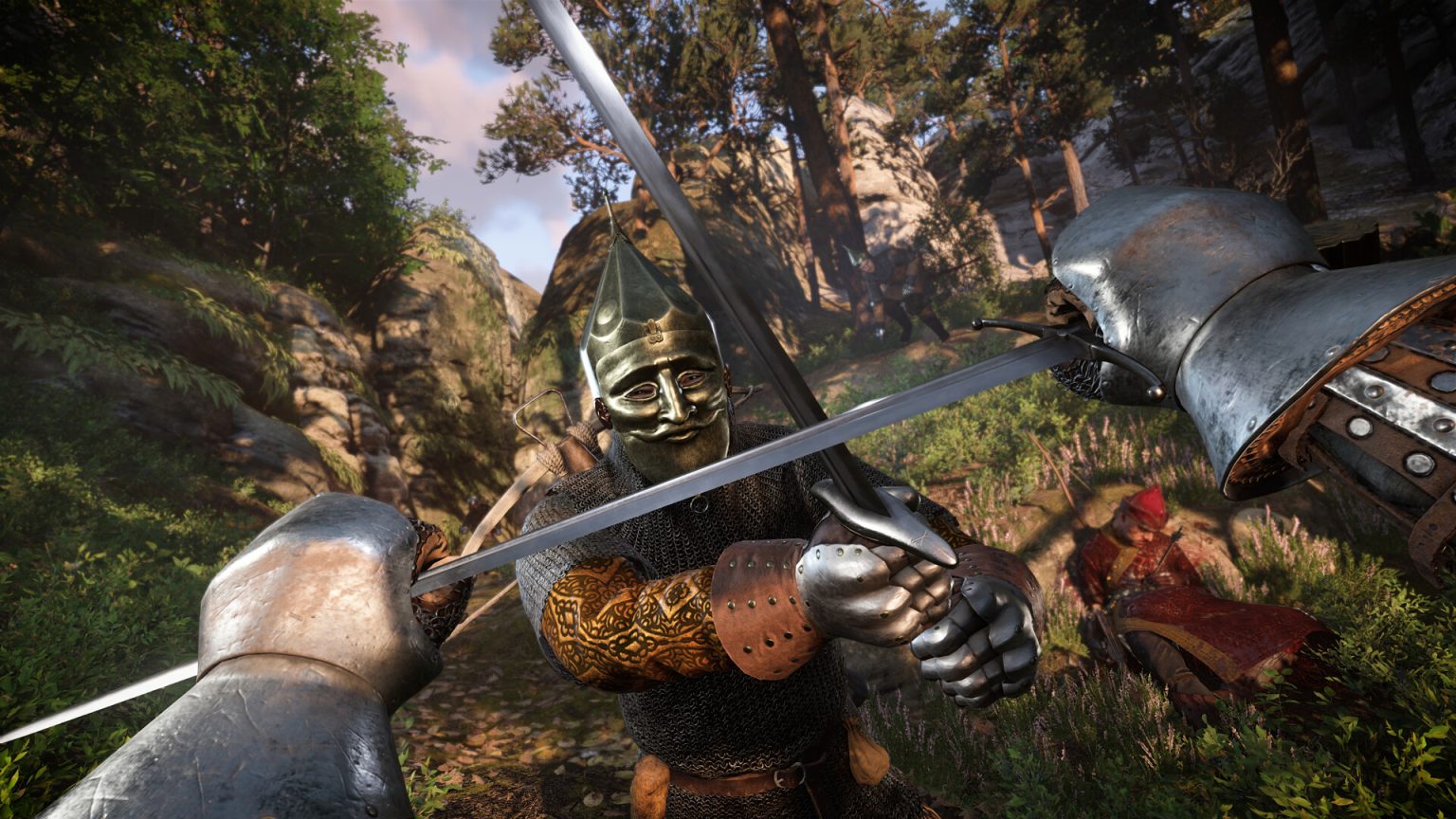
Melee combat revolves around distance, directional attacks, stamina and timing. It communicates the awkward danger of fighting in armour better than a weightless combo system would. A duel can turn on patience and positioning, while a crowded fight quickly punishes anyone who allows enemies to surround Henry.
That commitment does not make every exchange elegant. Camera control, target management and animation commitment can become difficult to read when multiple bodies occupy the same space. The system is strongest in deliberate one-on-one encounters; larger fights expose the tension between physical authenticity and the information a first-person game can communicate.
Ranged weapons and stealth widen the tactical vocabulary. A bow or crossbow can change the opening of an encounter, and darkness offers opportunities that daylight removes. Yet these are not instant solutions. Noise, visibility, skill and preparation determine whether the plan survives contact.
The game also understands that combat should not dominate every role. Alchemy, conversation, theft, travel and craft-related systems give players productive time outside battle. The result is slower than an action RPG built around constant enemy density, but the quieter tasks help violence retain consequence.
Bohemia feels inhabited rather than arranged
Warhorse’s environmental work gives villages, roads and larger settlements practical geography. Trades occupy plausible spaces, fields connect to communities and interiors show how people work rather than existing only as containers for loot. Historical consultation does not turn the game into a museum; it gives ordinary places enough structure to support fiction.
Character performances keep that detail human. Conversations can move between political pressure, comedy and embarrassment without making every person sound like a modern exposition machine. Henry’s existing history creates continuity, but the sequel provides enough context for newcomers to understand immediate loyalties and conflicts.
Visual realism is strongest in materials and light. Mud, cloth, metal and timber respond differently, while weather changes the mood of familiar routes. The world is not designed around constant panoramic reveals. Its appeal often comes from a lane, workshop or crowded room that looks used.
Sound supports the same restraint. Settlements carry labour and conversation, forests leave room for distance, and combat audio helps communicate armour contact. Music enters with purpose instead of covering every journey. Compared with the urban overload examined in our Cyberpunk 2077 review, this world earns scale through routine and social detail.
Technical state, accessibility and paid content
The PC version officially requires an SSD and scales from older mainstream hardware to demanding recommended specifications. Dense settlements, simulation and long sightlines make performance more variable than a corridor-based action game. This research review does not provide measured frame-rate data, so PC players should compare current patch reports with their exact hardware.
Interface density is the larger universal concern. Inventory, condition, status effects and quest information need space, and the game cannot remove them without simplifying its simulation. Better filtering and clearer comparisons can reduce friction, but the learning curve remains part of the experience.
Kingdom Come: Deliverance II is a premium single-player release rather than a live service. It also has paid story expansions and smaller cosmetic or equipment packs, with an Expansion Pass and higher-priced edition bundling major content. Those additions do not sell power inside a competitive economy, but buyers who want the complete narrative package should compare editions instead of assuming the base price includes every later story.
The core game remains substantial on its own. Its value depends less on map size than on whether the player enjoys inhabiting systems between quests. Someone who skips dialogue, maintenance and travel decisions will experience more resistance and less reward than a player willing to treat them as the point.
Who should travel with Henry
Kingdom Come: Deliverance II is best suited to players who accept inconvenience when it produces believable consequences. If maintaining equipment, planning travel and learning social rules sound like texture, the game offers an unusually responsive world. If those activities sound like obstacles between combat scenes, its scale will magnify the frustration.
Newcomers can begin here because the sequel establishes immediate relationships and stakes, but returning players bring useful knowledge of Henry and the combat language. Neither group should expect instant mastery. Early weakness is a deliberate baseline against which later competence becomes visible.
The game also rewards players comfortable with imperfect outcomes. Reloading every failed check can flatten its reactivity into a search for the approved route. Allowing a bad conversation or compromised plan to continue reveals more of what the quest design can do.
Before choosing a platform, compare current performance and control preferences. First-person melee benefits from precise, comfortable input, while the long campaign makes load times and stability more important than isolated screenshots.
Verdict
Kingdom Come: Deliverance II is impressive because its inconveniences are usually coherent. Clothing matters because society notices it. Practice matters because Henry is not entitled to mastery. Preparation matters because quests recognise more than the objective marker.
The slow start, crowded combat and interface burden prevent an unconditional recommendation. This is not a neutral fantasy playground; it asks the player to accept a specific historical texture and a hero whose abilities must be built through routine.
Score: 8.5/10. The score reflects a research-based assessment with zero independent hands-on hours. Players interested in reactive quests and grounded role-play have a strong reason to enter Bohemia, while those seeking immediate combat fluency should watch unedited gameplay before committing.
Sources: Warhorse Studios and Deep Silver official Steam materials, checked August 6, 2026.
Editorial note
This research-based editorial assessment uses official release information and public gameplay. Kaizensclan logged zero first-hand playtest hours.
This article was reviewed on August 6, 2026.

Related stories

Metaphor: ReFantazio review: politics through turn-based combat
Metaphor: ReFantazio carries familiar Atlus structures into a new fantasy world, then gives them a sharper public purpose. The calendar no longer tracks only.
Minishoot’ Adventures review: exploration under fire
This Minishoot Adventures review finds a small ship leaving its village to free captured friends and confront corrupted machines. SoulGame Studio combines an.
Mouthwashing review: horror after the crash
This Mouthwashing review enters the Tulpar after a crash leaves five crew members with dwindling supplies and no credible rescue. Wrong Organ shifts between.
Community channel
Join the discussion
Start a thoughtful, specific conversation about this story.
Verified readers only
Continue with Google to comment.
Your Google account creates a reader-only Kaizensclan profile. Your first comment is reviewed before publication.