Monster Train 2 review: a stronger strategic ascent
Our Monster Train 2 review examines seven hours of three-floor deckbuilding, five new clans, room and equipment cards, progression and run variety. Read the.

 8.5
8.5 Kaizensclan verdict
Our Monster Train 2 review examines seven hours of three-floor deckbuilding, five new clans, room and equipment cards, progression and run variety. Read the.
Review basis: 7 hours on PC. The score covers the systems and release build observed within that window, not a completionist playthrough.
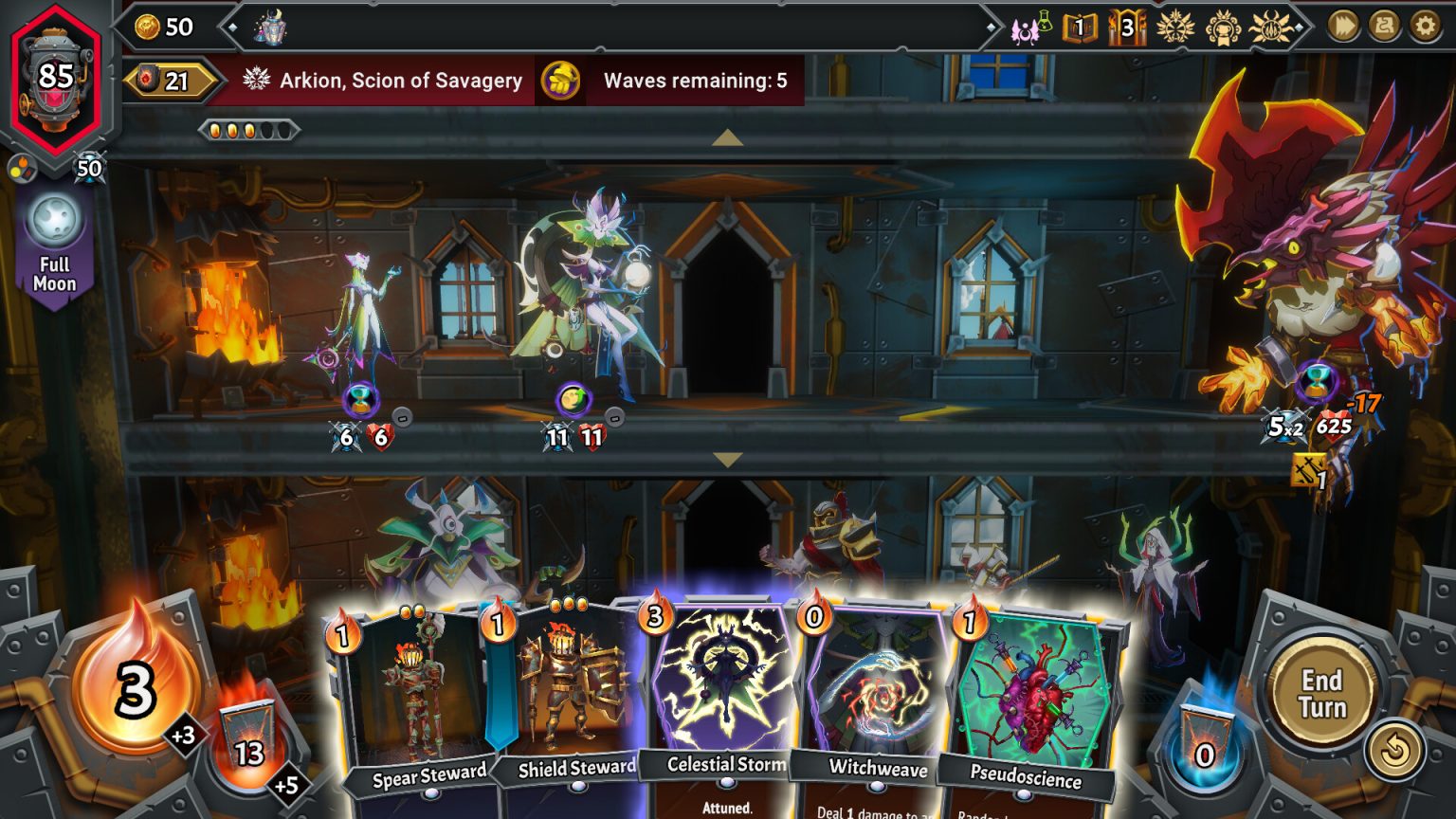
Monster Train 2 keeps the original’s best idea: enemies climb through three floors toward a vulnerable Pyre, and every card changes where the defence should hold. New clans, equipment and room cards deepen that vertical puzzle.
Monster Train 2 review: the opening hours
Early runs introduce five new clans while preserving the champion-plus-allied-clan structure. The first hours reward clear plans more than rare-card hunting. A modest unit placed on the correct floor often contributes more than an expensive card stranded behind a full capacity limit.
A route alternates battles, upgrades, shops and map events before a boss. Combat generates energy and card draw each turn while enemies advance upward. Damage that escapes a floor becomes the next floor’s problem, allowing deliberate leaks but punishing a defence that has no final answer.
Systems and meaningful decisions
Equipment modifies units, room cards change a floor, and clan mechanics create engines around armour, decay, spells or scaling. The strongest runs align these systems instead of collecting individually powerful cards. Capacity, draw and energy remain competing resources, so every upgrade has an opportunity cost.
Good progression changes the next decision instead of merely raising a number. During this review window, upgrades were judged by whether they created a new route, solved a recurring problem or encouraged a different risk. Busy menus received no extra credit when the underlying choice stayed obvious.
Controls, challenge and feedback
Dragging and targeting are clean, while previews make most damage outcomes legible. Difficulty rises through enemy abilities and covenant modifiers rather than faster input. Dense interactions can still create a long tooltip chain, especially when several triggers resolve after one attack.
Failure is most useful when the game explains enough to support another attempt. We tracked whether a setback revealed a readable rule, exposed a poor plan or simply demanded repetition. That distinction matters because difficulty can create tension without wasting the player’s time.
World, art and sound
The train, celestial enemies and expressive clans produce colourful fantasy without losing board clarity. Units occupy distinct silhouettes, and floor boundaries remain readable even when spell effects become elaborate.
Heavy impacts give large attacks satisfying weight, while shorter cues keep repeated triggers from becoming unbearable. Music supports the escalating journey but wisely leaves enough space for the constant rhythm of card play.
Presentation was also judged during ordinary play, not only in composed screenshots. Strong art direction guides attention through colour, motion and sound while preserving the mood. A beautiful scene is less successful if objectives, hazards or interactive objects disappear inside it.
Performance and interface
Performance was stable during seven PC hours. The largest issue was visual density during complex trigger chains, not frame-rate instability. Tooltips and history tools provide essential explanation, though newer players may still need to slow the animation speed.
One PC cannot represent every configuration, and later patches may change performance. The review therefore reports the observed build and avoids promising results on untested hardware. Players with a specific accessibility or performance requirement should check the current platform documentation before buying.
Onboarding and learning curve
The first session was separated from later sessions when judging clarity. A system that feels obscure for ten minutes may become expressive once its vocabulary settles, while an exciting tutorial can conceal a loop that never develops. We looked for explanations that connect an input to a consequence and then give the player room to apply the lesson without constant interruption.
Prior genre experience shortens that adjustment, but familiarity is not evidence that the interface succeeds. Important status, objective and resource information should remain available to a new player. Optional depth can live in tooltips and reference screens as long as the repeated decision is readable during normal play.
Pacing and replay value
A run moves briskly once the deck has a purpose. Unlocks, challenges and clan combinations support substantial replay, while daily and endless-style modes extend the structure beyond a single ascent.
Replay value can come from alternate routes, different builds, procedural incidents or the pleasure of mastering a fixed sequence. Those forms are not interchangeable. We credit only the replay structure visible during the stated hours and do not award points for a roadmap or an assumed endgame.
Accessibility and practical fit
Text size, contrast, remapping, subtitle presentation and audiovisual options were considered alongside the main mechanics. Individual access needs differ, so this review does not treat the presence of a settings menu as universal proof. Anyone relying on one specific feature should confirm it on the current platform build.
The practical buying question is also broader than technical compatibility. Consider whether a normal twenty-minute stretch contains the decisions, reading, repetition and downtime you enjoy. A trailer can accurately show the world while still hiding the cadence that occupies most of a play session.
Limits of the 7-hour review
Seven hours covered wins, losses and several clan pairings but not the highest covenant levels or every unlock. The score reflects the early and intermediate strategic range rather than mastery of the complete difficulty ladder.
The time window is long enough to test the repeated loop across several sessions, but it cannot certify every ending, late-game encounter or future update. Price, discounts and online population are not treated as permanent facts because each can change after publication.
Who should play it?
This is for players who want a deckbuilder where positioning matters as much as card order. Anyone who dislikes repeated runs, layered keywords or learning through defeat will meet friction despite the polished interface.
A score is useful only beside that audience description. Genre experience, preferred difficulty and tolerance for repetition can change the result. Watching unedited footage of normal play is a better final check than relying on a trailer built entirely from peak moments.
How the score was decided
The score combines the repeated quality of decisions, clarity of feedback, presentation, technical state and the fit between the game’s stated idea and its actual loop. One spectacular scene cannot erase recurring friction, and one awkward first hour does not outweigh a system that becomes consistently rewarding after it is understood.
Notes were compared across separate sessions to reduce the effect of novelty and fatigue. Strengths and limitations had to appear more than once before shaping the verdict. That method keeps the final number attached to the experience described here instead of to expectation, reputation or an untested promise.
Monster Train 2 review verdict
Monster Train 2 expands almost every part of the formula while keeping the three-floor defence understandable. Its added systems create better questions instead of merely adding more cards.
Pros: Dense three-floor tactics; New card types create flexible builds; Strong run variety.
Cons: Many keywords arrive quickly; Meta progression delays some options; Effects can crowd the screen.
Final score: 8.5/10. A confident sequel that expands the train without burying its tactical identity.
Source: official information and published records.
Continue with our practical guides and browse more reporting in the Kaizensclan archive.
A final check compared the opening impression with the repeated loop. Features that remained useful across separate sessions carried more weight than isolated surprises, while recurring friction counted even when it appeared minor on its own.
Editorial note
Hands-on review window recorded in the article metadata, supported by official documentation and public technical coverage.
This article was reviewed on August 7, 2026.

Related stories
Balatro review: poker hands become a score engine
Balatro borrows the recognition of poker hands without becoming a gambling simulation. Cards are resources in a run, blinds are score targets and jokers.
Minishoot’ Adventures review: exploration under fire
This Minishoot Adventures review finds a small ship leaving its village to free captured friends and confront corrupted machines. SoulGame Studio combines an.
Mouthwashing review: horror after the crash
This Mouthwashing review enters the Tulpar after a crash leaves five crew members with dwindling supplies and no credible rescue. Wrong Organ shifts between.
Community channel
Join the discussion
Start a thoughtful, specific conversation about this story.
Verified readers only
Continue with Google to comment.
Your Google account creates a reader-only Kaizensclan profile. Your first comment is reviewed before publication.