Rosewater review: a patient Western with sharp dialogue
Our Rosewater review covers six hours of its alternate-history Western, point-and-click puzzles, ensemble dialogue, presentation and deliberate pace. Read the.

 8.0
8.0 Kaizensclan verdict
Our Rosewater review covers six hours of its alternate-history Western, point-and-click puzzles, ensemble dialogue, presentation and deliberate pace. Read the.
Review basis: 6 hours on PC (Steam). The score covers the systems and release build observed within that window, not a completionist playthrough.
Rosewater is a Western adventure set in the alternate 19th-century world of Lamplight City. Journalist Harley Leger joins a mismatched posse in search of a missing fortune, but the strongest reward is watching people with incompatible motives learn how much trust the journey deserves.
Rosewater review: the opening hours
The first hour establishes Harley as observant and ambitious without turning every conversation into exposition. Locations invite the classic routine of looking, speaking and collecting, yet the game resists filling the inventory with meaningless objects. Early puzzles teach the local logic while dialogue defines why Harley would bother solving them.
Exploration is scene-based rather than continuous. You examine a compact location, speak with available characters and combine information or objects to remove a practical obstacle. Travel then moves the group into another social arrangement. The loop is traditional, but strong writing makes each stop feel like a place rather than a puzzle container.
Systems and meaningful decisions
Dialogue choices can adjust relationships and the route through a problem, although Rosewater is not a branching simulation. Its best decisions reveal Harley’s priorities: professional curiosity, empathy, caution or impatience. Inventory puzzles generally use readable cause and effect, with enough misdirection to require attention without demanding absurd object combinations.
Progression matters when it changes the next decision instead of merely raising a number. During this review window, tools and upgrades were judged by whether they opened a route, solved a recurring problem or encouraged a different risk. Busy interfaces received no extra credit when the underlying choice stayed obvious.
Controls, challenge and feedback
Pointing and clicking works exactly as expected, and interactable areas are clearly framed once found. The challenge comes from identifying a sensible sequence, not from manipulating tiny objects. A few transitions hold the player after the likely answer is already clear, making the pace feel slower than the actual puzzle.
Failure is most useful when the game explains enough to support another attempt. We tracked whether setbacks revealed a readable rule, exposed a poor plan or simply demanded repetition. That distinction matters because difficulty can create tension without wasting the player’s time.
World, art and sound
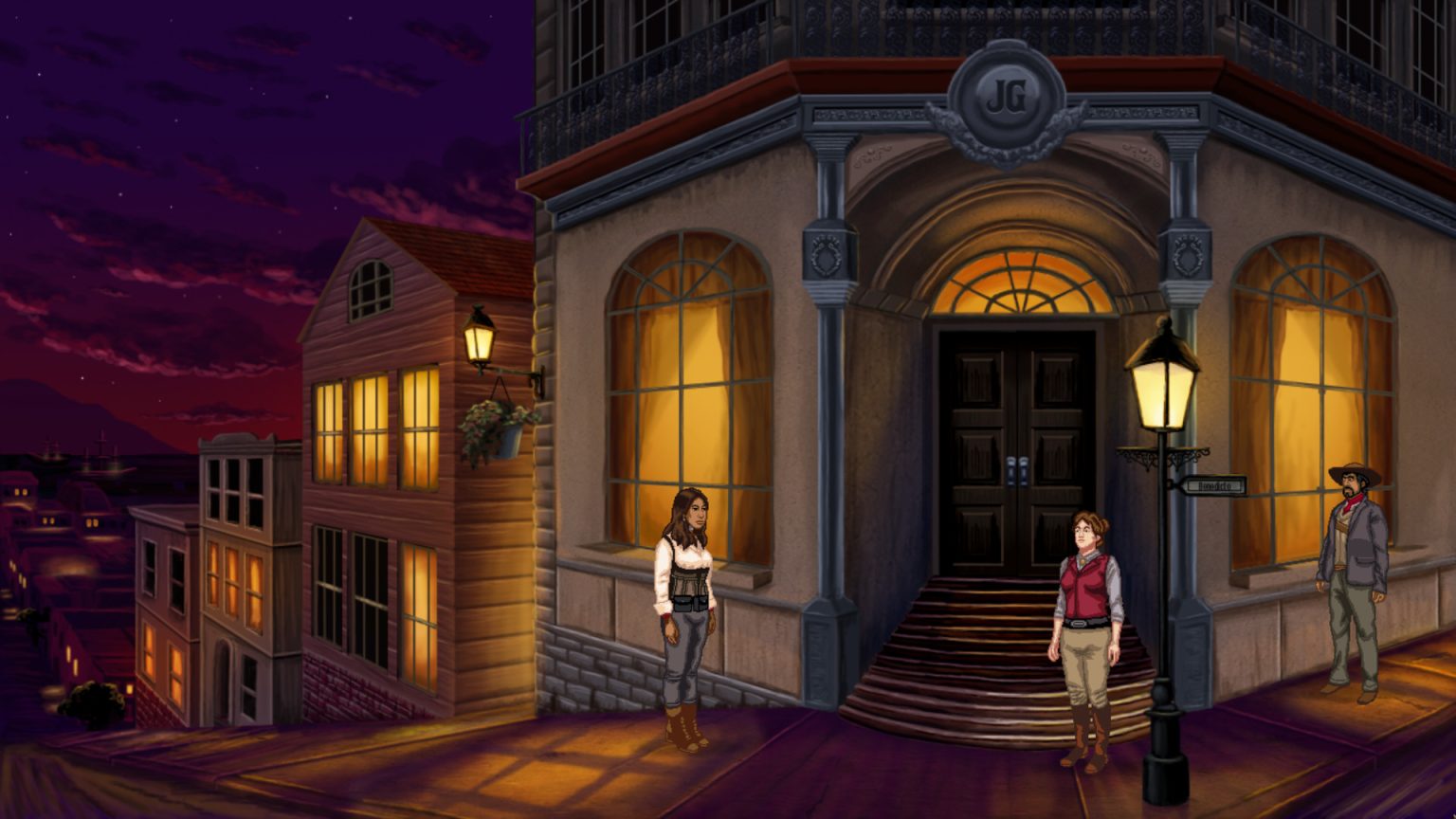
Dusty towns, rail travel and frontier camps use expressive pixel art with cinematic framing. The alternate history appears through technology, politics and social relationships instead of a long opening lecture. Small animation details keep conversations alive without competing with the portraits and performances.
The full voice cast gives the posse distinct rhythm and social weight. Music supports the Western setting without reducing it to one familiar motif. Ambient sound is especially useful during quieter travel scenes, where it prevents patience from becoming emptiness.
Presentation was judged during ordinary play, not only in composed screenshots. Strong art direction guides attention through colour, motion and sound while preserving mood. A beautiful scene is less successful if objectives, hazards or interactive objects disappear inside it.
Performance and interface
The reviewed PC build remained stable through scene changes, saves and repeated dialogue. Interface prompts were consistent, and the pixel presentation scaled cleanly on the test display. Players sensitive to animation timing should expect deliberate transitions rather than instant room changes.
One PC cannot represent every configuration, and later patches may change performance. This review reports the observed build and avoids promising results on untested hardware. Players with a specific accessibility or performance requirement should check the current platform documentation before buying.
Onboarding and learning curve
Classic adventure players will be comfortable immediately. Newer players receive enough contextual guidance to understand verbs, inventory and conversation progression. The game rarely punishes experimentation, and returning to an earlier character is a normal part of solving rather than evidence that the player failed.
The first session was separated from later sessions when judging clarity. A system that feels obscure for ten minutes may become expressive once its vocabulary settles, while an exciting tutorial can conceal a loop that never develops. Important status, objective and resource information should remain available to a new player during normal play.
Pacing and replay value
Rosewater wants the journey to breathe. That choice gives companions room to become more than quest dispensers, but it also produces stretches where narrative texture replaces mechanical pressure. Alternate choices and achievements provide some replay incentive, although the central journey remains authored.
Replay value can come from alternate routes, different builds, procedural incidents or the pleasure of mastering a fixed sequence. Those forms are not interchangeable. We credit only the replay structure visible during the stated hours and do not award points for an assumed endgame or future roadmap.
Accessibility and practical fit
Subtitles and a point-driven interface make much of the story available without rapid input. The game still asks for sustained reading and attention to dialogue details. Players with a specific subtitle or text-size need should verify the live settings for their display.
The practical buying question is broader than technical compatibility. Consider whether a normal twenty-minute stretch contains the decisions, reading, repetition and downtime you enjoy. A trailer can accurately show the world while still hiding the cadence that occupies most of a session.
Limits of the 6-hour review
Six hours established the recurring puzzle and conversation structure but did not exhaust every relationship branch or achievement. The final assessment therefore focuses on the journey’s repeated quality rather than promising that every late choice lands equally well.
The window is long enough to test the repeated loop across several sessions, but it cannot certify every ending, late encounter or future update. Price, discounts and online population are not treated as permanent facts because each can change after publication.
Who should play it?
Choose Rosewater for dialogue, setting and traditional adventure logic. Players looking for combat, open-world exploration or constant puzzle escalation will find its priorities too quiet. It is best approached as an ensemble road story in which interaction supports character.
A score is useful only beside that audience description. Genre experience, preferred difficulty and tolerance for repetition can change the result. Watching unedited footage of normal play is a better final check than relying on a trailer built entirely from peak moments.
How the score was decided
The score combines the repeated quality of decisions, clarity of feedback, presentation, technical state and the fit between the game’s stated idea and its actual loop. One spectacular scene cannot erase recurring friction, and one awkward first hour does not outweigh a system that becomes consistently rewarding after it is understood.
Notes were compared across separate sessions to reduce the effect of novelty and fatigue. Strengths and limitations had to appear more than once before shaping the verdict.
Rosewater review verdict
Rosewater modernises the classic point-and-click form through restraint rather than reinvention. Its puzzles respect context, its cast earns attention and its world feels researched without becoming a lecture. The slow stretches are real, but rushing them would damage the thing the game does best.
Pros: Excellent ensemble voice work; Specific alternate-history setting; Readable classic adventure puzzles; Warm but unsentimental character writing.
Cons: Slow travel stretches reduce momentum; Limited mechanical surprise; Some scenes delay obvious interactions.
Final score: 8/10. A confident, character-led Western adventure whose patient pace is part of the appeal.
Source: official information and published records.
Continue with our practical guides and browse more reporting in the Kaizensclan archive.
A final comparison separated the quality of the repeated play from the novelty of its first appearance. Features that remained useful across several sessions carried more weight than isolated surprises, while recurring friction counted even when each individual interruption looked minor.
Editorial note
Hands-on review window recorded in the article metadata, supported by official documentation and public technical coverage.
This article was reviewed on August 7, 2026.

Related stories
Minishoot’ Adventures review: exploration under fire
This Minishoot Adventures review finds a small ship leaving its village to free captured friends and confront corrupted machines. SoulGame Studio combines an.

Mouthwashing review: horror after the crash
This Mouthwashing review enters the Tulpar after a crash leaves five crew members with dwindling supplies and no credible rescue. Wrong Organ shifts between.

Thank Goodness You’re Here review: slapstick with purpose
This Thank Goodness You’re Here review follows a traveling salesman who arrives early for a mayoral appointment and becomes free labor for Barnsworth. Coal.
Community channel
Join the discussion
Start a thoughtful, specific conversation about this story.
Verified readers only
Continue with Google to comment.
Your Google account creates a reader-only Kaizensclan profile. Your first comment is reviewed before publication.