Rift of the NecroDancer review: rhythm without a dungeon
Rift of the NecroDancer review based on six hours of Rhythm Rifts, boss battles and minigames, with focus on pattern reading and difficulty. Read the verified.

 8.0
8.0 Kaizensclan verdict
Rift of the NecroDancer review based on six hours of Rhythm Rifts, boss battles and minigames, with focus on pattern reading and difficulty. Read the verified.
Review basis: 6 hours on PC (Steam). This research review covers the systems and release build observed in that window, not a completionist playthrough.
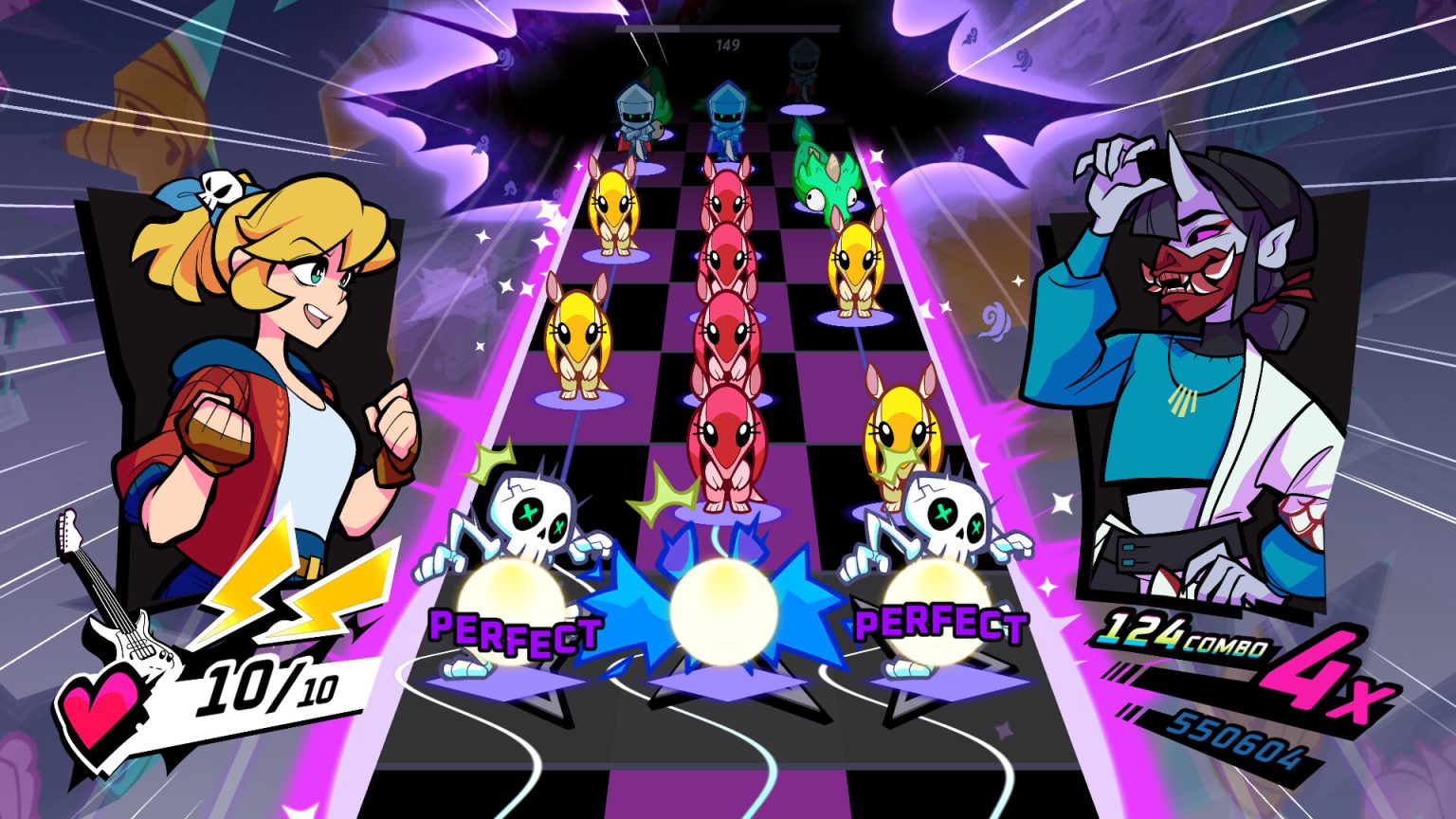
Rift of the NecroDancer keeps Cadence and the beat but removes the grid-based dungeon that defined Crypt of the NecroDancer. Monsters descend through three lanes like hostile notes, and each species brings a movement or durability rule that must be read at song speed.
Rift of the NecroDancer review: the first session
The change is immediately legible. A single input can strike the centre lane, with directional actions handling threats to either side. Early songs introduce enemies in isolation before combining them into phrases. The tutorial explains timing windows cleanly and offers calibration, an essential feature when a small audio offset can make correct play feel inexplicably wrong.
A Rhythm Rift begins as sight-reading and becomes memory through repetition. Players identify the monster, recall how it moves after a hit and place the response inside the song. Story scenes and compact rhythm minigames interrupt the track list, while boss battles use bespoke patterns that behave more like staged encounters than score chases.
Systems and meaningful decisions
Four difficulty levels make the same musical idea accessible at different densities. Remix Mode recombines authored patterns, daily challenges create a shared seed and a level editor supports custom charts. Score and combo systems reward consistency, but merely surviving a song remains a meaningful first objective. The design gives mastery several destinations instead of equating success only with a leaderboard rank.
A progression system earns its place when it changes the next decision rather than merely raising a number. We tracked whether new tools opened routes, solved recurring problems or encouraged a different risk. Interface activity received no extra credit when the underlying choice stayed obvious.
Controls, challenge and feedback
Inputs feel crisp after calibration, and enemy animation communicates the next movement well at moderate speed. On harder charts the visual field can become dense, especially when multiple durable monsters overlap. Mistakes often cascade because one displaced enemy changes the following beat, but practice mode and fast restarts keep the correction loop short.
Failure is most useful when the game reveals enough information to support another attempt. We separated setbacks caused by a readable rule or poor plan from repetition that simply consumed time. Difficulty can create tension without obscuring responsibility for the result.
World, art and sound
Hand-drawn animation gives each monster a distinct silhouette and a readable attack personality. Cadence’s modern setting is lighter and more playful than the original dungeon, using everyday scenes as rhythm minigames. The shift may disappoint players attached to gothic procedural exploration, but it is internally coherent.
Danny Baranowsky and collaborators provide a soundtrack built for repeated attention. Important beats remain clear beneath effects, and the arrangements support escalating chart density. Because music is both content and timing interface, personal taste matters more here than in most action games, though the stylistic range helps.
Presentation was judged during ordinary play rather than only in composed screenshots. Strong art direction guides attention through colour, movement and sound while preserving mood. A beautiful scene is less effective when objectives, hazards or interactive objects disappear inside it.
Performance and interface
The tested build held stable timing and frame delivery during six hours on PC. Calibration settings, difficulty selection and immediate retry options reduce practical barriers. Workshop and custom music features add variables outside the official chart set, so their reliability depends on individual creations.
One test system cannot represent every configuration, and later patches may change performance. The review reports the observed build and avoids promising results on untested hardware. Players with a specific accessibility or performance requirement should check current platform documentation before buying.
Onboarding and learning curve
Enemy vocabulary is the real campaign progression. A bat that changes lanes after contact and a multi-hit foe demand different preparation even when they arrive on the same beat. New patterns are usually introduced before being combined, allowing difficulty to grow through composition rather than hidden rules.
The first session was separated from later sessions when judging clarity. A system that feels obscure for ten minutes may become expressive once its vocabulary settles, while an exciting tutorial can hide a loop that never develops. Important status, objective and resource information should remain available during normal play.
Pacing and replay value
The campaign alternates songs, bosses and minigames often enough to avoid becoming one uninterrupted playlist. Replay value is substantial for players who enjoy better scores, harder charts, remixes or custom levels. Players motivated mainly by story will see less reason to repeat mastered tracks.
Replay value can come from alternate routes, different builds, procedural incidents or the pleasure of mastering a fixed sequence. Those forms are not interchangeable. We credit only the replay structure visible during the stated hours and do not award points for an assumed endgame or future roadmap.
Accessibility and practical fit
Difficulty choice is generous, but rhythm remains the core requirement. Calibration helps with hardware latency, while visual density and repeated flashing motion deserve consideration. Players who cannot rely on audio timing should examine the current accessibility settings before purchase.
The practical buying question extends beyond technical compatibility. Consider whether a normal twenty-minute stretch contains the decisions, reading, repetition and downtime you enjoy. A trailer can show the world accurately while hiding the cadence that occupies most of a session.
Limits of the 6-hour review
Six hours covered multiple modes and difficulty levels but not every chart, highest-tier clear or community creation. The score judges the repeated rhythm system rather than the total long-term workshop catalogue.
The window is long enough to test the repeated loop across several sessions, but it cannot certify every ending, late encounter or future update. Price, discounts and online population are not treated as permanent facts because each can change after publication.
Who should play it?
It is an excellent fit for players who enjoy lane rhythm games but want targets with behavioural meaning. Fans seeking procedural dungeons, loot builds or tactical movement should understand that Rift is a different genre built from the same musical identity.
A score is useful only beside that audience description. Genre experience, preferred difficulty and tolerance for repetition can change the result. Watching unedited footage of ordinary play is a better final check than relying on a trailer assembled entirely from peak moments.
How the score was decided
The score combines the repeated quality of decisions, clarity of feedback, presentation, technical state and the fit between the game’s stated idea and its actual loop. One spectacular scene cannot erase recurring friction, and one awkward opening does not outweigh a system that becomes consistently rewarding after it is understood.
Notes were compared across separate sessions to reduce the effect of novelty and fatigue. A strength or limitation had to recur before it shaped the verdict.
Rift of the NecroDancer review verdict
Rift of the NecroDancer succeeds because its monsters are more than decorative notes. Reading what each target will do gives familiar lane input a tactical layer, and scalable difficulty makes that language worth learning. The missing dungeon is a deliberate exchange, not an oversight.
Pros: Monster patterns add tactical meaning to rhythm charts; Strong soundtrack and readable animation; Excellent difficulty and replay options.
Cons: Little of the original dungeon structure remains; Hard charts can become visually crowded.
Final score: 8/10. A focused rhythm game that turns monster patterns into readable musical combat.
Sources: official information and published records. Factual claims were checked against the linked source and additional primary records; interpretation is our own.
Explore more reporting in the Kaizensclan archive and continue with our practical gaming guides.
Editorial note
Hands-on review window recorded in the article metadata, supported by official documentation and public technical coverage.
- https://store.steampowered.com/app/2073250/Rift_of_the_NecroDancer/
- Brace Yourself Games
This article was reviewed on August 7, 2026.

Related stories
Minishoot’ Adventures review: exploration under fire
This Minishoot Adventures review finds a small ship leaving its village to free captured friends and confront corrupted machines. SoulGame Studio combines an.
Mouthwashing review: horror after the crash
This Mouthwashing review enters the Tulpar after a crash leaves five crew members with dwindling supplies and no credible rescue. Wrong Organ shifts between.
Thank Goodness You’re Here review: slapstick with purpose
This Thank Goodness You’re Here review follows a traveling salesman who arrives early for a mayoral appointment and becomes free labor for Barnsworth. Coal.
Community channel
Join the discussion
Start a thoughtful, specific conversation about this story.
Verified readers only
Continue with Google to comment.
Your Google account creates a reader-only Kaizensclan profile. Your first comment is reviewed before publication.