Lonely Mountains: Snow Riders review: flow on fresh snow
Lonely Mountains Snow Riders review after five hours of skiing, shortcuts, time trials and multiplayer on its demanding, peaceful slopes. Read the verified.

 8.0
8.0 Kaizensclan verdict
Lonely Mountains Snow Riders review after five hours of skiing, shortcuts, time trials and multiplayer on its demanding, peaceful slopes. Read the verified.
Review basis: 5 hours on PC (Steam). This research review covers the systems and release build observed in that window, not a completionist playthrough.
Lonely Mountains: Snow Riders replaces downhill biking with skis and discovers that snow changes more than the scenery. Momentum is softer, turning arcs are wider and a promising shortcut can become an uncontrolled slide across ice or rock.
Lonely Mountains Snow Riders review: the first session
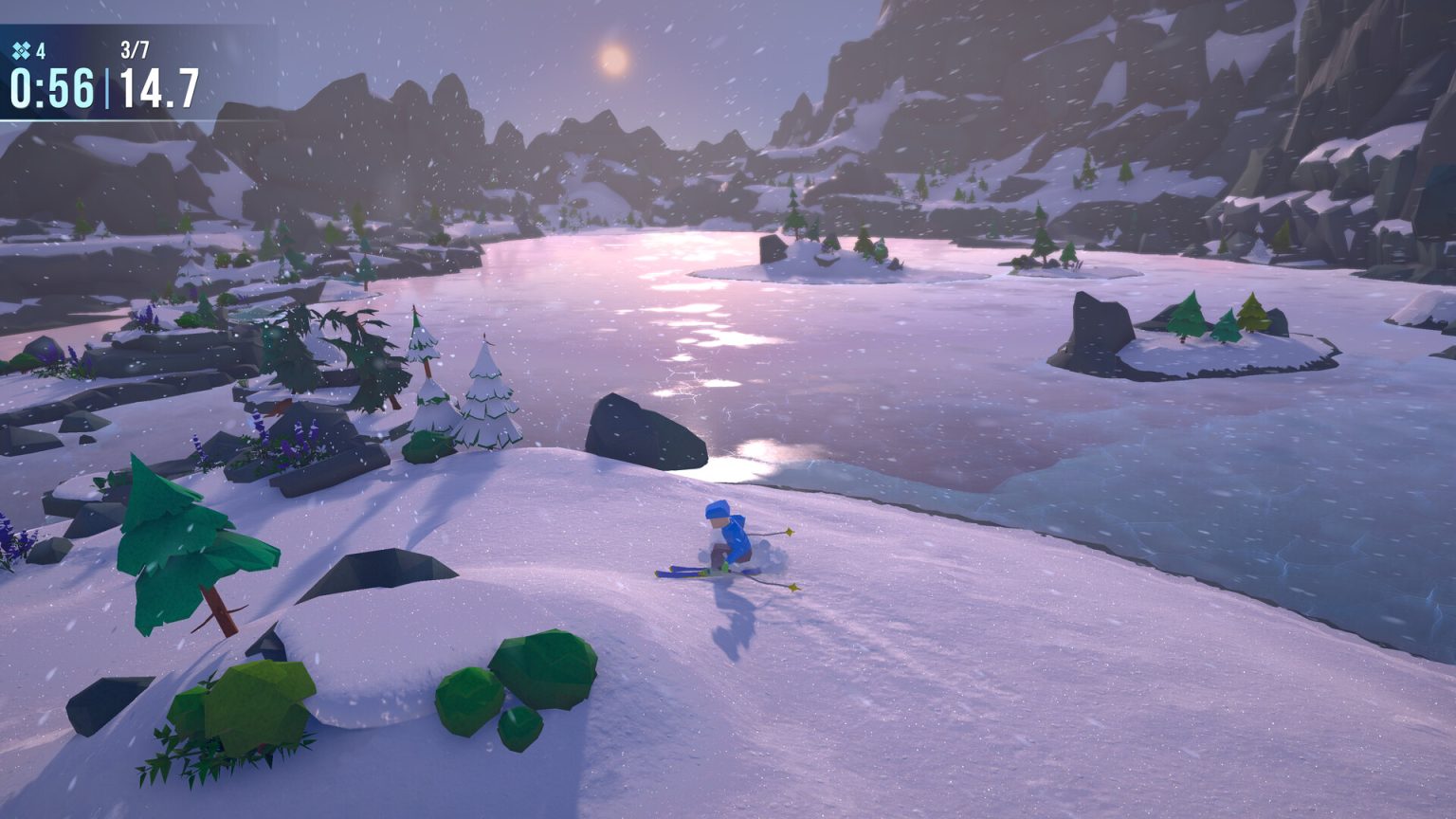
The first runs encourage caution. Checkpoints divide the slope into digestible sections, and a crash returns the skier quickly without erasing the entire descent. Camera composition shows the broad direction while leaving room to discover a cleaner line. The mountain is scenic, but every ridge and tree also communicates risk.
Players descend, learn where speed can be carried and repeat the route with a more ambitious target. Challenges unlock equipment, outfits and tricks. Exploration invites a slower search for alternate paths, while time trials demand commitment. Online co-op shares limited checkpoints and versus racing turns the same terrain into direct competition.
Systems and meaningful decisions
Handling sits between arcade response and a convincing sense of edges losing grip. Equipment choices adjust behaviour without creating a dense simulation setup screen. Tricks add another objective but do not replace route mastery. The best decisions happen before the turn: enter at the right speed, choose whether a jump is worth it and preserve enough control for the landing.
A progression system earns its place when it changes the next decision rather than merely raising a number. We tracked whether new tools opened routes, solved recurring problems or encouraged a different risk. Interface activity received no extra credit when the underlying choice stayed obvious.
Controls, challenge and feedback
Analogue steering communicates pressure well, and braking can rescue a conservative line. At high speed the isometric perspective occasionally hides the exact depth of a bump until experience supplies the answer. Crashes are frequent but usually attributable, and the rapid checkpoint restart keeps experimentation productive.
Failure is most useful when the game reveals enough information to support another attempt. We separated setbacks caused by a readable rule or poor plan from repetition that simply consumed time. Difficulty can create tension without obscuring responsibility for the result.
World, art and sound
Minimal figures and clean geometry let snow, rock and vegetation define each scene. Weather and lighting create atmosphere without burying the route. The diorama-like camera makes a lonely peak feel designed rather than empty, although foreground objects can briefly obstruct a precise approach.
Wind, ski contact and the muted impact of powder carry much of the mood. The restrained soundscape supports concentration and makes a hard landing feel physical. It does not chase the constant musical excitement of a conventional racing game.
Presentation was judged during ordinary play rather than only in composed screenshots. Strong art direction guides attention through colour, movement and sound while preserving mood. A beautiful scene is less effective when objectives, hazards or interactive objects disappear inside it.
Performance and interface
The PC build remained responsive during the five-hour window, including online sessions available for testing. Network quality and cross-platform population cannot be guaranteed from one review. Menus are clear, while fine control strongly favours an analogue gamepad over binary keyboard steering.
One test system cannot represent every configuration, and later patches may change performance. The review reports the observed build and avoids promising results on untested hardware. Players with a specific accessibility or performance requirement should check current platform documentation before buying.
Onboarding and learning curve
Each route teaches through terrain. A safe marked direction establishes the slope before optional shortcuts ask for sharper timing. Medals and challenges provide escalating goals without demanding the fastest standard immediately. The game rarely explains a perfect line because finding it is the play.
The first session was separated from later sessions when judging clarity. A system that feels obscure for ten minutes may become expressive once its vocabulary settles, while an exciting tutorial can hide a loop that never develops. Important status, objective and resource information should remain available during normal play.
Pacing and replay value
Short checkpoint segments make a useful session possible in fifteen minutes, but complete mastery can absorb an evening. Multiplayer adds variation through other skiers’ mistakes and route choices. Repeating fixed mountains is the central appeal, so players who dislike shaving seconds will exhaust the structure sooner.
Replay value can come from alternate routes, different builds, procedural incidents or the pleasure of mastering a fixed sequence. Those forms are not interchangeable. We credit only the replay structure visible during the stated hours and do not award points for an assumed endgame or future roadmap.
Accessibility and practical fit
The calm presentation should not be mistaken for low difficulty. Frequent crashes, precise analogue movement and spatial judgement define advanced play. Cooperative descent can reduce pressure socially, though shared checkpoint resources introduce a different form of consequence.
The practical buying question extends beyond technical compatibility. Consider whether a normal twenty-minute stretch contains the decisions, reading, repetition and downtime you enjoy. A trailer can show the world accurately while hiding the cadence that occupies most of a session.
Limits of the 5-hour review
Five hours were sufficient to compare exploration, time trials and multiplayer but not to master every mountain, unlock every item or evaluate the long-term competitive population. The review describes the launch structure observed on PC.
The window is long enough to test the repeated loop across several sessions, but it cannot certify every ending, late encounter or future update. Price, discounts and online population are not treated as permanent facts because each can change after publication.
Who should play it?
Snow Riders is for players who enjoy learning physical spaces and turning failure into route knowledge. It is less suitable for anyone expecting a licensed ski simulation, an open mountain resort or constant progression rewards.
A score is useful only beside that audience description. Genre experience, preferred difficulty and tolerance for repetition can change the result. Watching unedited footage of ordinary play is a better final check than relying on a trailer assembled entirely from peak moments.
How the score was decided
The score combines the repeated quality of decisions, clarity of feedback, presentation, technical state and the fit between the game’s stated idea and its actual loop. One spectacular scene cannot erase recurring friction, and one awkward opening does not outweigh a system that becomes consistently rewarding after it is understood.
Notes were compared across separate sessions to reduce the effect of novelty and fatigue. A strength or limitation had to recur before it shaped the verdict.
Lonely Mountains Snow Riders review verdict
Snow Riders captures the satisfying moment when a route stops feeling dangerous and begins to flow. Its mountains are peaceful places built for repetition, and the combination of precise handling, fast restarts and multiplayer gives that repetition purpose.
Pros: Expressive skiing and route selection; Fast restarts make failure productive; Beautiful restrained presentation.
Cons: Fixed routes demand an appetite for repetition; Perspective can obscure some high-speed terrain.
Final score: 8/10. A graceful skiing game whose calm mountains hide a demanding line-selection challenge.
Sources: official information and published records. Factual claims were checked against the linked source and additional primary records; interpretation is our own.
Explore more reporting in the Kaizensclan archive and continue with our practical gaming guides.
Editorial note
Hands-on review window recorded in the article metadata, supported by official documentation and public technical coverage.
- https://store.steampowered.com/app/2545360/Lonely_Mountains_Snow_Riders/
- Megagon Industries
This article was reviewed on August 7, 2026.

Related stories

Minishoot’ Adventures review: exploration under fire
This Minishoot Adventures review finds a small ship leaving its village to free captured friends and confront corrupted machines. SoulGame Studio combines an.

Mouthwashing review: horror after the crash
This Mouthwashing review enters the Tulpar after a crash leaves five crew members with dwindling supplies and no credible rescue. Wrong Organ shifts between.

Thank Goodness You’re Here review: slapstick with purpose
This Thank Goodness You’re Here review follows a traveling salesman who arrives early for a mayoral appointment and becomes free labor for Barnsworth. Coal.
Community channel
Join the discussion
Start a thoughtful, specific conversation about this story.
Verified readers only
Continue with Google to comment.
Your Google account creates a reader-only Kaizensclan profile. Your first comment is reviewed before publication.