Deliver At All Costs review: chaos behind the wheel
Deliver At All Costs review after six hours with its destructible 1959 world, absurd courier missions, driving physics and uneven narrative. Read the verified.

 6.5
6.5 Kaizensclan verdict
Deliver At All Costs review after six hours with its destructible 1959 world, absurd courier missions, driving physics and uneven narrative. Read the verified.
Review basis: 6 hours on PC (Steam). This research review covers the systems and release build observed in that window, not a completionist playthrough.
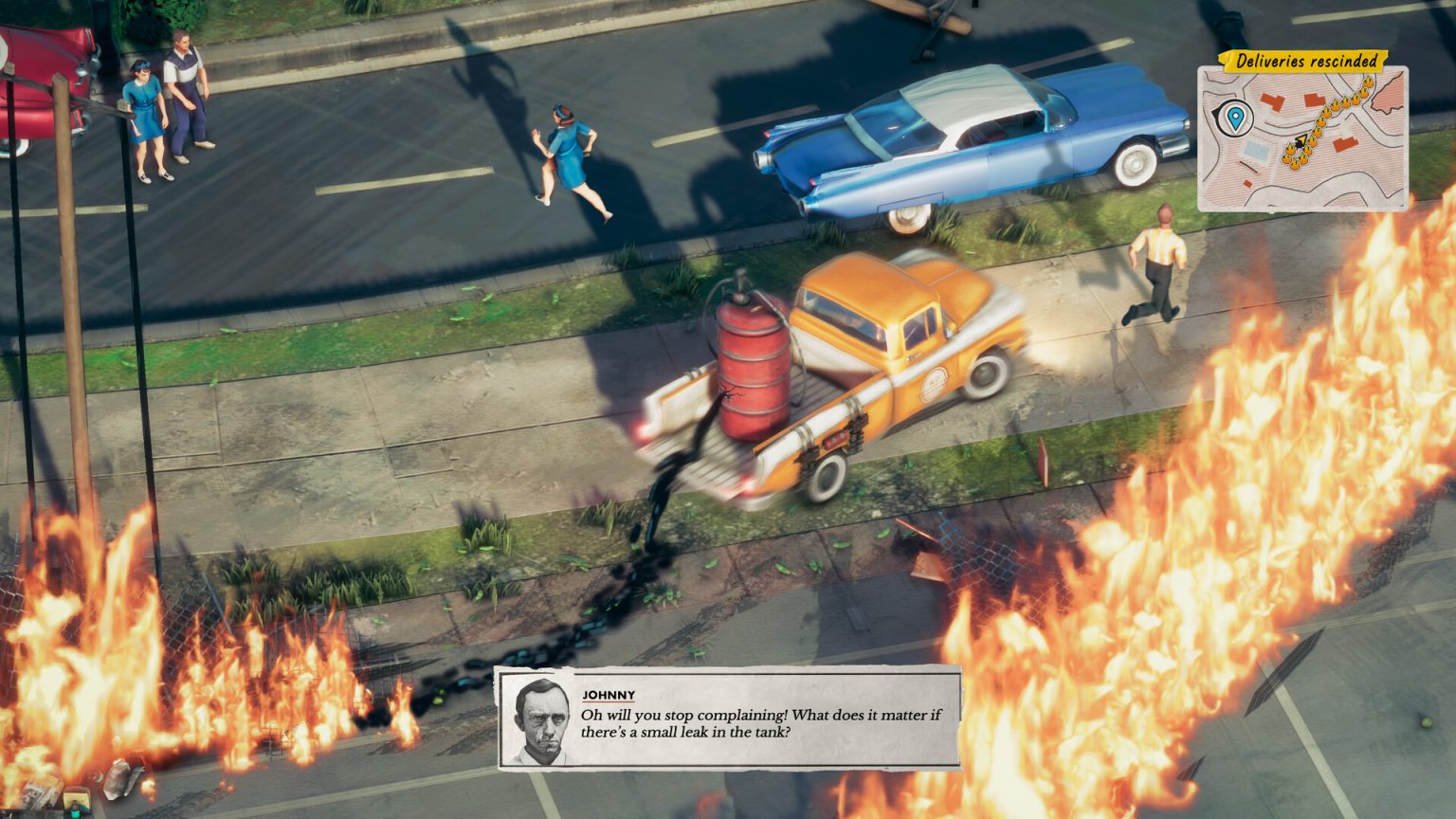
Deliver At All Costs makes a promising offer: drive bizarre cargo through a 1959-inspired city where fences, walls and street furniture are temporary suggestions. Its best missions convert an ordinary delivery into a physical comedy problem. Its weaker stretches expose handling and story friction that destruction cannot always hide.
Deliver At All Costs review: the first session
Winston Green begins as a desperate courier and quickly accepts jobs no sensible company would insure. The tutorial introduces driving, on-foot movement and a semi-open area without delaying the first collision. A period radio, saturated colour and exaggerated citizens establish the tone before the larger mystery starts competing for attention.
A mission assigns unusual cargo, creates a mechanical condition and asks Winston to reach a destination through a destructible space. Between jobs, players drive across districts, collect items and follow story objectives. The loop is strongest when the cargo changes the vehicle itself rather than serving as a fragile health bar.
Systems and meaningful decisions
Physics produce spontaneous incidents, but authored mission rules determine whether those incidents feel like solutions. A giant object swinging behind the vehicle changes cornering and creates useful destruction. More conventional travel exposes loose steering and repeated navigation. The semi-open world supports spectacle yet does not consistently reward exploring every side street.
A progression system earns its place when it changes the next decision rather than merely raising a number. We tracked whether new tools opened routes, solved recurring problems or encouraged a different risk. Interface activity received no extra credit when the underlying choice stayed obvious.
Controls, challenge and feedback
Vehicles communicate weight but can feel imprecise when a mission demands a clean approach. Destruction often allows recovery by creating a new route, which is thematically perfect. On-foot control and camera work are less convincing, especially in tight interiors. Checkpoints prevent most failures from becoming long punishments.
Failure is most useful when the game reveals enough information to support another attempt. We separated setbacks caused by a readable rule or poor plan from repetition that simply consumed time. Difficulty can create tension without obscuring responsibility for the result.
World, art and sound
The alternate 1959 setting combines postcard colour, suburban design and nuclear anxiety. Breakable construction gives towns a stage-set quality appropriate to the comedy. Repetition becomes visible in less important spaces, but major districts and mission locations maintain a distinct visual identity.
Radio advertising, engine noise and a period-inspired score do substantial world-building. Crashes have satisfying layers rather than one repeated bang. Voice acting sells broad character types, although the tonal move from slapstick delivery to psychological mystery is not always smooth.
Presentation was judged during ordinary play rather than only in composed screenshots. Strong art direction guides attention through colour, movement and sound while preserving mood. A beautiful scene is less effective when objectives, hazards or interactive objects disappear inside it.
Performance and interface
The tested PC build was playable across six hours, with occasional physics oddities expected in a heavily destructible environment. Performance could dip when a large chain of objects collapsed. Interface prompts were generally readable, but waypoint behaviour did not always compensate for an awkward vehicle position.
One test system cannot represent every configuration, and later patches may change performance. The review reports the observed build and avoids promising results on untested hardware. Players with a specific accessibility or performance requirement should check current platform documentation before buying.
Onboarding and learning curve
New missions usually demonstrate their gimmick quickly, then ask the player to improvise. Because ordinary traffic rules are irrelevant, the main lesson is recognising which structures can be broken safely. Some failures teach a route; others arise from unstable object behaviour and offer less useful information.
The first session was separated from later sessions when judging clarity. A system that feels obscure for ten minutes may become expressive once its vocabulary settles, while an exciting tutorial can hide a loop that never develops. Important status, objective and resource information should remain available during normal play.
Pacing and replay value
The campaign alternates strong set pieces with travel and exposition that slow the comedy. Optional destruction adds momentary replay value, but many mission surprises work best once. Players who enjoy producing accidental chaos will find more longevity than those focused exclusively on optimal completion.
Replay value can come from alternate routes, different builds, procedural incidents or the pleasure of mastering a fixed sequence. Those forms are not interchangeable. We credit only the replay structure visible during the stated hours and do not award points for an assumed endgame or future roadmap.
Accessibility and practical fit
The game includes readable objectives and forgiving destruction, but moving cameras, physics instability and repeated collisions may be uncomfortable for some players. Fine steering is easier with a controller. Current accessibility options should be checked for individual needs.
The practical buying question extends beyond technical compatibility. Consider whether a normal twenty-minute stretch contains the decisions, reading, repetition and downtime you enjoy. A trailer can show the world accurately while hiding the cadence that occupies most of a session.
Limits of the 6-hour review
Six hours covered multiple districts and mission types but not the entire three-act story or every vehicle. The verdict focuses on the recurring delivery structure and technical behaviour observed, not on an untested ending.
The window is long enough to test the repeated loop across several sessions, but it cannot certify every ending, late encounter or future update. Price, discounts and online population are not treated as permanent facts because each can change after publication.
Who should play it?
It fits players who enjoy broad physical comedy, destructible scenery and linear missions inside a loose hub. It is a poor substitute for a precise racing model or a systemic open-world crime game, despite visual echoes of both.
A score is useful only beside that audience description. Genre experience, preferred difficulty and tolerance for repetition can change the result. Watching unedited footage of ordinary play is a better final check than relying on a trailer assembled entirely from peak moments.
How the score was decided
The score combines the repeated quality of decisions, clarity of feedback, presentation, technical state and the fit between the game’s stated idea and its actual loop. One spectacular scene cannot erase recurring friction, and one awkward opening does not outweigh a system that becomes consistently rewarding after it is understood.
Notes were compared across separate sessions to reduce the effect of novelty and fatigue. A strength or limitation had to recur before it shaped the verdict.
Deliver At All Costs review verdict
Deliver At All Costs is most persuasive when cargo, vehicle and city collide into one readable joke. Too often the journey between those moments asks its loose controls and uneven narrative to carry the weight. The chaos is real and sometimes excellent, but the delivery is inconsistent.
Pros: Destructible environments create genuine improvisation; Strong 1950s audiovisual identity; Best cargo concepts change how the vehicle behaves.
Cons: Loose handling undermines precise tasks; Story and travel interrupt the strongest mission rhythm; Physics failures are not always informative.
Final score: 6.5/10. Destructive deliveries create memorable chaos, but mission quality and control never become equally reliable.
Sources: official information and published records. Factual claims were checked against the linked source and additional primary records; interpretation is our own.
Explore more reporting in the Kaizensclan archive and continue with our practical gaming guides.
Editorial note
Hands-on review window recorded in the article metadata, supported by official documentation and public technical coverage.
- https://store.steampowered.com/app/1880610/Deliver_At_All_Costs/
- Studio Far Out Games
This article was reviewed on August 7, 2026.

Related stories

Minishoot’ Adventures review: exploration under fire
This Minishoot Adventures review finds a small ship leaving its village to free captured friends and confront corrupted machines. SoulGame Studio combines an.

Mouthwashing review: horror after the crash
This Mouthwashing review enters the Tulpar after a crash leaves five crew members with dwindling supplies and no credible rescue. Wrong Organ shifts between.

Thank Goodness You’re Here review: slapstick with purpose
This Thank Goodness You’re Here review follows a traveling salesman who arrives early for a mayoral appointment and becomes free labor for Barnsworth. Coal.
Community channel
Join the discussion
Start a thoughtful, specific conversation about this story.
Verified readers only
Continue with Google to comment.
Your Google account creates a reader-only Kaizensclan profile. Your first comment is reviewed before publication.