Team review meetings that end with one clear change
Use a 45-minute structure that protects attention and assigns the next action.

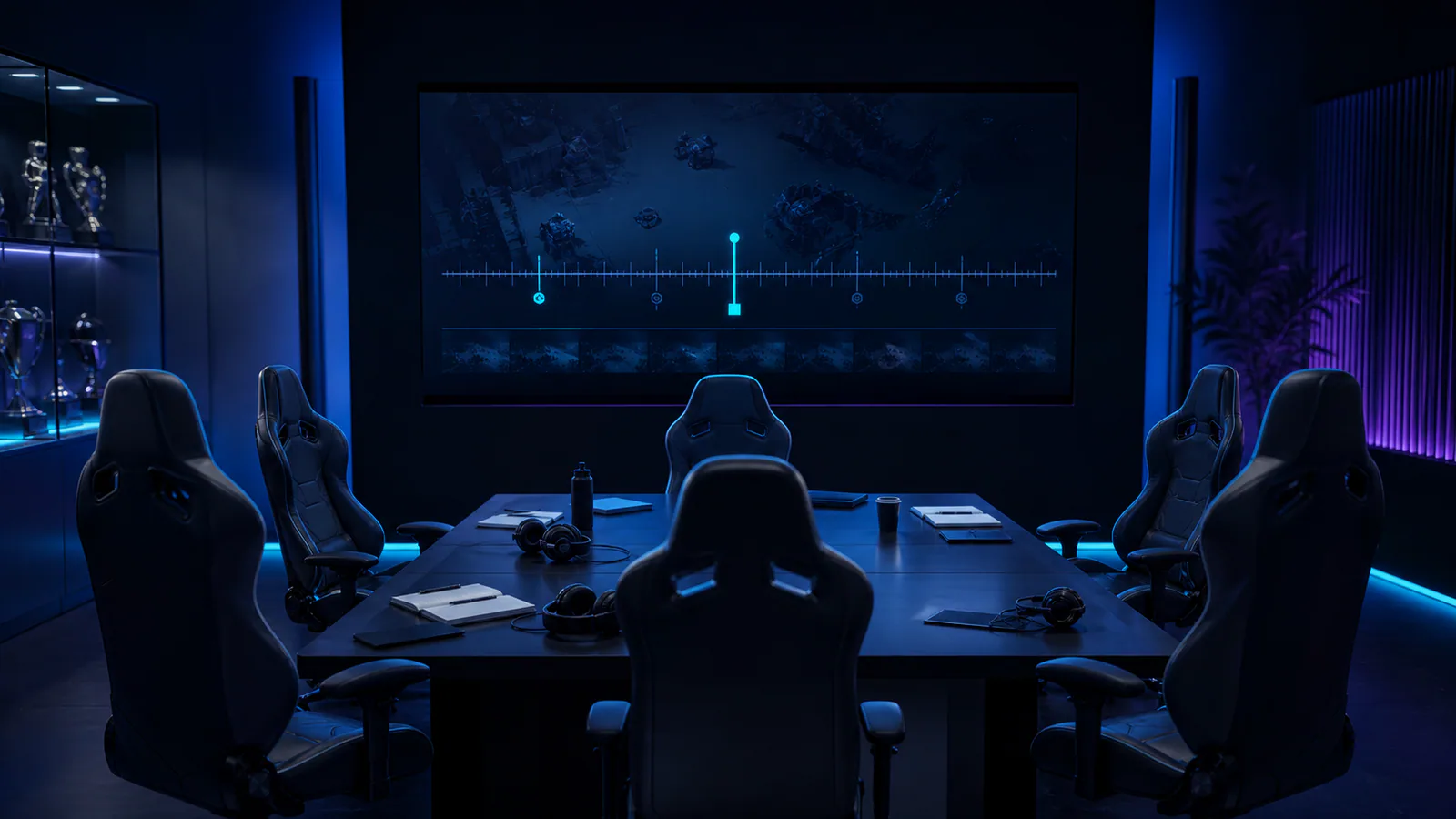
A team review meeting succeeds when practice changes afterward. Length, intensity and the number of clips discussed are poor measures of value. Players need a shared description of the problem, a small replacement behaviour and a test that shows whether it worked. This 45-minute esports team review agenda creates those outputs without turning the room into a trial.
Before the meeting: prepare one question
The reviewer selects one repeated situation and no more than three clips. Each clip should show the decision beginning, not just its punishment. Send the question in advance so players arrive ready to reconstruct information: “How do we hand over control after the first objective?” is more useful than “Why did we throw our leads?”
Choose a facilitator and a note owner. The facilitator protects the sequence; the note owner records evidence, decision and action. Neither role needs to be the head coach.
Minutes 0–10: establish the shared record
Play the first clip once without interruption. Ask players to list what was known, what was assumed and what remained uncertain. The facilitator separates observations from interpretations on the board. This reduces hindsight: the replay audience can see information the player never received.
Agree on a neutral sentence describing the repeated state. Do not move forward until everyone can recognise that state in another match.
Minutes 10–25: compare decisions
View the remaining clips and pause before the first divergence. Invite the player who owned the decision to explain their trigger, then ask teammates what trigger they expected. The aim is to find incompatible rules, not the loudest defence.
Limit alternatives to two realistic options. Test each against time, resources and communication available in the clip. Our VOD review checklist provides the evidence framework, while the CS2 demo workflow shows a game-specific version.
Minutes 25–35: write the replacement behaviour
A useful change has an owner, trigger and observable action. For example: “After the first site is secured, the support player names the unobserved route before utility is repositioned.” Read the sentence aloud and ask each player what they will do when they hear it.
If answers differ, the rule is not finished. Simplify it until the five roles connect. Avoid adding exceptions during the first version; practice will reveal which exception is real.
Minutes 35–45: design the test
Choose the next scrim block or drill, the number of repetitions and the evidence the note owner will collect. A lost round can still count as successful execution if the agreed call happened on time. Separating process from result gives the team honest feedback sooner.
End by parking unresolved issues in a visible backlog. Assign no more than one secondary individual task. At the next review, begin with evidence from the test before opening a new topic. This rhythm builds trust: meetings stop being places where every old error returns and become a reliable bridge from replay to practice.
Editorial note
Kaizensclan editorial workflow for evidence-led team review.
- Kaizensclan Editorial Policy — editorial-policy.html
This article was reviewed on July 31, 2026.

Related stories
Path of Exile 2 Sorceress leveling guide for 0.5.4e
Path of Exile 2 Sorceress leveling is smoother when the character solves one damage loop before collecting every elemental skill. Patch 0.5.4e is the referenc.

Minecraft mace combat guide for Java 1.21.9
Minecraft mace combat turns vertical movement into damage. Java Edition 1.21.9 is the reference version. A smash attack requires striking while falling far.
Dota 2 Watcher control guide for patch 7.41e
Dota 2 Watcher control is useful when it protects the next movement, not when a support activates every structure on cooldown. Patch 7.41e is the reference.
Community channel
Join the discussion
Start a thoughtful, specific conversation about this story.
Verified readers only
Continue with Google to comment.
Your Google account creates a reader-only Kaizensclan profile. Your first comment is reviewed before publication.