Esports comms: say more in five words or fewer
Separate information, intention and urgency so teammates can act before the call ends.

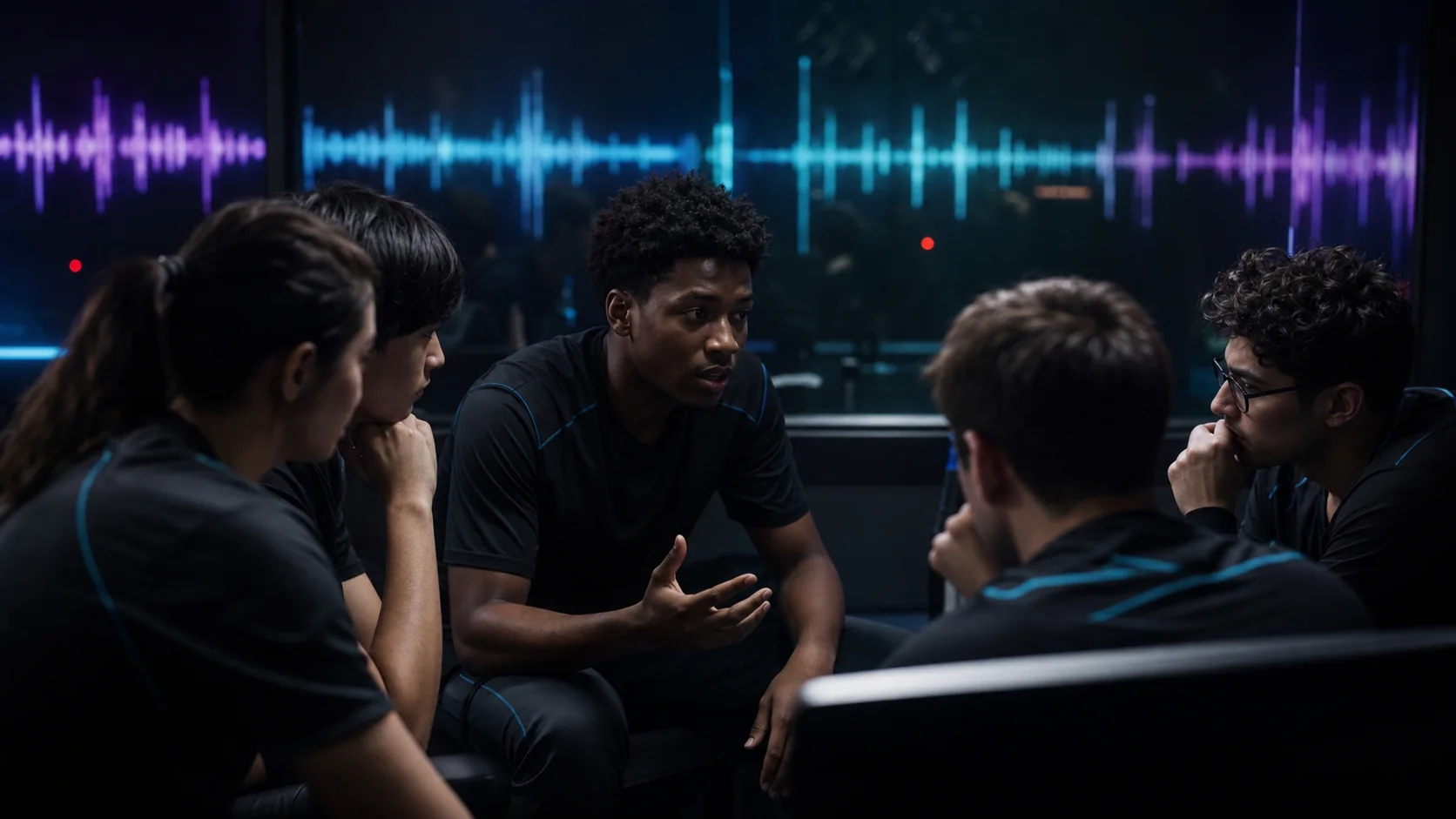
This esports comms guide is for ranked groups and amateur teams whose voice channel gets louder as the round gets worse. You will use a five-word framework to report information, intention and urgency without burying the useful detail.
A good call changes a decision
Communication is not a live commentary track. A useful call changes where a teammate looks, moves or spends a resource. If the sentence does none of those things, it can usually wait until the round ends.
The framework is simple: place, count, state, action, timing. You rarely need all five parts. “Two ramp, bomb seen” is enough because the location, number and critical state imply the next decision.
Information before interpretation
Start with what you directly saw or heard. “One crossed left” is stronger than “they are ending left.” The first call gives evidence; the second turns a glimpse into a full strategy and can drag the team into a bad rotation.
When you do interpret, mark the confidence: “likely rotate” or “could be fake.” This tiny distinction keeps a prediction useful without disguising it as certainty.
Intention prevents duplicate work
Say what you are about to do when a teammate could reasonably attempt the same job. “Flashing close, then swing” stops a second flash. “Holding exit, tap it” lets the defuser trust the angle. Intention is especially valuable when the minimap cannot show timing.
Keep the subject obvious. In a fast fight, “I will watch the northern connector” becomes “holding north.” The team already knows who is speaking.
Urgency without volume
Repeat the critical word, not the entire sentence. “Bomb down, bomb down” survives chaos better than a louder paragraph. Reserve raised volume for immediate threats; if everything is urgent, nothing is.
After death, give the last confirmed location, damage only when reliable and any resource you clearly observed. Then stop. Let living players hear footsteps and their own plan.
Six calls to practise
- “Two site, bomb seen.”
- “No contact; keep default.”
- “Flash ready in two.”
- “I can trade you.”
- “Half complete, stay on.”
- “No time; keep weapons.”
Practise by limiting the team to one breath per call during a scrim. Review only the moments when someone asked for clarification. The goal is not robotic silence; it is shared vocabulary.
Build a team dictionary
Choose one name for every important location and remove duplicates. Define three timing words—now, wait and ready—and use them consistently. Agree how you report low health, missing opponents and a cancelled plan. A small dictionary beats individual eloquence.
Apply the framework in our Valorant retake protocol, CS2 outside utility guide and Dota 2 map-reading guide. The games differ; the information problem does not.
What to say after a mistake
Use a correction that helps the next decision: “my flash missed, no blind” or “I lost connector, watch rotate.” An apology can wait until the round ends. Defending the mistake in real time adds noise and usually forces teammates to split attention between the game and the explanation.
After the round, state the fix once. “I will call before swinging” is useful. A long account of why the timing failed is only valuable during review.
How an in-game leader should listen
The caller needs exceptions, not five confirmations. Teammates should report information that changes the plan and remain quiet when their area behaves as expected. The leader then repeats the decision, not every detail: “finish default,” “group now” or “save.”
If two calls conflict, prioritise direct recent evidence and ask one short question. “Bomb seen?” resolves more than debating which read sounds smarter.
Create calm during a losing streak
Reduce communication to observable facts and the next action. Avoid score commentary, blame and predictions about the match. A team can control one round, one resource and one timing; the previous mistakes are no longer actionable.
Choose one reset phrase that everyone understands, such as “clear channel.” It should end side conversations without sounding punitive. Calm is not silence—it is a channel where useful information can arrive.
A ten-minute comms review
- Clip two rounds with overlapping calls.
- Write the useful fact from each sentence.
- Remove repeated subjects and explanations.
- Agree on the shortest version.
- Use that version in the next session.
Review successful rounds too. Good communication often disappears because nothing dramatic happens; identifying it gives the team a model to repeat.
Before you queue
Ask the team to improve one type of call, not the entire channel. Choose locations, timing or intention for the session. A narrow target makes feedback specific and keeps players from feeling monitored every time they speak.
Record a short round only with everyone’s permission. Transcribe the busiest ten seconds and underline words that changed a decision. Everything else is a candidate for removal or delay. Run the same scenario again with the shorter calls, then check whether teammates acted sooner or asked fewer questions. The goal is not minimum word count for its own sake; it is enough shared context delivered before the decision expires. Keep the final version in a shared note so returning teammates use the same language next session.
Editorial note
This framework was tested by the Kaizensclan editorial team and manually reviewed on July 27, 2026. Generated editorial artwork is credited to Kaizensclan.
Editorial note
- Official update notes and Kaizensclan editorial testing
This article was reviewed on July 27, 2026.

Related stories
Path of Exile 2 Sorceress leveling guide for 0.5.4e
Path of Exile 2 Sorceress leveling is smoother when the character solves one damage loop before collecting every elemental skill. Patch 0.5.4e is the referenc.
Minecraft mace combat guide for Java 1.21.9
Minecraft mace combat turns vertical movement into damage. Java Edition 1.21.9 is the reference version. A smash attack requires striking while falling far.
Dota 2 Watcher control guide for patch 7.41e
Dota 2 Watcher control is useful when it protects the next movement, not when a support activates every structure on cooldown. Patch 7.41e is the reference.
Community channel
Join the discussion
Start a thoughtful, specific conversation about this story.
Verified readers only
Continue with Google to comment.
Your Google account creates a reader-only Kaizensclan profile. Your first comment is reviewed before publication.