Valorant retakes: a five-player protocol that works
Coordinate timing, utility and the defuse without requiring a full playbook.

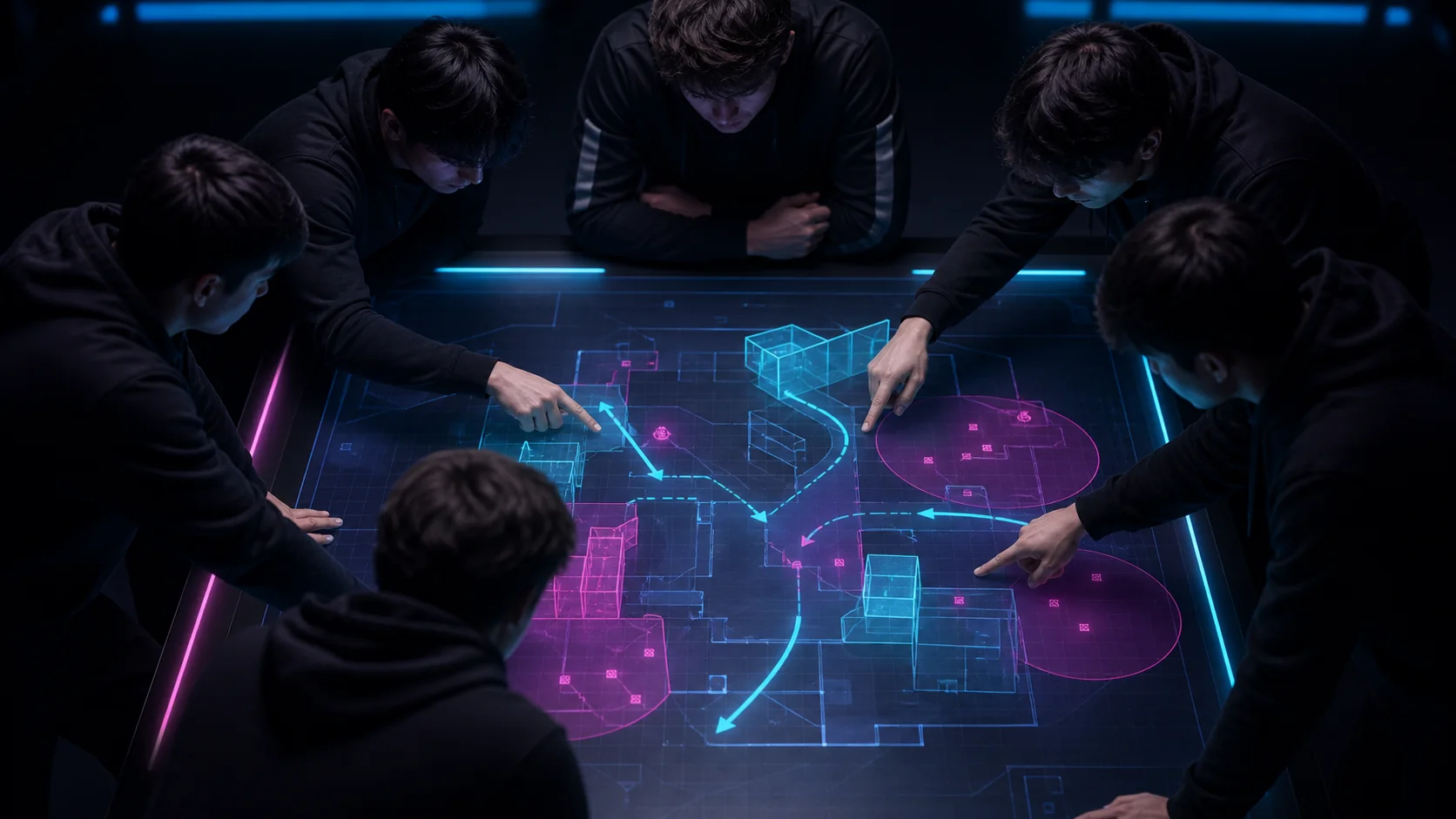
This Valorant retake guide gives ranked teams a protocol that survives imperfect communication. You will learn when to save, how to group without surrendering every lane and how to spend utility in a sequence that creates one decisive fight instead of five separate ones.
Decide before you rotate
A retake begins when the site is lost, not when the Spike is planted. The nearest defender should state three facts: how many attackers were seen, where the Spike is likely going and whether a teammate can safely delay. Everyone else answers with arrival time and useful utility.
Make the save decision early. If two players are alive against five, key ultimates are unavailable and the economy cannot support the next buy, walking into stacked post-plant angles is usually a donation. A clear “save” is better than ten seconds of hopeful silence.
Step 1: create one shared clock
Use the first arriving player as the clock. They do not enter; they announce when they can pressure. A teammate on the opposite side answers with a simple delay: “two seconds” or “ready.” This gives the team one start signal without asking a stranger to understand a full playbook.
Do not confuse grouping with standing in one doorway. Two players can threaten different entrances while sharing timing. The goal is to force defenders to turn, move or spend utility at the same moment.
Step 2: clear the close layer
- Use the cheapest information tool first: a recon ability, drone, flash or shoulder peek.
- Clear corners that can immediately trade the entry.
- Hold the escape route while the first player takes space.
- Only then spend the second wave of utility on the planted position.
Teams often throw every ability at the back of site while an attacker waits beside the entrance. Divide the site into close, middle and post-plant layers. Solve them in that order unless hard information gives you a better route.
Step 3: preserve one answer for the defuse
Keep one smoke, displacement tool or flash for the first defuse tap. The attackers are waiting for that sound cue; your remaining ability forces them to move or delays their peek long enough to establish a crossfire. Spending everything on entry makes the final five seconds much harder.
The player with the weakest weapon should usually touch the Spike first while teammates hold likely swings. This is not a rigid rule, but it stops your best rifle from staring at the floor during the most important duel.
The comms that matter
- “Three site, one main” gives count and last known space.
- “Ready in two” creates timing.
- “Flash close, then swing” states utility and action.
- “Half, stay on” prevents a panic release.
- “No time, exit” ends the round cleanly.
Names, numbers and verbs beat explanations. If a call needs two breaths, shorten it before the next round. Our five-word communication framework gives more examples.
A repeatable practice block
Run three custom rounds on one site. In round one, use no damaging utility. In round two, require a two-sided entry. In round three, require one ability to remain for the defuse. Swap roles after every attempt so the team understands both the entry and support timing.
Patch 13.00 changed agent and map conditions, so check the official notes before copying a professional setup. The protocol itself is role-based: information, entry, trade, defuse and denial. That makes it durable even when specific cooldowns move. Next, use our Summit defense guide to apply the structure on the newest competitive map.
How to adapt when a teammate arrives late
Do not freeze the entire retake while waiting for perfect numbers. The grouped players should take safe close space and hold the next pressure point. The late player states an arrival time and chooses the route that creates the widest angle from the group.
If utility is expiring, begin with the players who are present and convert the late teammate into the trade or defuse role. A plan with imperfect spacing still beats five individual reactions. What matters is that nobody crosses the point of no return without announcing it.
Common retake failures
The first failure is the silent entry: one player sees an opening, crosses two angles and dies before teammates know the retake began. The second is utility duplication, where two flashes solve the same corner and leave nothing for the plant. The third is the ceremonial tap—touching the Spike without anyone holding the expected swing.
Review the first ten seconds after the plant. Mark the save decision, the group timing and the first utility sequence. Most failed retakes are decided there, well before the final duel.
Before you queue
Agree on three words with your group: ready, wait and save. Those calls are enough to create a shared clock, stop an early entry and end an impossible attempt. You can add map language later.
During the match, review only the first retake decision. Ask whether the team chose to save or group quickly, then whether the first player crossed on a call. Do not rebuild the entire round between buys. One corrected trigger is easier to repeat than a complete lecture. If you are solo, state your own arrival time and utility in one sentence; even silent teammates can use information that arrives early and includes an action.
Sources and update note
Riot Games: Valorant patch notes 13.00
This article was manually reviewed on July 27, 2026. Generated editorial artwork is credited to Kaizensclan.
Editorial note
- Official update notes and Kaizensclan editorial testing
This article was reviewed on July 27, 2026.

Related stories

VALORANT Bind A execute guide for patch 13.02
A reliable Bind A execute creates two simultaneous problems instead of sending five players through A Short. Control either Showers or the Short cubbies, cut.
VALORANT Split B execute guide for patch 13.02
A Split B execute works when B Main and mid pressure arrive together. Patch 13.02 is the reference version. Clear close angles, deny Heaven vision and reserve.

VALORANT Lotus A execute guide for patch 13.02
A consistent Lotus A execute begins before the barrier drops. The attacking team needs a Rubble plan, utility for A Main and Tree, a plant location that.
Community channel
Join the discussion
Start a thoughtful, specific conversation about this story.
Verified readers only
Continue with Google to comment.
Your Google account creates a reader-only Kaizensclan profile. Your first comment is reviewed before publication.