Minishoot’ Adventures review: exploration under fire
This Minishoot Adventures review finds a small ship leaving its village to free captured friends and confront corrupted machines. SoulGame Studio combines an.

 8.5
8.5 Kaizensclan verdict
This Minishoot Adventures review finds a small ship leaving its village to free captured friends and confront corrupted machines. SoulGame Studio combines an.
Review basis: 7 hours on PC. The stated time covers several sessions with the release build and is not a claim of full completion.
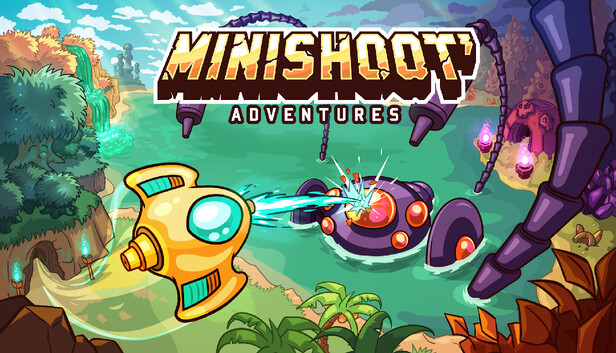
This Minishoot Adventures review finds a small ship leaving its village to free captured friends and confront corrupted machines. SoulGame Studio combines an overhead adventure map with twin-stick firing, making every new route both a navigation question and a test of projectile control.
Minishoot Adventures review: the opening hours
The opening teaches movement, aiming and a basic shot before sending the ship through a gate into the wider world. Caves, locked structures and conspicuous gaps immediately mark future returns. NPCs communicate with icons and animation instead of long dialogue, keeping the rescue premise clear and light.
Explore a region, clear enemy groups, collect experience and currency, then spend upgrades that improve combat or movement. Dungeons end in pattern-based bosses and often grant an ability that opens old barriers. Fast travel and a detailed map reduce the cost of revisiting earlier forks.
Systems and meaningful decisions
Level upgrades cover damage, firing behavior, defense and utility, while hidden modules change capabilities more directly. Healing fountains and save points establish safe routes. Difficulty options and assist settings let players tune projectile speed or survivability without removing the satisfaction of reading an attack pattern.
We judged progression by whether it changed the next decision rather than merely increasing a number. A useful unlock opens a route, answers a recurring problem or creates a new risk. Busy menus received no extra credit when the underlying choice remained obvious.
Controls, combat and feedback
Movement and aiming feel immediate on controller, and the ship’s small hitbox makes dense volleys readable. Dashing supplies both travel speed and defensive timing after it is unlocked. Contact with scenery during a tense circle can be frustrating, but arenas generally leave enough space for intentional movement.
Failure is productive when the game supplies enough information for a better attempt. We separated setbacks caused by a readable rule or poor plan from repetition that only consumed time. Challenge can create tension without hiding responsibility for the outcome.
World and visual direction
Bright biomes use clean silhouettes so hostile shots remain visible over grass, water and ruins. The world is compact enough for landmarks to matter and layered enough to hide caves behind later abilities. Enemy corruption supplies a visual through-line without making every region share one palette.
Presentation was assessed during ordinary play, not only in composed screenshots. Strong direction guides attention through colour, movement and contrast while preserving mood. A beautiful effect becomes a liability when it hides an objective, hazard or rival.
Music and sound design
Weapon impacts and enemy breaks have sharp confirmation, while low-health and boss cues remain distinct. Music is melodic but rarely overwhelms projectile information. Town themes provide a useful reset after extended combat, helping the rescue hub feel increasingly inhabited.
Audio was treated as atmosphere and information. Distinct warnings, impacts and movement cues matter more over several hours than one loud set piece, although a memorable score can give repeated actions identity.
Performance and interface
The PC build maintained smooth input and fast room transitions during seven hours. Interface icons are clear, and remapping plus assist options broaden access. Players using a mouse can aim naturally, but the analog movement and vibration of a controller fit the game’s circular encounters particularly well.
One platform cannot represent every configuration, and later patches may change performance. We report the observed experience without promising results on untested hardware. Players with strict accessibility or frame-rate requirements should check current platform documentation.
We also compared the advertised fantasy with the action repeated between major set pieces. A score rises when ordinary minutes express the same strengths as the trailer, and falls when progress regularly depends on friction the game does not acknowledge or explain.
Learning curve and pacing
Early enemies isolate one projectile idea at a time before bosses combine arcs, walls and aimed bursts. Exploration teaches itself through visible but unreachable objects. A missed upgrade can make a route harder without making progress impossible, and the map eventually supplies tools for systematic cleanup.
The opening session was separated from later play. A system that initially feels obscure may become expressive after its vocabulary settles, while a polished tutorial can hide a loop that never develops. Essential status and resource information should remain available during play.
Replay value and practical fit
Seven hours reached the later regions and several major bosses without exhausting every secret. Upgrades arrive frequently enough that backtracking usually reveals more than currency. Higher difficulties, optional bosses and completion hunting create replay value, although the main structure remains fixed.
Replay value can come from alternate routes, builds, conversations or mastery of a fixed sequence. Those forms are not interchangeable. We credit only the structure visible in the stated hours and do not award points for an assumed endgame or promised roadmap.
Value and accessibility
The campaign provides a focused middle length between an arcade run and a sprawling Metroidvania. It respects time through quick travel and short retries. Players who dislike twin-stick aiming may still find the central verb tiring even with assists.
Value was judged from the quality and repeatability of the available experience, not from a temporary discount. A compact game can justify its scope when every hour develops the idea; a larger game can still waste time through repetition.
The buying question extends beyond technical compatibility. Consider whether a normal twenty-minute stretch contains the decisions, reading, repetition and downtime you enjoy. Unedited footage of ordinary play is often a better final check than a trailer assembled from peak moments.
Limits of the 7-hour review
The test window did not complete every optional challenge or highest difficulty. It covers the main exploration rhythm, multiple dungeons and enough bosses to judge progression. Late completion rewards are not assumed in the score.
The test window was long enough to revisit the core loop across separate sessions, but it did not cover every ending, late encounter or future update. Price, discounts and online population are not treated as permanent facts.
Who should play it?
Choose it if Zelda-style ability gates and bullet-hell pattern reading sound compatible rather than contradictory. Avoid it if you need character dialogue, build complexity or a world driven by quests instead of spatial curiosity.
Minishoot Adventures review verdict
Minishoot’ Adventures joins two familiar forms by finding their shared pleasure: entering danger to make the map larger. Responsive control and excellent visual clarity keep the experiment coherent. Its story is slight, but the act of exploration rarely is.
Pros: responsive twin-stick combat; excellent map and visual clarity; rewarding ability-based backtracking.
Cons: minimal character storytelling; scenery collisions can interrupt dodges; core aiming loop may tire some players.
Final score: 8.5/10. A precise fusion of Zelda-like exploration and twin-stick combat that keeps discovery readable without losing intensity.
Sources: primary release notes or official records. Factual claims were checked against these records; interpretation is our own.
Continue with the Kaizensclan archive, our practical guides and the latest game reviews.
How the review time was used
The stated hours included ordinary progression, optional exploration and repeat sessions rather than only the opening spectacle. Notes separated a durable system from a single memorable scene. No score includes unseen endings, promised updates or an assumed endgame.
Editorial note
Hands-on review window recorded in the article metadata, supported by official documentation and public technical coverage.
This article was reviewed on August 11, 2026.

Related stories

Mouthwashing review: horror after the crash
This Mouthwashing review enters the Tulpar after a crash leaves five crew members with dwindling supplies and no credible rescue. Wrong Organ shifts between.

Thank Goodness You’re Here review: slapstick with purpose
This Thank Goodness You’re Here review follows a traveling salesman who arrives early for a mayoral appointment and becomes free labor for Barnsworth. Coal.

1000xRESIST review: memory becomes rebellion
This 1000xRESIST review begins in the Orchard, where generations of sisters serve the immortal ALLMOTHER after an alien catastrophe. Sunset Visitor uses memor.
Community channel
Join the discussion
Start a thoughtful, specific conversation about this story.
Verified readers only
Continue with Google to comment.
Your Google account creates a reader-only Kaizensclan profile. Your first comment is reviewed before publication.