Donkey Kong Bananza review: destruction with purpose
Our Donkey Kong Bananza review examines eight hours of terrain destruction, Pauline’s transformations, exploration and performance on Switch 2. Read our.

 9.0
9.0 Kaizensclan verdict
Our Donkey Kong Bananza review examines eight hours of terrain destruction, Pauline’s transformations, exploration and performance on Switch 2. Read our.
Review basis: 8 hours on Nintendo Switch 2. The stated time covers several sessions with the release build and is not a claim of full completion.
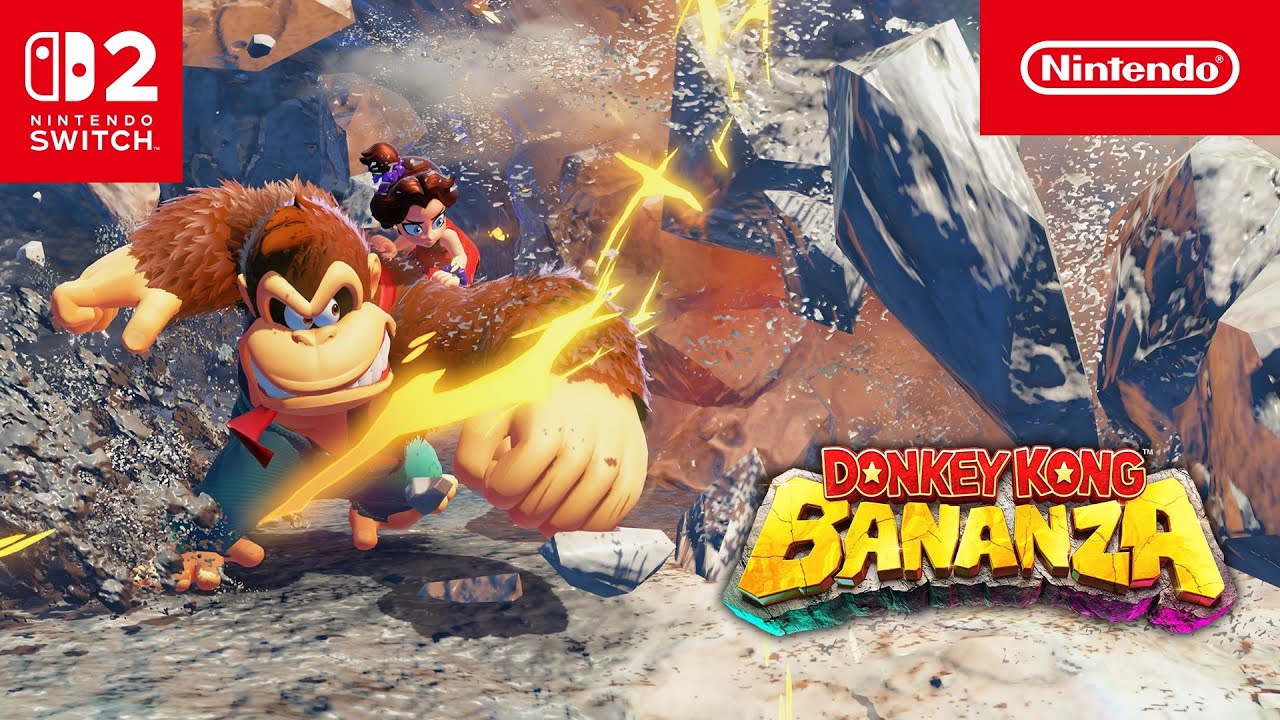
Donkey Kong Bananza makes a wonderfully reckless first impression: almost every wall looks temporary, every floor invites a downward punch and each bright layer hides rewards inside the material itself. The surprise is how quickly that freedom becomes readable rather than chaotic.
Donkey Kong Bananza review: first impressions
The opening establishes DK’s strength before adding Pauline as a companion and musical partner. Basic punches, ground strikes, tearing and throwing chunks all have immediate uses. Early layers quietly teach material rules, so breaking scenery becomes an informed search instead of random excavation.
A normal stretch alternates between following the route deeper, noticing a suspicious formation, carving a tunnel and solving a compact challenge for a Banandium Gem. Fossils and gold support customization and skills, but curiosity remains the strongest reward because the environment usually answers experimentation with something tangible.
Systems and meaningful decisions
The skill tree improves familiar verbs rather than introducing a separate management game. Pauline’s songs enable Bananza transformations that change mobility and damage, giving each form a clear environmental purpose. The strongest upgrades widen possible approaches; less exciting nodes simply make gathering or survival more forgiving.
Progression was judged by whether it changed the next decision instead of merely increasing a number. A useful unlock opens a route, answers a recurring problem or creates a new risk. Busy menus received no extra credit when the underlying choice remained obvious.
Controls, combat and feedback
DK feels heavy at impact and agile between impacts. Directional punches, climbing and terrain surfing connect cleanly enough that a failed jump rarely feels mysterious. The camera can struggle inside narrow player-made tunnels, yet the game usually lets another punch create space instead of trapping the player in bad geometry.
Failure is productive when the game supplies enough information for a better attempt. We separated setbacks caused by a readable rule or poor plan from repetition that only consumed time. Challenge can create tension without hiding responsibility for the outcome.
World and visual direction
Each underground layer has a distinct material palette, local inhabitants and structural joke. Soft soil invites tunnelling, hard surfaces redirect attention and open caverns make transformations spectacular. Destruction does not erase the art direction because landmarks and colour continue to guide the route after nearby walls collapse.
Presentation was assessed during ordinary play, not only in composed screenshots. Strong direction guides attention through colour, movement and contrast while preserving mood. A beautiful effect becomes a liability when it hides an objective, hazard or rival.
Music and sound design
Punches have a rounded, satisfying weight while crumbling terrain produces enough variation to communicate material. Pauline’s singing is mechanically linked to transformations, so music enters the movement loop rather than sitting behind it. Repeated collection sounds are bright without overwhelming dialogue.
Audio was treated as atmosphere and information. Distinct warnings, impacts and movement cues matter more over several hours than one loud set piece, although a memorable score can give repeated actions identity.
Performance and interface
Across the test window, rapid destruction occasionally made the image busier and performance less even than calm exploration, but controls remained responsive. Interface prompts are concise and maps make layer progress understandable. Automatic camera choices were the more persistent irritation, especially when tunnelling vertically.
One platform cannot represent every configuration, and later patches may change performance. We report the observed experience without promising results on untested hardware. Players with a strict accessibility or frame-rate requirement should check current platform documentation.
Learning curve
Bananza introduces one verb at a time, then asks players to combine it with the environment. Optional challenge rooms demand cleaner execution than the main path, creating a useful difficulty ladder. Younger players can make progress through persistence, while experienced players are rewarded for reading material and momentum.
The opening session was separated from later play. A system that initially feels obscure may become expressive after its vocabulary settles, while a polished tutorial can hide a loop that never develops. Essential status and resource information should remain available during play.
Pacing and replay value
The campaign keeps changing surroundings before one terrain idea grows stale. Optional gems encourage revisits, and skill choices create reasons to approach missed challenges differently. Eight hours revealed meaningful mechanical escalation without exhausting the transformation system or the density of secrets.
Replay value can come from alternate routes, builds, conversations or mastery of a fixed sequence. Those forms are not interchangeable. We credit only the structure visible in the stated hours and do not award points for an assumed endgame or promised roadmap.
Monetization and value
The reviewed base game provides a complete premium adventure without selling power inside the campaign. Separate downloadable content and later additions should be judged on their own scope. The base value comes from a dense sequence of discoveries rather than an inflated checklist.
Value was judged from the quality and repeatability of the available experience, not from a temporary discount. A compact game can justify its scope when every hour develops the idea; a larger game can still waste time through repetition.
Accessibility and practical fit
Generous recovery, clear icons and flexible terrain routes make the main journey approachable, though heavy visual motion during destruction may require adjustments for sensitive players. The game fits short sessions because individual challenges resolve quickly, yet exploration can easily stretch a planned stop.
The buying question extends beyond technical compatibility. Consider whether a normal twenty-minute stretch contains the decisions, reading, repetition and downtime you enjoy. Unedited footage of ordinary play is often a better final check than a trailer assembled from peak moments.
We compared the advertised fantasy with the action repeated between major set pieces. A score rises when ordinary minutes express the same strengths as the trailer, and falls when progress regularly depends on friction the game does not acknowledge or explain.
Limits of the 8-hour review
Eight hours covered multiple layers, several Bananza forms, boss encounters and a substantial set of optional rooms, but not the full campaign or every collectible. Late-game challenge, completion rewards and post-launch DLC are therefore outside this score.
The window was long enough to test the repeated loop across separate sessions, but not every ending, late encounter or future update. Price, discounts and online population are not treated as permanent facts.
Who should play it?
Play it if you enjoy 3D platformers, tactile exploration and worlds that reward testing the obvious boundary. Players seeking rigid obstacle courses with little deviation may find the constant digging distracting, while completionists should be ready to inspect every surface.
Donkey Kong Bananza review verdict
Nintendo turns technical spectacle into level design. Breaking the world is fun on its own, but the lasting achievement is that rubble, tunnels and transformations continually produce meaningful navigation decisions instead of serving as a short-lived visual trick.
Pros: Expressive destruction that changes navigation; Excellent movement and impact feedback; Dense optional discoveries; Distinct transformations with clear uses.
Cons: Camera can fight narrow tunnels; Busy destruction causes occasional visual clutter; Completionist play can interrupt forward momentum.
Final score: 9/10. A joyful 3D platformer where destruction creates routes instead of replacing careful exploration.
Sources: official information or tournament records. Factual claims were checked against the linked record; interpretation is our own.
Continue with the Kaizensclan archive and our practical gaming guides.
Editorial note
Hands-on review window recorded in the article metadata, supported by official documentation and public technical coverage.
This article was reviewed on August 10, 2026.

Related stories
Lost in Random The Eternal Die review: a sharper roll
Our Lost in Random The Eternal Die review tests seven hours of roguelite combat, dice powers, relic combinations and Queen Aleksandra’s escape. Read our.

Date Everything review: romance around the house
Our Date Everything review explores six hours of object romance, branching dialogue, voice performances and relationship outcomes inside one house. Read our.

MindsEye review: ambition under technical pressure
Our MindsEye review covers five hours of Jacob Diaz’s campaign, driving, third-person combat, mission scripting and technical performance. Read our verified.
Community channel
Join the discussion
Start a thoughtful, specific conversation about this story.
Verified readers only
Continue with Google to comment.
Your Google account creates a reader-only Kaizensclan profile. Your first comment is reviewed before publication.