Sword of the Sea review: movement carries the adventure
Our Sword of the Sea review covers eight hours of Hoversword movement, environmental restoration, tricks, exploration, presentation and repetition. Read the.

 8.0
8.0 Kaizensclan verdict
Our Sword of the Sea review covers eight hours of Hoversword movement, environmental restoration, tricks, exploration, presentation and repetition. Read the.
Review basis: 8 hours on PC (Steam). The score covers the systems and release build observed within that window, not a completionist playthrough.
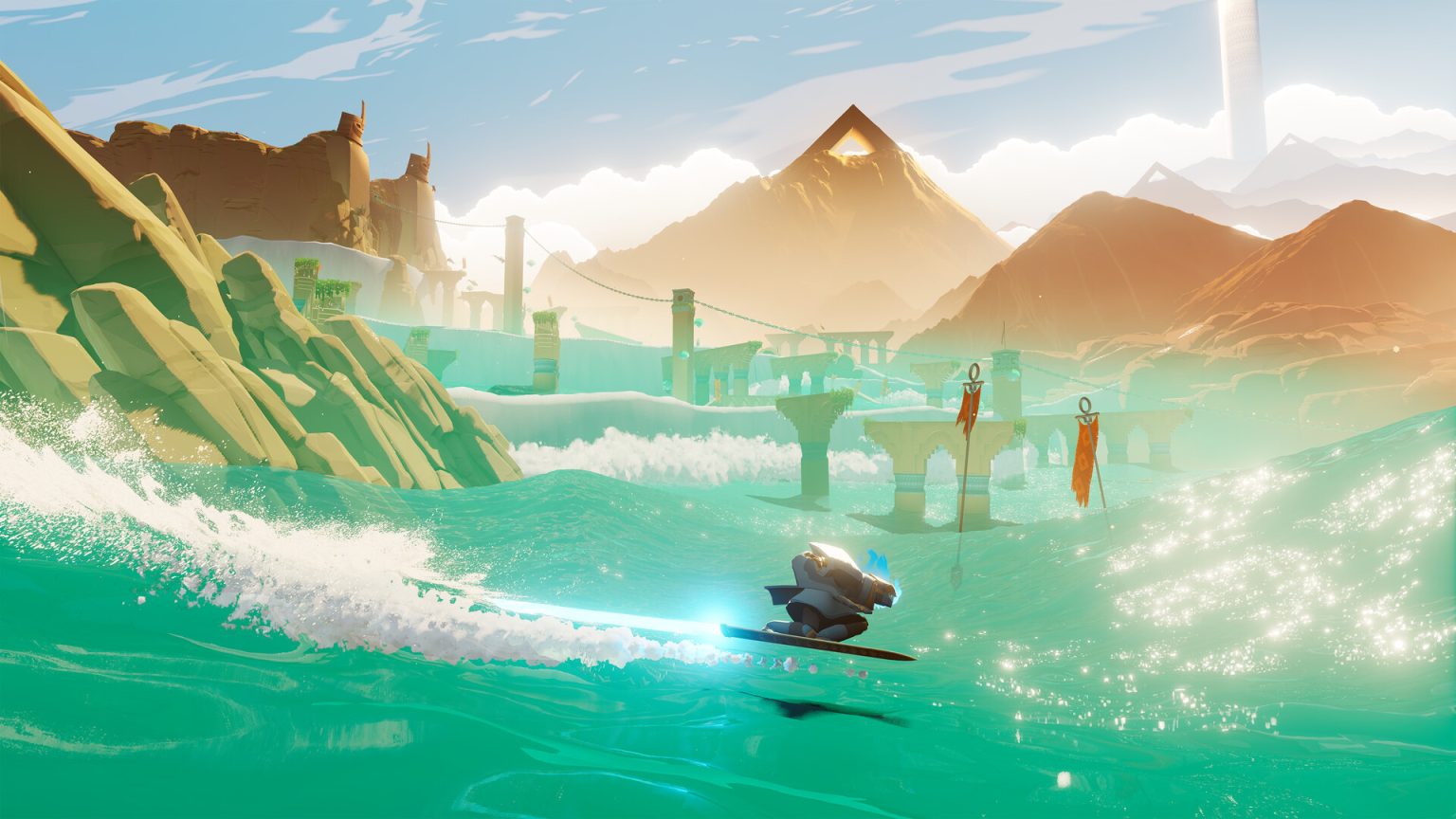
Sword of the Sea gives its resurrected Wraith a Hoversword that behaves like a snowboard, skateboard and surfboard. The journey to restore a buried ocean is familiar atmospheric-adventure territory, but the important story is written by momentum across dunes, ruins and newly returned water.
Sword of the Sea review: the opening hours
The first valley establishes carving before it explains mythology. Slopes generate speed, crests become ramps and broad walls invite a ride. Controls are approachable enough to produce a graceful line quickly, while collectibles and environmental targets encourage looking away from the obvious route.
Each region combines traversal, light exploration and acts of restoration. Releasing water transforms dead space into a brighter route and often changes the emotional tempo. Tricks add expression and some objectives, but maintaining speed through a landscape is the more durable pleasure.
Systems and meaningful decisions
The Hoversword joins acceleration, turning and aerial control into a coherent tool. Terrain is effectively level geometry and resource: a good line carries momentum into the next ramp, while a poor landing makes the player rebuild speed. Combat and puzzles appear lightly, preventing them from replacing movement as the central verb.
Progression matters when it changes the next decision instead of merely raising a number. During this review window, tools and upgrades were judged by whether they opened a route, solved a recurring problem or encouraged a different risk. Busy interfaces received no extra credit when the underlying choice stayed obvious.
Controls, challenge and feedback
Carving has enough resistance to make direction meaningful without becoming a simulation. Jumps and tricks read clearly, and recovery from a bad landing is quick. The limited difficulty means mastery is mostly self-directed; the game rarely demands an advanced line before allowing progress.
Failure is most useful when the game explains enough to support another attempt. We tracked whether setbacks revealed a readable rule, exposed a poor plan or simply demanded repetition. That distinction matters because difficulty can create tension without wasting the player’s time.
World, art and sound
Giant Squid uses monumental ruins, sweeping sand and saturated water to make restoration immediately legible. The visual lineage from ABZÛ and The Pathless is evident, sometimes to the point of familiarity. Even so, terrain built for riding gives these spaces their own function.
Austin Wintory’s score expands with speed and environmental change, helping a long descent feel authored without taking control away. Surface audio distinguishes sand, stone and water. The mix supports flow instead of filling every quiet approach.
Presentation was judged during ordinary play, not only in composed screenshots. Strong art direction guides attention through colour, motion and sound while preserving mood. A beautiful scene is less successful if objectives, hazards or interactive objects disappear inside it.
Performance and interface
The reviewed PC build maintained responsive control during high-speed traversal and broad landscape views. Performance expectations vary substantially with resolution and hardware, so players should compare the current requirements and use platform-specific reports.
One PC cannot represent every configuration, and later patches may change performance. This review reports the observed build and avoids promising results on untested hardware. Players with a specific accessibility or performance requirement should check the current platform documentation before buying.
Onboarding and learning curve
The basics are intentionally immediate. Optional shells, trick challenges and harder lines provide reasons to refine control, but the game does not bury essential movement behind a long upgrade tree. Players seeking deep scoring systems may reach the mechanical ceiling early.
The first session was separated from later sessions when judging clarity. A system that feels obscure for ten minutes may become expressive once its vocabulary settles, while an exciting tutorial can conceal a loop that never develops. Important status, objective and resource information should remain available to a new player during normal play.
Pacing and replay value
Eight hours covered the principal journey and a meaningful amount of optional exploration. The campaign benefits from not stretching every biome, although repeated restoration beats become predictable. Returning for cleaner lines and missed collectibles is pleasant rather than necessary.
Replay value can come from alternate routes, different builds, procedural incidents or the pleasure of mastering a fixed sequence. Those forms are not interchangeable. We credit only the replay structure visible during the stated hours and do not award points for an assumed endgame or future roadmap.
Accessibility and practical fit
Readable objectives and forgiving recovery make progress approachable, but constant third-person motion may affect sensitive players. Current camera, motion and controller options should be checked directly. The game communicates much of its story visually rather than through dense text.
The practical buying question is broader than technical compatibility. Consider whether a normal twenty-minute stretch contains the decisions, reading, repetition and downtime you enjoy. A trailer can accurately show the world while still hiding the cadence that occupies most of a session.
Limits of the 8-hour review
The review window covered the main movement vocabulary and late regions but not every collectible or optimal challenge score. It is sufficient to judge the repeated traversal loop, not to certify complete mastery of every line.
The window is long enough to test the repeated loop across several sessions, but it cannot certify every ending, late encounter or future update. Price, discounts and online population are not treated as permanent facts because each can change after publication.
Who should play it?
Play Sword of the Sea for expressive movement, environmental art and a compact meditative journey. Skip it if challenge, combat depth or a dense narrative is essential to your adventure games.
A score is useful only beside that audience description. Genre experience, preferred difficulty and tolerance for repetition can change the result. Watching unedited footage of normal play is a better final check than relying on a trailer built entirely from peak moments.
How the score was decided
The score combines the repeated quality of decisions, clarity of feedback, presentation, technical state and the fit between the game’s stated idea and its actual loop. One spectacular scene cannot erase recurring friction, and one awkward first hour does not outweigh a system that becomes consistently rewarding after it is understood.
Notes were compared across separate sessions to reduce the effect of novelty and fatigue. Strengths and limitations had to appear more than once before shaping the verdict.
Sword of the Sea review verdict
Sword of the Sea succeeds whenever the Hoversword converts landscape into motion. Its objectives are light and its artistic ancestry is obvious, but neither flaw changes the physical pleasure of reading a slope and carrying one clean line into the horizon.
Pros: Excellent momentum and carving; Striking environmental transformation; Clear visual direction; Austin Wintory score supports movement.
Cons: Light challenge limits tension; Trick system could develop further; Familiar artistic motifs.
Final score: 8/10. A beautiful movement game whose Hoversword supplies more joy than its light objectives.
Source: official information and published records.
Continue with our practical guides and browse more reporting in the Kaizensclan archive.
A final comparison separated the quality of the repeated play from the novelty of its first appearance. Features that remained useful across several sessions carried more weight than isolated surprises, while recurring friction counted even when each individual interruption looked minor.
Editorial note
Hands-on review window recorded in the article metadata, supported by official documentation and public technical coverage.
This article was reviewed on August 7, 2026.

Related stories
Minishoot’ Adventures review: exploration under fire
This Minishoot Adventures review finds a small ship leaving its village to free captured friends and confront corrupted machines. SoulGame Studio combines an.

Mouthwashing review: horror after the crash
This Mouthwashing review enters the Tulpar after a crash leaves five crew members with dwindling supplies and no credible rescue. Wrong Organ shifts between.
Thank Goodness You’re Here review: slapstick with purpose
This Thank Goodness You’re Here review follows a traveling salesman who arrives early for a mayoral appointment and becomes free labor for Barnsworth. Coal.
Community channel
Join the discussion
Start a thoughtful, specific conversation about this story.
Verified readers only
Continue with Google to comment.
Your Google account creates a reader-only Kaizensclan profile. Your first comment is reviewed before publication.