Skin Deep review: slapstick stealth with systemic bite
Our Skin Deep review tests five hours of Blendo Games' barefoot immersive FPS, covering stealth systems, improvised sabotage, readability and performance.

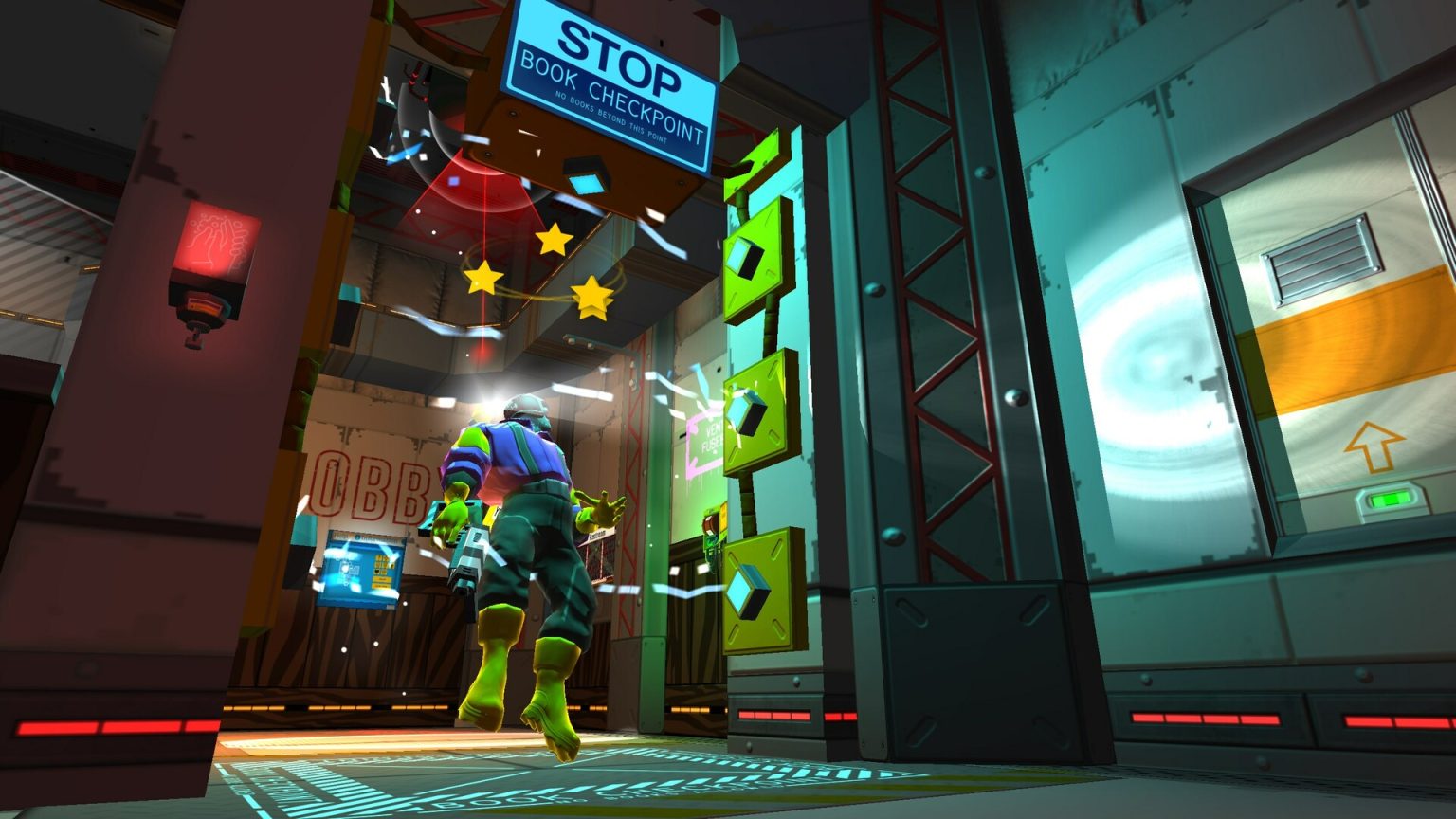 8.0
8.0 Kaizensclan verdict
Our Skin Deep review tests five hours of Blendo Games' barefoot immersive FPS, covering stealth systems, improvised sabotage, readability and performance.
Review basis: 5 hours on PC (Steam). The score covers the systems and release build observed within that window, not a completionist playthrough.
Skin Deep begins with a wonderfully practical science-fiction job: corporations freeze an insurance operative aboard cargo ships, then thaw her when pirates trigger an alarm. The result is a barefoot immersive FPS where sneezing, broken glass and explosive decompression are tactical facts rather than jokes pasted over a conventional shooter.
Skin Deep review: the opening hours
The first ship teaches through physical consequences. Glass enters bare feet, a sneeze can reveal position and an unsecured object may become a distraction or projectile. Objectives leave room for several approaches, so the tutorial is less about memorising one stealth route than learning which parts of the environment are verbs.
A typical mission asks you to move through a non-linear vessel, rescue trapped cats, disable or evade pirates and reach a clean exit. Keys, vents, pressure systems and improvised tools connect spaces. Plans frequently begin as stealth and become controlled chaos after one noise lands in the wrong corridor.
Systems and meaningful decisions
The best interactions combine. A thrown object moves a guard, an opened route changes pressure, and a hacked system turns that movement into an opportunity. Weapons exist, but limited security and vulnerable hostages discourage treating every room as an arena. The game rewards remembering what the ship can do.
Progression matters when it changes the next decision instead of merely raising a number. During this review window, tools and upgrades were judged by whether they opened a route, solved a recurring problem or encouraged a different risk. Busy interfaces received no extra credit when the underlying choice stayed obvious.
Controls, challenge and feedback
Movement and object handling feel deliberately immediate, which helps when a quiet plan collapses. Visual feedback usually explains whether a pirate heard, saw or investigated something. Comedy can make the scene look loose, but successful escape still depends on spacing and timing rather than random physics.
Failure is most useful when the game explains enough to support another attempt. We tracked whether setbacks revealed a readable rule, exposed a poor plan or simply demanded repetition. That distinction matters because difficulty can create tension without wasting the player’s time.
World, art and sound
Chunky shapes, strong colours and readable silhouettes give each ship a toy-box clarity. Corporate absurdity appears in signage, procedures and cargo rather than long lore entries. Cats provide an emotional objective without turning the tone sentimental.
Footsteps, alerts, sneezes and machinery carry useful positional information. The soundscape can become crowded during a full alarm, yet that density accurately communicates lost control. Music supports the caper tone without hiding the cues required for stealth.
Presentation was judged during ordinary play, not only in composed screenshots. Strong art direction guides attention through colour, motion and sound while preserving mood. A beautiful scene is less successful if objectives, hazards or interactive objects disappear inside it.
Performance and interface
The PC build tested smoothly during ordinary navigation and multi-system incidents. Physics-heavy scenes can create more clutter than a scripted encounter, but no repeated blocker ended a mission during the window. Settings and current hardware requirements should be checked independently.
One PC cannot represent every configuration, and later patches may change performance. This review reports the observed build and avoids promising results on untested hardware. Players with a specific accessibility or performance requirement should check the current platform documentation before buying.
Onboarding and learning curve
Skin Deep explains essential interactions and then lets combinations emerge. Players accustomed to following objective markers may initially overlook vents or environmental controls. Failure remains approachable because it demonstrates a rule that can be exploited next time.
The first session was separated from later sessions when judging clarity. A system that feels obscure for ten minutes may become expressive once its vocabulary settles, while an exciting tutorial can conceal a loop that never develops. Important status, objective and resource information should remain available to a new player during normal play.
Pacing and replay value
Compact missions suit experimentation. Replaying a ship can reveal routes and interactions missed in the first solution, while escalating security creates natural pressure. The structure is strongest in sessions where one or two missions leave enough energy to reconsider mistakes.
Replay value can come from alternate routes, different builds, procedural incidents or the pleasure of mastering a fixed sequence. Those forms are not interchangeable. We credit only the replay structure visible during the stated hours and do not award points for an assumed endgame or future roadmap.
Accessibility and practical fit
The game relies on first-person movement, spatial audio and fast reactions when stealth breaks. Players sensitive to motion should inspect camera options and unedited footage. Important states also receive visual treatment, but not every auditory cue has an identical substitute.
The practical buying question is broader than technical compatibility. Consider whether a normal twenty-minute stretch contains the decisions, reading, repetition and downtime you enjoy. A trailer can accurately show the world while still hiding the cadence that occupies most of a session.
Limits of the 5-hour review
Five hours covered several ships and repeated system combinations but not the full campaign or every late tool. The verdict describes the established mission grammar and avoids assuming that all later layouts maintain the same balance.
The window is long enough to test the repeated loop across several sessions, but it cannot certify every ending, late encounter or future update. Price, discounts and online population are not treated as permanent facts because each can change after publication.
Who should play it?
Play Skin Deep if you enjoy immersive sims, stealth that tolerates recovery and humour grounded in mechanics. Avoid it if physical comedy reads as imprecision or if you want a shooter built around a large conventional arsenal.
A score is useful only beside that audience description. Genre experience, preferred difficulty and tolerance for repetition can change the result. Watching unedited footage of normal play is a better final check than relying on a trailer built entirely from peak moments.
How the score was decided
The score combines the repeated quality of decisions, clarity of feedback, presentation, technical state and the fit between the game’s stated idea and its actual loop. One spectacular scene cannot erase recurring friction, and one awkward first hour does not outweigh a system that becomes consistently rewarding after it is understood.
Notes were compared across separate sessions to reduce the effect of novelty and fatigue. Strengths and limitations had to appear more than once before shaping the verdict.
Skin Deep review verdict
Skin Deep is funny because its world behaves consistently enough for mistakes to matter. A shard in a foot, a badly timed sneeze and a decompression plan belong to one system. That coherence turns slapstick into strategy and gives its small spaces impressive possibility.
Pros: Flexible ship layouts; Excellent improvised problem solving; Clear physical interactions; Distinct comic personality.
Cons: Busy encounters can become visually noisy; Enemy behaviour occasionally looks awkward; Barefoot hazards interrupt momentum.
Final score: 8/10. A playful stealth sandbox where physical comedy and useful systems strengthen each other.
Source: official information and published records.
Continue with our practical guides and browse more reporting in the Kaizensclan archive.
A final comparison separated the quality of the repeated play from the novelty of its first appearance. Features that remained useful across several sessions carried more weight than isolated surprises, while recurring friction counted even when each individual interruption looked minor.
Editorial note
Hands-on review window recorded in the article metadata, supported by official documentation and public technical coverage.
This article was reviewed on August 7, 2026.

Related stories
Minishoot’ Adventures review: exploration under fire
This Minishoot Adventures review finds a small ship leaving its village to free captured friends and confront corrupted machines. SoulGame Studio combines an.

Mouthwashing review: horror after the crash
This Mouthwashing review enters the Tulpar after a crash leaves five crew members with dwindling supplies and no credible rescue. Wrong Organ shifts between.
Thank Goodness You’re Here review: slapstick with purpose
This Thank Goodness You’re Here review follows a traveling salesman who arrives early for a mayoral appointment and becomes free labor for Barnsworth. Coal.
Community channel
Join the discussion
Start a thoughtful, specific conversation about this story.
Verified readers only
Continue with Google to comment.
Your Google account creates a reader-only Kaizensclan profile. Your first comment is reviewed before publication.