Eriksholm: The Stolen Dream Review
Our Eriksholm: The Stolen Dream review covers six hours of isometric stealth, character switching and a tightly authored search for Herman. Read the verified.

 8.1
8.1 Kaizensclan verdict
Our Eriksholm: The Stolen Dream review covers six hours of isometric stealth, character switching and a tightly authored search for Herman. Read the verified.
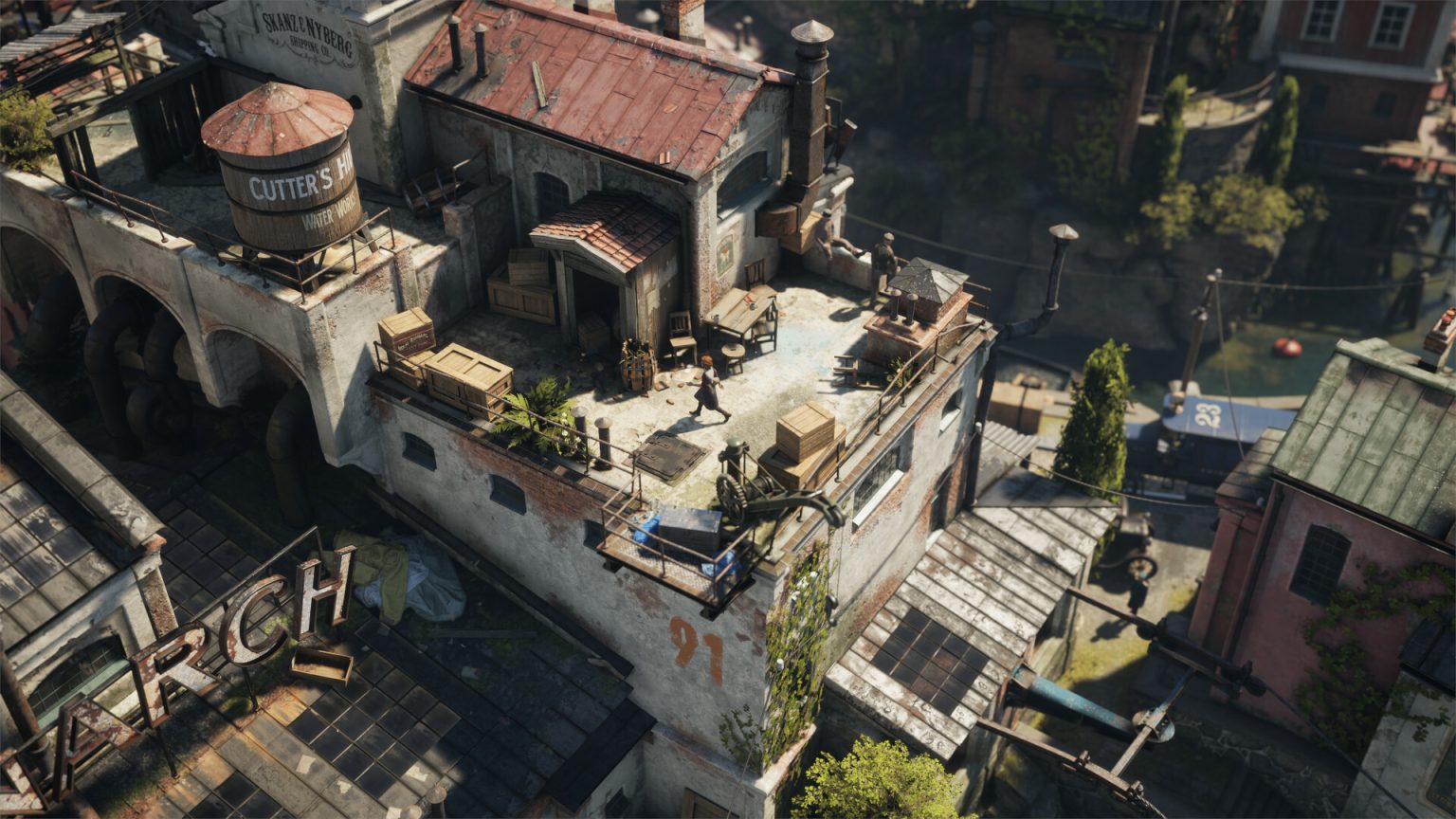
Eriksholm: The Stolen Dream follows Hanna after her brother Herman disappears and the city’s authorities begin pursuing her. River End Games uses an isometric camera, detailed urban spaces and multiple playable characters to turn the search into a sequence of stealth puzzles with strong narrative momentum.
What the first 6 hours cover
Six hours covered the introduction of the core cast, several large stealth spaces and repeated character-switching puzzles. The tested window is long enough to judge guard readability and the structure of solutions, but it does not include the complete story or every late-game combination.
Hanna begins without the power to fight through patrols. She hides, observes vision cones and uses the environment to move through controlled streets and interiors. The vulnerability fits the story and teaches the game’s grammar quickly: information comes before movement, and a clean route is more important than speed.
Core loop and decision-making
Each area presents patrol timing, hiding places, vertical connections and interactable distractions. New companions add abilities that can solve different parts of the same space. Switching characters turns a route into cooperation: one person creates an opening while another uses it, often from a separate elevation.
Eriksholm offers more flexibility than a single-solution puzzle, but it is not a broad immersive simulation. The level design usually guides the player toward a small set of intended interactions. Satisfaction comes from reading and sequencing those tools cleanly rather than inventing a completely unsupported tactic.
Progression and structure
Abilities arrive through the cast instead of a conventional skill tree. That keeps progression tied to character and prevents grinding from bypassing a puzzle. It also means a player who dislikes one tool cannot replace it with a build; the authored solution expects the team’s particular capabilities.
Narrative scenes and stealth spaces alternate at a deliberate pace. The mystery gives every restricted district a reason to enter, and environmental detail communicates class, industry and control without stopping for exposition. Linear progression protects pacing but limits the desire to replay for radically different routes.
Controls and difficulty
Pointing movement through an isometric scene is accurate, and the interface communicates valid targets and danger. Camera composition usually keeps patrol information visible. In dense corners, selecting a precise destination can require extra care because foreground detail and walkable space overlap.
Detection rules are consistent enough that failure normally identifies a missed guard, sound or timing. Restarts are quick and checkpoints respect the puzzle structure. Stealth veterans may solve the intended language rapidly, but later multi-character sequences increase planning load without relying on arbitrary enemy awareness.
Art, sound and world-building
Eriksholm is exceptionally composed. Industrial streets, interiors and water create a grounded alternate-history city, while lighting directs attention without painting every answer in bright colour. Close character work survives the distant camera through strong animation and cinematics.
The city feels governed rather than merely decorated. Patrols, architecture and social boundaries support the plot’s pressure, and Hanna’s search has personal urgency before the conspiracy expands. Voice performances keep the cast human inside spaces designed with almost architectural precision.
Performance and interface
The PC build ran consistently at the selected settings during testing. Subtitle and objective presentation remained clear, and loading after failure was short enough to support experimentation. The highly detailed art can make small interactables less immediate until the player learns the visual language.
Session rhythm and replay value
A good review window needs to distinguish novelty from a loop that remains interesting after its rules are familiar. We therefore returned to ordinary activities after their first tutorial and compared how much attention the repeated version demanded. Repetition is not automatically a weakness: it can create mastery, comfort or strategic planning. It becomes friction when the same input produces no new information, meaningful execution or useful choice.
Replay value depends on the structure of Eriksholm: The Stolen Dream Review. Alternate routes, builds, procedural incidents, job combinations or simply a strong authored atmosphere can all support another session, but they are not interchangeable. This review credits the forms of replay visible during testing and does not assume that unseen endgame content will solve an early limitation. A future patch may expand the game, yet the score belongs to the released experience played here.
Narrative, agency and consequences
Story was evaluated by how well it motivates the next action and whether characters respond consistently to the world around them. Agency does not require every scene to branch. A linear game can still make the player responsible for observation and execution, while an open game can offer many icons without meaningful decisions. The relevant question is whether the structure clearly communicates what the player controls and then gives those choices an appropriate consequence.
This review was completed across more than one session so that the score did not depend on the excitement of a single opening hour. Repeated actions were checked for consistency, feedback and recovery cost. A system earned credit when it created a meaningful choice after the tutorial had ended, not simply because its menu contained many options.
The stated playtime is enough to evaluate the opening contract, several repeated loops and the reliability of the basic controls. It is not enough to claim complete knowledge of every late-game build, route or ending. Where a system was visible but not properly tested, it was excluded from the verdict instead of being treated as guaranteed depth.
Difficulty was judged through clarity as well as challenge. A demanding encounter can be fair when the game communicates cause and consequence, while an easy sequence can still be frustrating when objectives or controls are inconsistent. Previous experience with the genre changes the learning curve, so the audience description should be read beside the numerical score.
Accessibility and comfort settings were considered within the tested PC build, but individual needs differ. Players who require a specific subtitle, colour, remapping, field-of-view or motion option should check the current official store information before buying. Patches can improve technical behaviour after this review date.
Price, discounts and online population are intentionally not used as permanent facts. Those values change. The durable question is whether the released mechanics and authored content support the kind of play the reader wants. Roadmaps were not scored; only features present in the tested build affected the verdict.
Who will enjoy it
Play it for authored stealth, clear cooperation puzzles and a city built with unusual visual confidence. Players seeking systemic chaos, combat improvisation or a sandbox with many unscripted solutions should expect a more directed experience.
Pros and cons
Pros
- Excellent isometric level composition
- Character switching creates layered puzzles
- Strong world-building and performances
Cons
- Solutions can feel tightly prescribed
- Limited build or combat expression
- Dense scenes occasionally hide small interactions
Verdict after 6 hours
Eriksholm succeeds by knowing what kind of stealth game it is. It does not pretend every guard can be approached through dozens of systems; it builds elegant spaces around a focused set of tools. Six hours show consistent rules, careful pacing and enough character-driven variation to make its linearity feel intentional rather than restrictive.
This assessment covers 6 hours on PC. Release facts and advertised features were checked against the publisher’s official store materials; the score reflects the experience inside that declared window.
Source: official release information.
Read more in our practical guides and browse the Kaizensclan article archive.
Editorial note
Hands-on review window recorded in the article metadata, supported by official documentation and public technical coverage.
This article was reviewed on August 7, 2026.

Related stories

Indiana Jones and the Great Circle review: hands-on archaeology
MachineGames understands that Indiana Jones is compelling because he is curious, fallible and quick enough to improvise when a plan collapses. The Great Circl.

Minishoot’ Adventures review: exploration under fire
This Minishoot Adventures review finds a small ship leaving its village to free captured friends and confront corrupted machines. SoulGame Studio combines an.

Mouthwashing review: horror after the crash
This Mouthwashing review enters the Tulpar after a crash leaves five crew members with dwindling supplies and no credible rescue. Wrong Organ shifts between.
Community channel
Join the discussion
Start a thoughtful, specific conversation about this story.
Verified readers only
Continue with Google to comment.
Your Google account creates a reader-only Kaizensclan profile. Your first comment is reviewed before publication.