The Precinct Review
Our The Precinct review covers seven hours of patrols, arrests, investigations and vehicle pursuits inside its neon-noir police sandbox. Read the verified.

 7.7
7.7 Kaizensclan verdict
Our The Precinct review covers seven hours of patrols, arrests, investigations and vehicle pursuits inside its neon-noir police sandbox. Read the verified.
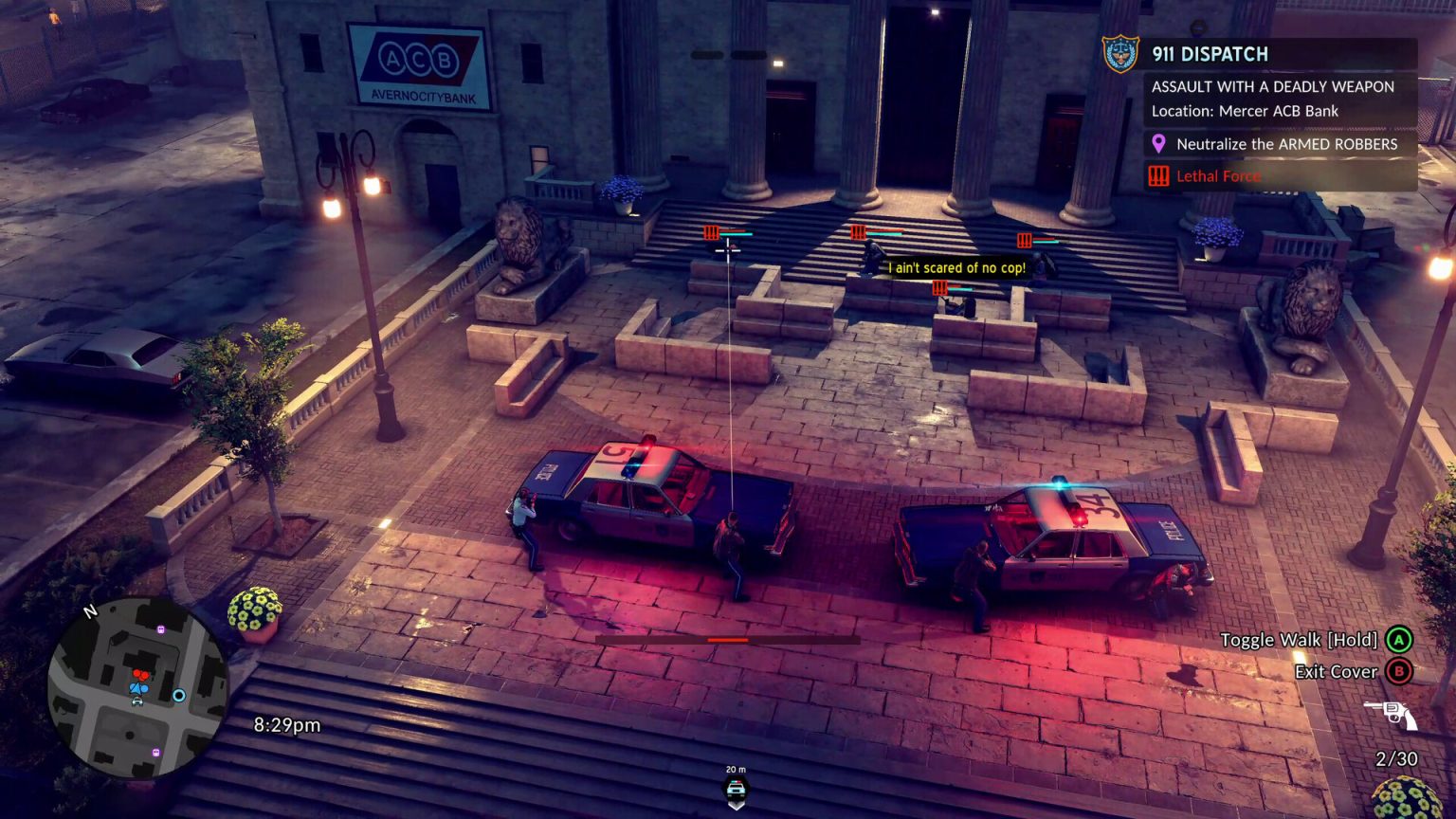
The Precinct casts the player as rookie officer Nick Cordell Jr. in Averno City, 1983. Its isometric streets combine scheduled shifts, procedural crimes, traffic enforcement, gunfights and an investigation into the death of Nick’s father. The result sits between arcade action and police procedure rather than committing completely to either.
What the first 7 hours cover
Seven hours included foot and vehicle patrols, traffic stops, arrests, evidence handling, support calls and several story missions. That window reveals the basic rhythm and the way procedural incidents repeat, but it does not complete the central conspiracy or every district progression tier.
The tutorial explains legal grounds and arrest steps through controlled incidents before the city begins generating its own calls. Early patrols make small violations meaningful because the player must observe, check identification and decide whether evidence supports a search or charge. The fantasy works when procedure creates anticipation rather than paperwork.
Core loop and decision-making
A shift begins with an assignment, but radio calls and visible offences constantly interrupt the route. The player can pursue a dangerous driver, respond to a robbery, request transport or return to a quieter ticket. This layered interruption is the game’s best system because a simple stop can escalate without requiring a scripted mission.
The decision model is broad but not legally exhaustive. Correct charges improve performance, while unsupported actions reduce the shift rating. Backup tools let the player call patrol cars, roadblocks and other help, so the sandbox rewards delegation. Repeated interface steps can become automatic once the same offence appears several times.
Progression and structure
Experience unlocks additional equipment, support capabilities and assignments. The curve gives patrols a practical reward without turning Nick into a superhero. New tools widen response options, although the underlying arrest sequence changes less than the city around it. Progress feels strongest when it reduces friction or enables a new pursuit tactic.
Procedural calls sit beside authored gang investigations and personal story beats. The combination prevents shifts from feeling completely random, but it also exposes tonal seams: an urgent conspiracy mission may be followed by an ordinary parking offence. Players comfortable creating their own patrol rhythm will accept that contrast more easily.
Controls and difficulty
On-foot aiming and interaction are readable from the isometric camera, and driving favours an arcade response over simulation weight. High-speed chases can become visually crowded around traffic and street furniture. The support menu is powerful, but selecting the right response under pressure takes more interface attention than the action sometimes allows.
Most failures come from escalation rather than enemy durability. A missed turn extends a chase, an unsupported search hurts the rating, and poor positioning turns an arrest into a firefight. The game is forgiving enough to preserve momentum, yet its systems are at their best when the player follows process instead of treating every call as a shooter encounter.
Art, sound and world-building
Averno City’s rain, neon and brickwork sell a stylised 1980s setting without hiding street information. The isometric camera makes city blocks resemble an active model railway, especially when several emergency vehicles converge. Radio chatter and sirens provide strong texture even when individual lines repeat.
Day, weather and traffic make familiar routes feel less static. Pedestrians and incidents give districts activity, though the simulation becomes easier to read as a collection of generators after several shifts. The mystery provides direction, but the city’s ordinary interruptions are the more durable attraction.
Performance and interface
The PC build remained playable through the review window, with occasional traffic and collision oddities during crowded pursuits. Interface text and objectives were readable, and controller input suited driving. Minor systemic glitches matter because the game asks the player to trust cause and consequence.
Session rhythm and replay value
A good review window needs to distinguish novelty from a loop that remains interesting after its rules are familiar. We therefore returned to ordinary activities after their first tutorial and compared how much attention the repeated version demanded. Repetition is not automatically a weakness: it can create mastery, comfort or strategic planning. It becomes friction when the same input produces no new information, meaningful execution or useful choice.
Replay value depends on the structure of The Precinct Review. Alternate routes, builds, procedural incidents, job combinations or simply a strong authored atmosphere can all support another session, but they are not interchangeable. This review credits the forms of replay visible during testing and does not assume that unseen endgame content will solve an early limitation. A future patch may expand the game, yet the score belongs to the released experience played here.
Narrative, agency and consequences
Story was evaluated by how well it motivates the next action and whether characters respond consistently to the world around them. Agency does not require every scene to branch. A linear game can still make the player responsible for observation and execution, while an open game can offer many icons without meaningful decisions. The relevant question is whether the structure clearly communicates what the player controls and then gives those choices an appropriate consequence.
This review was completed across more than one session so that the score did not depend on the excitement of a single opening hour. Repeated actions were checked for consistency, feedback and recovery cost. A system earned credit when it created a meaningful choice after the tutorial had ended, not simply because its menu contained many options.
The stated playtime is enough to evaluate the opening contract, several repeated loops and the reliability of the basic controls. It is not enough to claim complete knowledge of every late-game build, route or ending. Where a system was visible but not properly tested, it was excluded from the verdict instead of being treated as guaranteed depth.
Difficulty was judged through clarity as well as challenge. A demanding encounter can be fair when the game communicates cause and consequence, while an easy sequence can still be frustrating when objectives or controls are inconsistent. Previous experience with the genre changes the learning curve, so the audience description should be read beside the numerical score.
Accessibility and comfort settings were considered within the tested PC build, but individual needs differ. Players who require a specific subtitle, colour, remapping, field-of-view or motion option should check the current official store information before buying. Patches can improve technical behaviour after this review date.
Price, discounts and online population are intentionally not used as permanent facts. Those values change. The durable question is whether the released mechanics and authored content support the kind of play the reader wants. Roadmaps were not scored; only features present in the tested build affected the verdict.
Who will enjoy it
It fits players who enjoy making stories from procedural calls, enforcing small rules and watching a quiet patrol become a chase. Anyone seeking a strict legal simulator or a dense open-world crime epic should expect a lighter, more repetitive hybrid.
Pros and cons
Pros
- Atmospheric and readable isometric city
- Procedural calls create memorable escalation
- Useful backup and pursuit systems
Cons
- Arrest routines become repetitive
- Traffic and collision behaviour can be rough
- Story and patrol tones do not always align
Verdict after 7 hours
The Precinct understands that the patrol fantasy depends on uncertainty between routine and danger. Its best shifts create that uncertainty naturally, while weaker stretches repeat the same custody steps with different suspects. Seven hours show a lively, attractive sandbox with enough systemic interaction to recommend, provided repetition is part of the expected job.
This assessment covers 7 hours on PC. Release facts and advertised features were checked against the publisher’s official store materials; the score reflects the experience inside that declared window.
Source: official release information.
Read more in our practical guides and browse the Kaizensclan article archive.
Editorial note
Hands-on review window recorded in the article metadata, supported by official documentation and public technical coverage.
This article was reviewed on August 7, 2026.

Related stories

Minishoot’ Adventures review: exploration under fire
This Minishoot Adventures review finds a small ship leaving its village to free captured friends and confront corrupted machines. SoulGame Studio combines an.

Mouthwashing review: horror after the crash
This Mouthwashing review enters the Tulpar after a crash leaves five crew members with dwindling supplies and no credible rescue. Wrong Organ shifts between.
Thank Goodness You’re Here review: slapstick with purpose
This Thank Goodness You’re Here review follows a traveling salesman who arrives early for a mayoral appointment and becomes free labor for Barnsworth. Coal.
Community channel
Join the discussion
Start a thoughtful, specific conversation about this story.
Verified readers only
Continue with Google to comment.
Your Google account creates a reader-only Kaizensclan profile. Your first comment is reviewed before publication.