Killing Floor 3 Review: Co-op Under Pressure
Our Killing Floor 3 review covers five hours of co-op survival, examining gun feel, specialist roles, Zed behavior, progression and launch-period friction.

 7.0
7.0 Kaizensclan verdict
Our Killing Floor 3 review covers five hours of co-op survival, examining gun feel, specialist roles, Zed behavior, progression and launch-period friction.
Killing Floor 3 keeps the series’ essential proposition intact: a squad enters a compact arena, survives escalating Zed waves, buys equipment and hopes its economy is strong enough for the boss. Its modernization is most visible in movement, enemy behavior and specialist identity.
First 5 hours
The first matches are immediately legible to returning players. Weak enemies establish rhythm, larger specimens force target priority, and the trader phase turns accuracy into purchasing power. New movement options make arenas less static, but escape still depends on teammates clearing space rather than one player vaulting forever.
Five hours covered several specialists, weapon tiers and difficulty settings. Each wave asks the team to balance ammunition, armor and upgrades against future pressure. The loop remains strong because mistakes have an economic afterlife: an expensive death can weaken the following wave even after a successful recovery.
Systems and progression
Specialists combine passive bonuses, gadgets and skill choices with preferred weapons. Their identity is clearer than a completely open class, though early progression limits how quickly a player can test alternative configurations. Shared fundamentals still matter: lane coverage, ammunition discipline and focus fire carry more matches than a clever isolated build.
Experience unlocks options over time, providing direction but also making the opening hours feel narrower than the full design. Weapon modifications offer useful tuning, yet the immediate pleasure remains buying a gun that changes the sound and force of the next wave. Long-term depth will depend on balance and content support.
Combat, control and difficulty
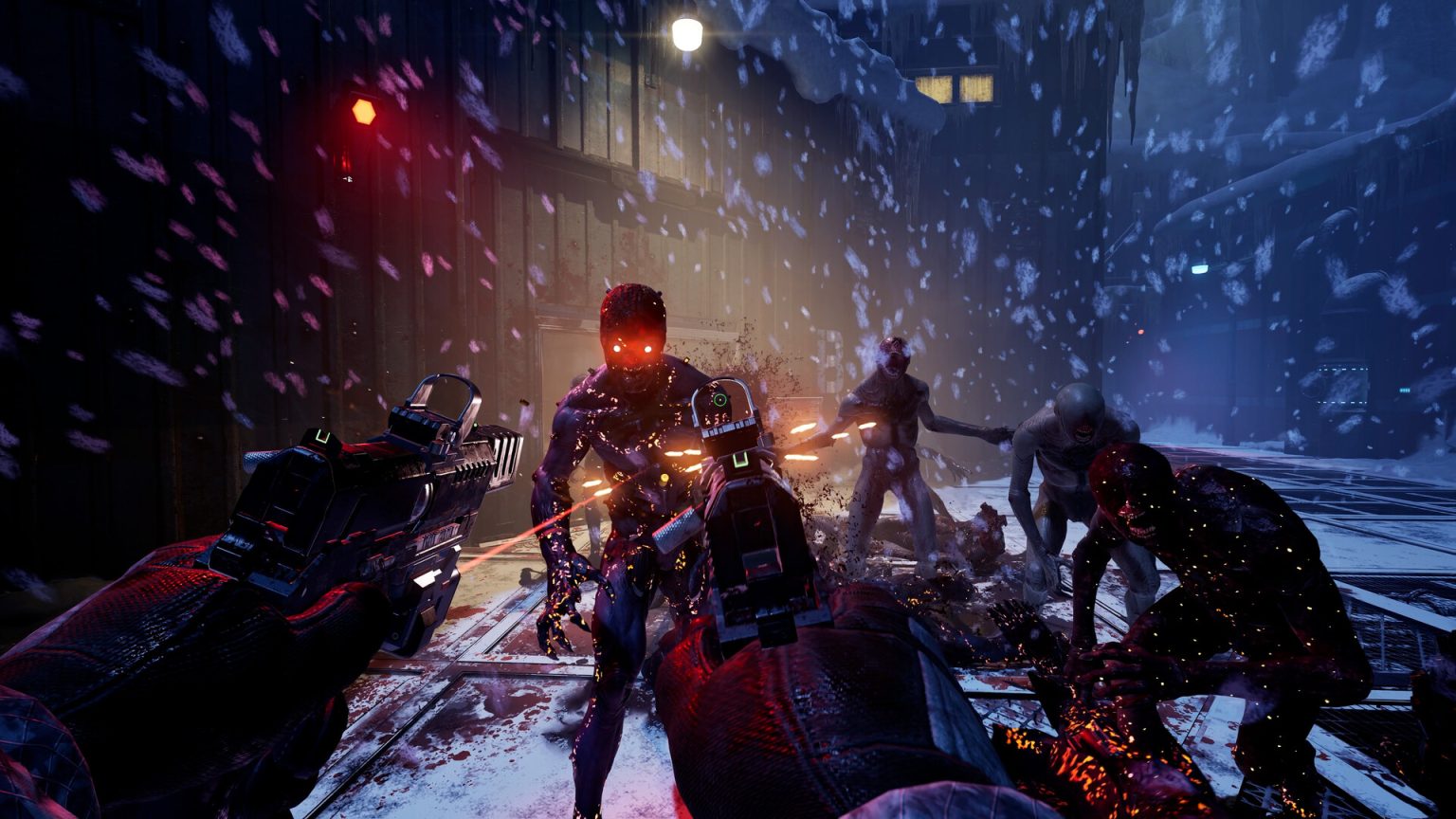
Weapons kick, crack and dismember with the impact expected from Killing Floor. Zeds climb and approach from more angles, making complacent firing lines less reliable. The most exciting moments occur when the formation bends without breaking and players rotate their attention from a high-value target to a collapsing flank.
Sprinting, sliding and mantling make repositioning smoother, while aiming remains direct. Visual effects can become dense when several abilities and heavy enemies overlap, so threat recognition occasionally suffers. Communication is especially important because mobility may separate a panicked player from healing and covering fire.
World, presentation and performance
Industrial and research spaces provide readable loops, elevation changes and choke points. They serve combat well, though the early selection cannot sustain surprise indefinitely. Environmental storytelling is secondary to navigation, and the best maps clearly communicate where a team can retreat before the corridor becomes lethal.
Online performance was generally playable in the review window, but live co-op quality depends on region, host conditions and future patches. The PC release lists cross-platform online co-op and uses Easy Anti-Cheat. Players sensitive to account systems or kernel-level anti-cheat should review current requirements before purchase.
Onboarding and learning curve
Killing Floor 3 Review: Co-op Under Pressure introduces its ideas through the normal play loop rather than assuming immediate mastery. During this review window, the useful measure was how often a failed attempt taught a transferable lesson. Clear feedback makes experimentation productive; unclear feedback makes the same repetition feel arbitrary. The game is strongest when a new system changes the next decision instead of adding another menu notification.
Familiarity with the co-op survival fps genre shortens the adjustment period, but it should not be confused with quality. We judged whether controls, objectives and consequences were communicated consistently. Tutorials can explain buttons; the design still has to show why and when those buttons matter.
Pacing and decision density
A useful hour is not necessarily an hour packed with rewards. Strong pacing alternates pressure with enough quiet time to understand a place, compare options or prepare the next attempt. Killing Floor 3 Review: Co-op Under Pressure is most convincing when its slower passages create context for the following decision. It is less convincing when travel, repeated setup or interface work delays a choice whose answer is already obvious.
The stated playtime is long enough to evaluate the opening contract and several repeated loops, but not enough to promise that late-game balance follows the same pattern. We therefore avoided projecting an early upgrade curve across the entire campaign. Where later systems are visible but not properly tested, they remain outside the score rather than being treated as guaranteed depth.
Accessibility and player fit
Readable text, remappable controls, subtitle presentation and adjustable audiovisual settings can determine whether a player reaches the design at all. Available options were considered alongside the moment-to-moment experience, although individual access needs differ. Anyone relying on a specific feature should verify the current platform build and official accessibility information before purchasing.
The clearest audience for Killing Floor 3 Review: Co-op Under Pressure is a player who values forceful weapon feedback and can tolerate progression starts slowly. Someone seeking a different pace or structure may reasonably reach another conclusion even if every system works as intended. A review score summarizes that balance; it does not replace the audience description.
Replay value and longer-term outlook
Replay value can come from alternate choices, improved execution, cooperative variation or simply the pleasure of revisiting a well-made space. The first 5 hours show whether the core loop supports repetition, but live updates and undiscovered content can change its durability. We do not award points for a roadmap. The verdict is based on the released experience tested here.
Price and online population can change after publication, so neither is presented as a permanent fact. The durable buying question is whether the current mechanics and authored content justify a place in the reader’s rotation. Technical fixes may improve friction later, but they should be confirmed in patch notes rather than assumed.
What works
Gun feedback, enemy pressure and the trader economy still create an excellent cooperative pulse. Specialists give squads reasons to coordinate, while more mobile Zeds prevent every defense from becoming a stationary firing gallery.
What holds it back
The first hours expose repetition before progression opens enough alternatives. Match variety depends heavily on map knowledge, difficulty and teammates, and spectacle can obscure priority targets. The foundation feels stronger than the initial breadth built on top of it.
Verdict after 5 hours
Killing Floor 3 is easiest to recommend to a regular group that enjoys refining wave survival. Five hours showed a dependable, physical shooter with meaningful co-op roles. Solo queue players may want broader content and progression before the loop reaches the longevity associated with the series.
This assessment covers a focused 5-hour review window on PC. It is an early-game verdict, not a claim to have exhausted every route, build or endgame system. The release facts were checked against the publisher’s official store materials, while the score reflects the experience available within that stated window.
Continue with our practical guides and follow the latest stories in the Kaizensclan archive.
Editorial checks and boundaries
We compared the repeated experience across more than one session instead of scoring the excitement of a single opening hour. Novelty can disguise friction, while early confusion can disappear once a control pattern becomes familiar. Notes focused on the decisions repeated most often, the clarity of feedback and the cost of recovering from an error. Those observations support the verdict more reliably than isolated visual highlights.
No review window can reproduce every hardware configuration or player history. Platform, input method and prior genre knowledge can alter the result. The score therefore belongs beside the stated 5-hour scope, strengths and limitations. Readers should use all four pieces together when deciding whether the game matches their priorities.
Editorial note
Hands-on review window recorded in the article metadata, supported by official documentation and public technical coverage.
This article was reviewed on August 7, 2026.

Related stories

Minishoot’ Adventures review: exploration under fire
This Minishoot Adventures review finds a small ship leaving its village to free captured friends and confront corrupted machines. SoulGame Studio combines an.

Mouthwashing review: horror after the crash
This Mouthwashing review enters the Tulpar after a crash leaves five crew members with dwindling supplies and no credible rescue. Wrong Organ shifts between.
Thank Goodness You’re Here review: slapstick with purpose
This Thank Goodness You’re Here review follows a traveling salesman who arrives early for a mayoral appointment and becomes free labor for Barnsworth. Coal.
Community channel
Join the discussion
Start a thoughtful, specific conversation about this story.
Verified readers only
Continue with Google to comment.
Your Google account creates a reader-only Kaizensclan profile. Your first comment is reviewed before publication.