RoadCraft Review: Heavy Work, Real Satisfaction
Our RoadCraft review covers six hours of rebuilding routes with heavy machinery, examining terrain simulation, logistics, co-op potential and mission pacing.

 7.5
7.5 Kaizensclan verdict
Our RoadCraft review covers six hours of rebuilding routes with heavy machinery, examining terrain simulation, logistics, co-op potential and mission pacing.
RoadCraft applies Saber Interactive’s terrain technology to recovery work rather than wilderness survival. Its satisfaction comes from making a broken route dependable: clearing debris, reshaping ground, laying material and watching supply traffic finally pass.
First 6 hours
The first contracts teach a language of weight and preparation. A vehicle can reach the objective and still be the wrong tool, while a careless turn may ruin freshly levelled ground. The pace feels slow until the player begins reading each site as a chain of dependencies.
During six hours, the loop expanded from operating one machine to coordinating a small fleet. Scouting identifies obstacles, loaders and cranes clear them, specialized equipment prepares the surface, and transport routes test whether the repair is genuinely usable. Each completed link unlocks more efficient movement across the region.
Systems and progression
Terrain deformation matters at wheel level. Ruts, slopes and loose material affect traction, so a visually flat path may still fail under a loaded truck. Vehicle recovery tools provide insurance, but planning a stable approach is faster than repeatedly rescuing a machine from a self-created trap.
New vehicles broaden the available solutions rather than functioning as simple power upgrades. The useful question is not which machine has the highest number, but which attachment, turning radius and load profile fits the current site. That makes the garage feel like a working toolkit.
Combat, control and difficulty
There is no combat; difficulty comes from mass, geometry and sequence. Moving a heavy object safely can demand more concentration than an action encounter because a rushed correction compounds the problem. The simulation is forgiving enough to experiment but firm enough that preparation saves real time.
Driving has believable inertia and each vehicle asks for a slightly different rhythm. The camera is generally informative in open areas, yet can become awkward near structures or when a long vehicle reverses into a narrow approach. Rebinding and sensitivity adjustment help, but spatial awareness remains part of the challenge.
World, presentation and performance
Disaster-damaged regions communicate the purpose of the work without turning every objective into spectacle. Mud, broken bridges and abandoned industrial spaces create varied operating conditions. The strongest visual moment is often modest: normal traffic moving through a place that was inaccessible an hour earlier.
Performance was stable during the review window, though large work sites and complex terrain are the obvious stress points. RoadCraft supports solo play and online co-op, including cross-platform functionality listed by the publisher. Co-op should shorten repetitive transport, provided the group agrees on roles.
Onboarding and learning curve
RoadCraft Review: Heavy Work, Real Satisfaction introduces its ideas through the normal play loop rather than assuming immediate mastery. During this review window, the useful measure was how often a failed attempt taught a transferable lesson. Clear feedback makes experimentation productive; unclear feedback makes the same repetition feel arbitrary. The game is strongest when a new system changes the next decision instead of adding another menu notification.
Familiarity with the construction and driving simulation genre shortens the adjustment period, but it should not be confused with quality. We judged whether controls, objectives and consequences were communicated consistently. Tutorials can explain buttons; the design still has to show why and when those buttons matter.
Pacing and decision density
A useful hour is not necessarily an hour packed with rewards. Strong pacing alternates pressure with enough quiet time to understand a place, compare options or prepare the next attempt. RoadCraft Review: Heavy Work, Real Satisfaction is most convincing when its slower passages create context for the following decision. It is less convincing when travel, repeated setup or interface work delays a choice whose answer is already obvious.
The stated playtime is long enough to evaluate the opening contract and several repeated loops, but not enough to promise that late-game balance follows the same pattern. We therefore avoided projecting an early upgrade curve across the entire campaign. Where later systems are visible but not properly tested, they remain outside the score rather than being treated as guaranteed depth.
Accessibility and player fit
Readable text, remappable controls, subtitle presentation and adjustable audiovisual settings can determine whether a player reaches the design at all. Available options were considered alongside the moment-to-moment experience, although individual access needs differ. Anyone relying on a specific feature should verify the current platform build and official accessibility information before purchasing.
The clearest audience for RoadCraft Review: Heavy Work, Real Satisfaction is a player who values tactile terrain work and can tolerate slow early pacing. Someone seeking a different pace or structure may reasonably reach another conclusion even if every system works as intended. A review score summarizes that balance; it does not replace the audience description.
Replay value and longer-term outlook
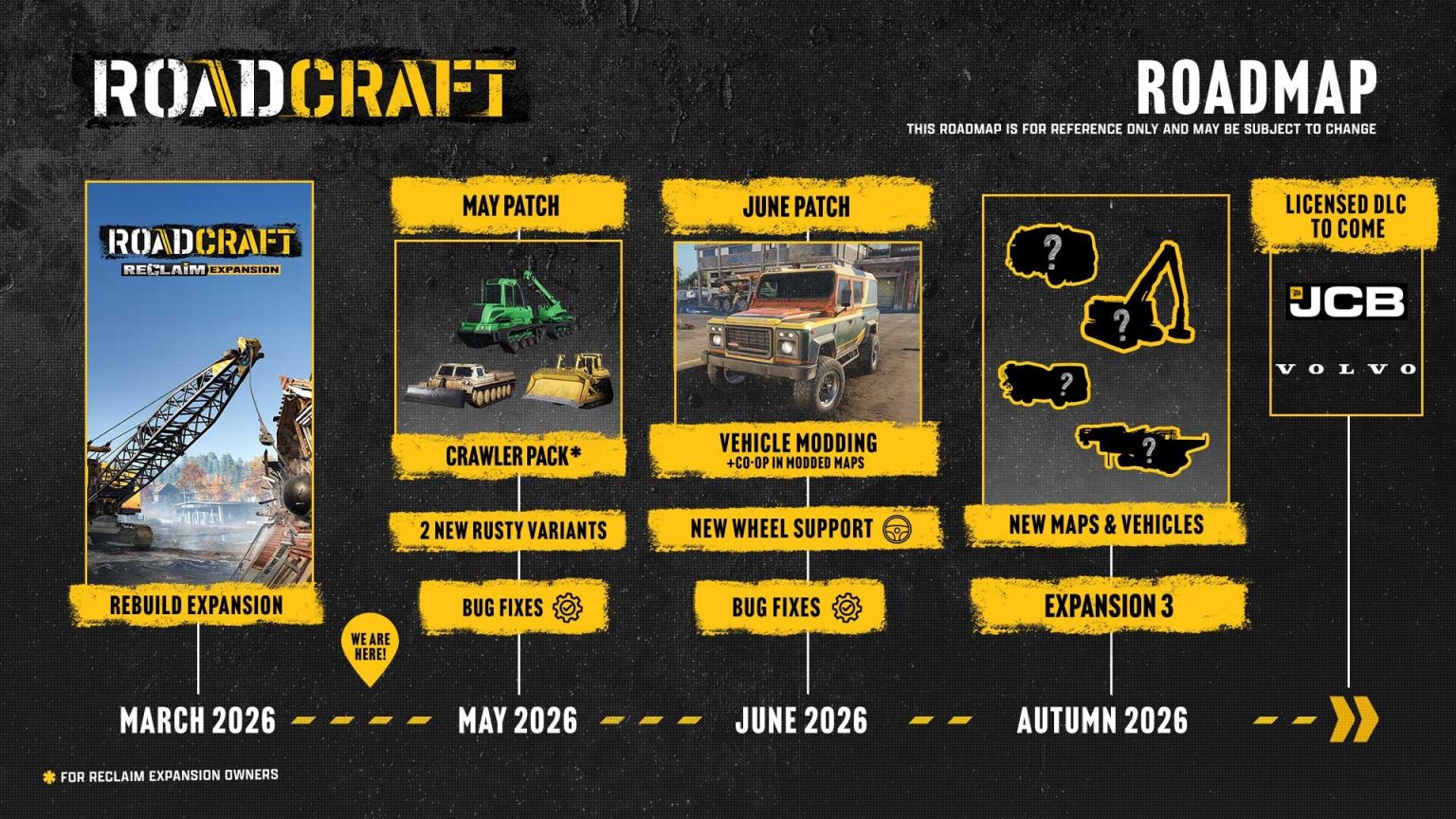
Replay value can come from alternate choices, improved execution, cooperative variation or simply the pleasure of revisiting a well-made space. The first 6 hours show whether the core loop supports repetition, but live updates and undiscovered content can change its durability. We do not award points for a roadmap. The verdict is based on the released experience tested here.
Price and online population can change after publication, so neither is presented as a permanent fact. The durable buying question is whether the current mechanics and authored content justify a place in the reader’s rotation. Technical fixes may improve friction later, but they should be confirmed in patch notes rather than assumed.
What works
Few games make infrastructure feel this tangible. A repaired road changes future jobs, so patient work creates its own convenience. The machinery is varied, the terrain communicates mistakes clearly, and logistics gives every pile of material a reason to exist.
What holds it back
The deliberate pace can become repetition when a task requires several similar journeys. Camera friction and long resets are most noticeable after a small error. Players looking for SnowRunner-style open-ended hauling may also need time to adjust to the stronger construction focus.
Verdict after 6 hours
RoadCraft is at its best when a complicated site becomes routine because the player understood it. Six hours revealed a thoughtful simulation with a narrow but convincing fantasy. It will reward patient co-op crews and solo planners more than anyone seeking constant novelty.
This assessment covers a focused 6-hour review window on PC. It is an early-game verdict, not a claim to have exhausted every route, build or endgame system. The release facts were checked against the publisher’s official store materials, while the score reflects the experience available within that stated window.
Continue with our practical guides and follow the latest stories in the Kaizensclan archive.
Editorial checks and boundaries
We compared the repeated experience across more than one session instead of scoring the excitement of a single opening hour. Novelty can disguise friction, while early confusion can disappear once a control pattern becomes familiar. Notes focused on the decisions repeated most often, the clarity of feedback and the cost of recovering from an error. Those observations support the verdict more reliably than isolated visual highlights.
No review window can reproduce every hardware configuration or player history. Platform, input method and prior genre knowledge can alter the result. The score therefore belongs beside the stated 6-hour scope, strengths and limitations. Readers should use all four pieces together when deciding whether the game matches their priorities.
Editorial note
Hands-on review window recorded in the article metadata, supported by official documentation and public technical coverage.
This article was reviewed on August 7, 2026.

Related stories
Minishoot’ Adventures review: exploration under fire
This Minishoot Adventures review finds a small ship leaving its village to free captured friends and confront corrupted machines. SoulGame Studio combines an.

Mouthwashing review: horror after the crash
This Mouthwashing review enters the Tulpar after a crash leaves five crew members with dwindling supplies and no credible rescue. Wrong Organ shifts between.

Thank Goodness You’re Here review: slapstick with purpose
This Thank Goodness You’re Here review follows a traveling salesman who arrives early for a mayoral appointment and becomes free labor for Barnsworth. Coal.
Community channel
Join the discussion
Start a thoughtful, specific conversation about this story.
Verified readers only
Continue with Google to comment.
Your Google account creates a reader-only Kaizensclan profile. Your first comment is reviewed before publication.