Tempest Rising review: classic RTS with modern control
Our Tempest Rising review tests base building, resource control, faction identity, campaign missions and multiplayer fundamentals after seven hours on PC.

 8.0
8.0 Kaizensclan verdict
Our Tempest Rising review tests base building, resource control, faction identity, campaign missions and multiplayer fundamentals after seven hours on PC.
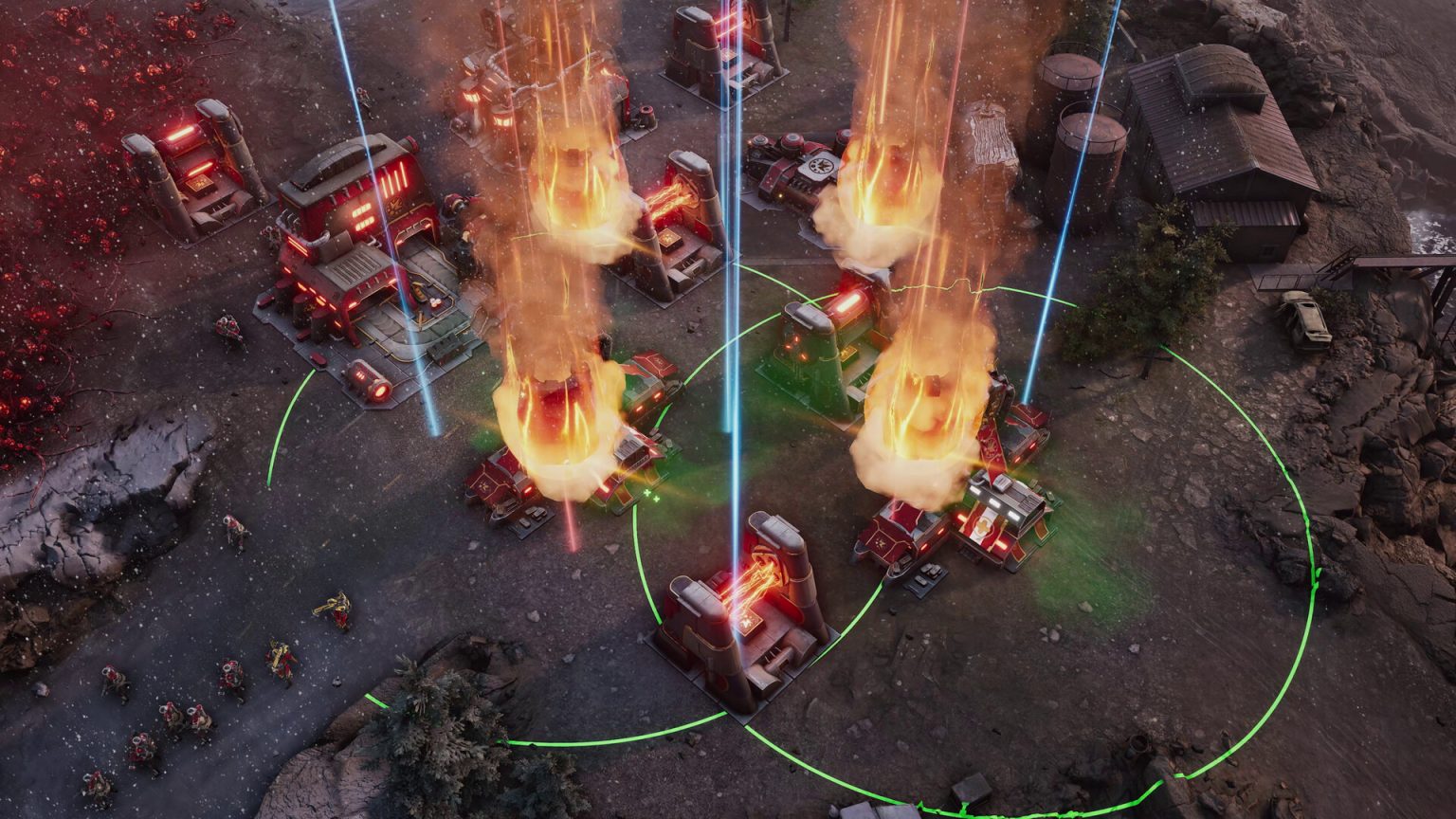
Tempest Rising knows exactly which real-time strategy habits it wants to revive: visible bases, contested resources and armies that become dangerous because their roles overlap. Seven hours on PC show a confident campaign and two meaningfully different factions. Occasional pathfinding trouble and familiar military storytelling keep it from complete command.
Base building produces immediate decisions
Construction starts with power, production and access to Tempest resources. Expanding too slowly leaves money unclaimed; expanding without scouting gives an opponent a valuable target. The economy stays legible enough that a mistake can be identified before the entire match collapses.
Buildings matter as geography. Production placement changes reinforcement time, defensive structures create retreat lines and exposed power infrastructure can turn a winning army into a powerless base.
The factions solve economy differently
The Global Defense Force favors organized military infrastructure and reliable combined arms. The Tempest Dynasty feels more aggressive and less conventional, asking the player to use faction tools rather than translate one build order directly across both sides.
That asymmetry improves campaign pacing. A mission completed with careful armor and artillery does not teach the complete answer for the other faction, so a second campaign asks for adaptation instead of cosmetic repetition.
Combat rewards control groups and restraint
Infantry, armor, air units and support abilities create clear counter relationships. Focus fire matters, but pulling damaged units back and protecting vulnerable range often produces more value than selecting the whole army and attacking one point.
Large groups can bunch around terrain or struggle to preserve the formation the player intended. Those moments are manageable with smaller control groups, although the extra correction feels like friction rather than strategic challenge.
Campaign missions teach transferable skills
Objectives introduce scouting, defense, expansion and timing in combinations that resemble multiplayer problems. Optional tasks encourage map control without making every mission a scavenger hunt. Briefings supply context and keep the next operational goal clear.
The narrative uses recognizable postwar factions and command-room personalities. It is delivered with conviction, including full-motion video, but the characters initially fit established RTS roles more readily than they surprise.
Multiplayer starts before the first battle
A useful build order secures workers, production and scouting without locking the player into one response. The first scout should answer a question: is the opponent expanding, teching or preparing early pressure? Copying a memorized sequence after that evidence changes is how a stable opening becomes a loss.
Seven hours are enough to test fundamentals, not to map every matchup or current balance trend. Competitive players should verify the live patch before treating any unit timing as permanent.
Presentation values battlefield clarity
Units use strong silhouettes and faction color, while weapon effects communicate threat without hiding the target. Zoom and interface scale support rapid selection on a normal desktop display. Dense battles remain readable until several area effects overlap.
The soundtrack is a highlight, combining industrial momentum with the deliberate pulse associated with classic base-building campaigns. Alerts are distinct enough to guide attention without every warning demanding the camera.
Technical state and monetization
The tested PC build handled campaign battles reliably, though large formations exposed navigation quirks. This review does not provide frame-rate benchmarks across hardware; the official requirements and current patch notes remain the right compatibility reference.
Tempest Rising is a premium RTS. Its campaigns and multiplayer fundamentals are included in the purchase, with no battle pass or paid power system shaping the reviewed progression.
What seven hours can establish
The review window covers both faction identities, early campaign design, skirmish fundamentals and several technology paths. It cannot settle high-level multiplayer balance or the complete quality of both campaigns.
The score rests on what is already clear: production choices matter, counters are readable and the factions create different planning rhythms. Later balance updates may change optimal openings without removing that foundation.
Session rhythm and decision load
Tempest Rising works best when a session ends after a meaningful return, objective or discovery rather than at an arbitrary timer. The reviewed 7-hour window included short experiments and longer connected sessions, making it possible to judge immediate controls and the way several decisions accumulate.
The strongest rhythm alternates planning with execution. Menus and preparation matter because they change the next action, but they become friction when organization takes longer than the problem it should solve. That tension is already visible in the opening.
Onboarding and accessibility
The early hours introduce the central verbs before expecting efficient play. Tooltips and objective language explain immediate actions, while animation, color and sound carry part of the teaching. Players should still review the available text, input, subtitle and difficulty options against their own needs because this article cannot certify every accessibility requirement.
A useful tutorial permits a mistake and then shows why the result changed. Tempest Rising generally creates that feedback through nearby retries or recoverable decisions, although the complexity of real-time strategy means some systems become clear only after they interact.
Difficulty, failure and recovery
Difficulty is most persuasive when failure identifies a decision: poor positioning, an incomplete loadout, wasted time or a misunderstood system. The reviewed opening usually provides that evidence instead of relying only on larger enemy numbers. Repetition is more productive when the player changes one assumption rather than rushing the identical attempt.
The listed weakness — pathfinding can bunch large armies — can make recovery feel slower than the best sections deserve. It does not erase the central loop, but it should shape expectations for players with limited session time or low tolerance for repeated administration.
Who should play it
Tempest Rising is easiest to recommend to players who value responsive base building and unit control and two factions have distinct economies. Those qualities appear early enough that the recommendation does not depend on a late unlock or a promise that the game becomes interesting after many hours.
Players seeking a completely different genre rhythm should treat the score as audience-specific. A numerical verdict summarizes execution within the game’s goals; it does not mean every reader will enjoy those goals equally.
Replay value and longer-term questions
The opening supports another approach through alternative routes, priorities, builds or team decisions. Replay value will ultimately depend on whether later content changes the questions or simply expands the amount of the same answer. The short review window cannot settle that balance.
A completed campaign or substantially longer save could reveal pacing issues invisible during discovery. The score rewards proven mechanics and presentation while reserving judgment on exhaustive content, endgame optimization and every narrative outcome.
What updates can change
Patches may improve performance, adjust balance or reorganize interface friction after this review. They cannot be assumed to fix a problem until official notes and the live build confirm the change. Readers should compare the publication date with the current version before treating a technical observation as permanent.
The verdict remains anchored to design choices less likely to disappear: how the game communicates goals, how its systems connect and whether the first 7 hours create reasons to continue. Those are the qualities the score measures.
Verdict
Tempest Rising succeeds because it treats classic RTS structure as a living design rather than a museum exhibit. Base placement, scouting and combined arms generate useful decisions quickly, while modern controls reduce unnecessary friction even when pathfinding occasionally creates some of its own.
For another systems-focused verdict, read our Civilization VII review. Our Atomfall review offers a different approach to exploration and incomplete information.
Source: Tempest Rising official Steam page; Slipgate Ironworks / 3D Realms.
Editorial note
Hands-on review window recorded in the article metadata, supported by official documentation and public technical coverage.
This article was reviewed on August 7, 2026.

Related stories

Lost in Random The Eternal Die review: a sharper roll
Our Lost in Random The Eternal Die review tests seven hours of roguelite combat, dice powers, relic combinations and Queen Aleksandra’s escape. Read our.

Date Everything review: romance around the house
Our Date Everything review explores six hours of object romance, branching dialogue, voice performances and relationship outcomes inside one house. Read our.

MindsEye review: ambition under technical pressure
Our MindsEye review covers five hours of Jacob Diaz’s campaign, driving, third-person combat, mission scripting and technical performance. Read our verified.
Community channel
Join the discussion
Start a thoughtful, specific conversation about this story.
Verified readers only
Continue with Google to comment.
Your Google account creates a reader-only Kaizensclan profile. Your first comment is reviewed before publication.