Civilization VII review: bold Ages, uneven transitions
Our Civilization VII review examines its three-Age campaign, leader and civilization combinations, tactical map design and uneven transitions after five hours.

 7.5
7.5 Kaizensclan verdict
Our Civilization VII review examines its three-Age campaign, leader and civilization combinations, tactical map design and uneven transitions after five hours.
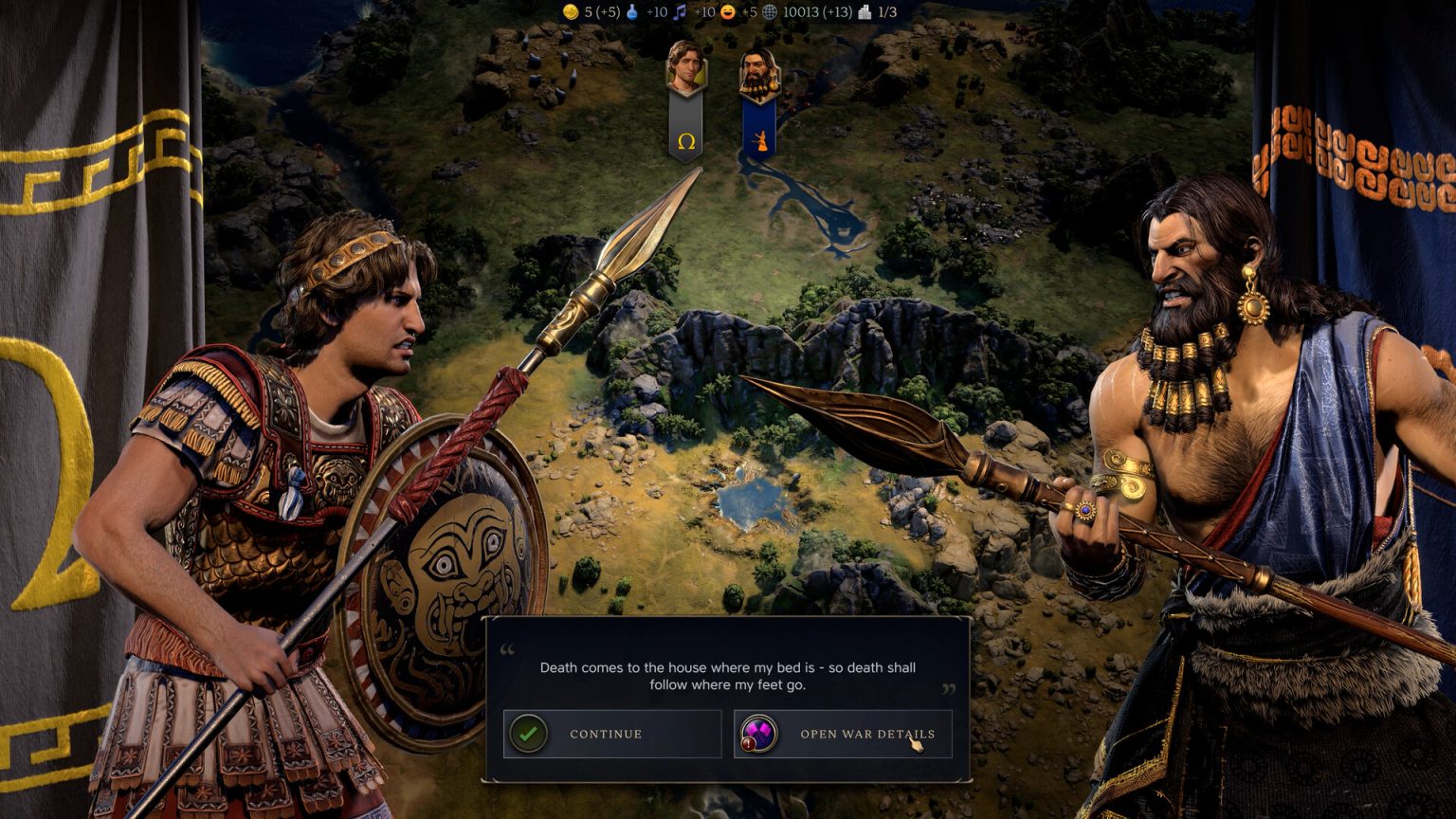
Civilization VII is a confident attempt to reorganize the 4X campaign around three distinct Ages. After five hours on PC, its tactical map and flexible leader pairings are already compelling, but the transitions that define the new structure can weaken the sense of one continuous civilization.
Score: 7.5/10. This is a research review based on a five-hour hands-on window, official documentation and the launch version’s core systems.
The first hours make expansion readable
Firaxis retains the familiar rhythm: scout, settle, improve tiles, negotiate and decide when military pressure is worth the cost. The map communicates terrain and settlement opportunities cleanly, so the early turns create meaningful plans without demanding encyclopedic knowledge.
Commanders reduce unit-handling friction by gathering forces and helping armies move as coherent groups. City management also emphasizes consequential choices over repetitive clicks. The result is a brisk opening that still produces recognizable strategic identities.
Leaders and civilizations are separate choices
A leader is no longer permanently tied to one civilization. That creates unusual combinations and lets players build around mechanical synergy instead of reenacting a fixed historical pairing. It is playful and strategically rich, though some combinations inevitably feel more like a rules experiment than a historical narrative.
The Age system pushes that idea further. Antiquity, Exploration and Modern each alter objectives, available civilizations and the scale of the map. A transition can refresh a campaign that might otherwise settle into routine.
Age changes are the central compromise
The same reset can interrupt attachment. Cities and accomplishments persist in forms, but changing civilization and moving into a redesigned ruleset makes the campaign feel segmented. Players who value a single unbroken national story may find the structure emotionally thinner than its mechanics suggest.
Five hours are enough to test the opening logic and experience the system’s direction, not to exhaust every victory path. Interface friction also becomes visible early: important information exists, yet some screens take more navigation than the underlying decision deserves.
Combat and diplomacy reward preparation
Combat benefits from terrain, unit composition and commander placement. Diplomacy uses Influence as a resource, encouraging players to budget relationships rather than click every available proposal. Neither system is opaque, but both punish plans built without a reserve.
That makes Civilization VII approachable without becoming shallow. New players can understand why a move failed, while experienced players have enough interlocking bonuses to optimize.
Performance and presentation
The art direction favors a detailed tabletop quality. Leaders are expressive, terrain remains legible at useful zoom levels and the score supports long sessions without demanding attention. On PC, control density still favors mouse and keyboard.
The review window did not reveal the complete late-game load or multiplayer meta, so this verdict does not claim exhaustive performance coverage. Firaxis has continued updating the game since launch, and buyers should consult current patch notes before treating any interface complaint as permanent.
Verdict
Civilization VII is most successful when its Ages create a fresh strategic problem. It is least convincing when that transition breaks the story a player has built in their head. The foundations are strong enough to recommend to curious 4X players, with the warning that campaign continuity is no longer sacred.
For more structured decision-making, our objective vision guide offers a different competitive example, while our CS2 utility guide focuses on repeatable preparation.
Source: official Steam page; 2K and Firaxis Games.
Settlements make growth a staged decision
New settlements begin as towns and can later become cities. That distinction makes expansion more than a race to place as many urban centers as possible. A town can specialize around food, production or trade while supporting the wider empire, whereas conversion into a city asks the player to assume more direct management. The system creates a useful pause between claiming territory and committing to a full development plan.
Influence from surrounding terrain remains important. A settlement with good resources but poor defensive geometry solves a different problem from one placed on a secure frontier. Civilization VII communicates those trade-offs well enough that the player can form a plan before every yield has been optimized.
Legacy goals give each Age a direction
Each Age presents objectives connected to broad paths such as culture, science, military achievement and economy. These goals provide momentum and help a new player identify productive actions. They also risk making a historical sandbox feel like a list of assignments when the optimal route becomes too visible.
The better interpretation is to treat a Legacy Path as a source of pressure, not an order. Pursuing one path can still create advantages in another, and the strongest turns often solve two problems at once. A military move may secure a scientific resource; a diplomatic agreement may protect the time needed to complete a wonder.
Crisis systems change the end of an Age
As an Age approaches its conclusion, crisis rules introduce constraints that prevent a dominant empire from simply repeating its best turn. This produces drama and prepares the mechanical transition. It can also make success feel temporarily invalidated, especially when the chosen penalties clash with a carefully specialized economy.
The concept is valuable because a campaign needs disruption. The execution will divide players according to how much they enjoy mandatory adaptation. In the five-hour window, the promise of the system was clearer than its full long-term balance.
Multiplayer potential and uncertainty
Simultaneous or faster turns can make multiplayer more practical, and the Ages offer natural breakpoints for a session. Competitive balance is much harder to judge from a short test. Leader-civilization combinations create a large matrix, so community knowledge and patches will shape the strongest openings over time.
Players buying primarily for multiplayer should verify current lobby options, platform support and rules after the latest update. The launch design provides a strong tactical base, but no five-hour review can responsibly claim to map a mature metagame.
Accessibility and onboarding
Tooltips explain many immediate effects, and advisors help turn a broad goal into the next action. The challenge is hierarchy: a new player needs to know which number matters now and which can wait. Some menus present the data without making that priority obvious.
Fortunately, mistakes rarely end a campaign on the spot. The Age structure creates opportunities to redirect specialization, giving learners room to recover. That forgiveness makes the game easier to recommend than its many interacting systems might suggest.
What the five-hour window can establish
A strategy game of this scale cannot be exhausted in one evening. The test covers the opening economy, settlement specialization, early diplomacy, combat fundamentals and the direction of an Age transition. It cannot settle the balance of every leader pairing, identify the strongest victory route or measure performance in the largest late campaign.
The score therefore describes how clearly Civilization VII presents its new structure and how satisfying its immediate decisions feel. Continued patches can improve interface friction and rebalance combinations, but the tension between strategic renewal and narrative continuity is built into the design. Players who want an uninterrupted historical identity should weigh that structural choice more heavily than any individual balance number.
For newcomers, the opening succeeds because a mistake creates a new problem rather than an instant defeat. For veterans, the question is whether the Age framework produces enough variety to justify losing some of the continuity that defined earlier entries.
Review scope: Five hours establish the opening systems and presentation, while a completed campaign could change conclusions about late-game variety and narrative payoff.
Editorial note
Five-hour review window, supported by official documentation and public technical coverage.
This article was reviewed on August 7, 2026.

Related stories
Minishoot’ Adventures review: exploration under fire
This Minishoot Adventures review finds a small ship leaving its village to free captured friends and confront corrupted machines. SoulGame Studio combines an.
Mouthwashing review: horror after the crash
This Mouthwashing review enters the Tulpar after a crash leaves five crew members with dwindling supplies and no credible rescue. Wrong Organ shifts between.

Thank Goodness You’re Here review: slapstick with purpose
This Thank Goodness You’re Here review follows a traveling salesman who arrives early for a mayoral appointment and becomes free labor for Barnsworth. Coal.
Community channel
Join the discussion
Start a thoughtful, specific conversation about this story.
Verified readers only
Continue with Google to comment.
Your Google account creates a reader-only Kaizensclan profile. Your first comment is reviewed before publication.