Monster Hunter Wilds review — brilliant hunts, heavy baggage
Our Monster Hunter Wilds review weighs superb weapon design and seamless ecosystems against uneven PC performance and an excessive cosmetic catalogue.

 7.5
7.5 Kaizensclan verdict
Our Monster Hunter Wilds review weighs superb weapon design and seamless ecosystems against uneven PC performance and an excessive cosmetic catalogue.
This Monster Hunter Wilds review finds Capcom’s hunting formula at its most welcoming and spectacular, but not its cleanest. Focus Mode, mobile weapon access and connected ecosystems reduce the friction between seeing a monster and making a tactical response. The hunt design remains excellent; the qualification is a demanding PC version and a cosmetic catalogue that feels excessive beside a full-price game.
Review methodology: Kaizensclan did not independently benchmark or play the release build. This assessment uses official documentation, current store information and public gameplay, with zero hands-on hours disclosed. Features, supported modes and the current DLC catalogue were checked against the official Steam listing.
Monster Hunter Wilds makes information easier to act on
The series still revolves around learning a monster rather than deleting a health bar. Position, animation, weapon commitment and part damage determine whether an opening is real. Wilds makes that information more accessible through Focus Mode, which supports deliberate aiming and highlights wounds that hunters can exploit with focused strikes.
That addition does not flatten the 14 weapon types. Great Sword users still plan around commitment, Bow players manage distance and resources, and technical weapons preserve their separate gauges or transformation rules. Focus Mode gives those identities a shared way to address a target without converting them into skins for the same moveset.
The Seikret mount changes preparation and recovery. Hunters can carry a second weapon and switch in the field, allowing a hunt to adapt without a full camp reset. Mounted travel also smooths the transition between tracks, resources and combat. The convenience is substantial, although it reduces some of the old tension around committing to a loadout.
Wounds create useful team priorities. A group can coordinate around damaged parts, stagger windows and roles instead of four players attacking whichever surface is closest. That clarity connects with the cooperative discipline described in our Helldivers 2 review, but Wilds demands more knowledge of animation and equipment.
Connected environments improve the hunt loop
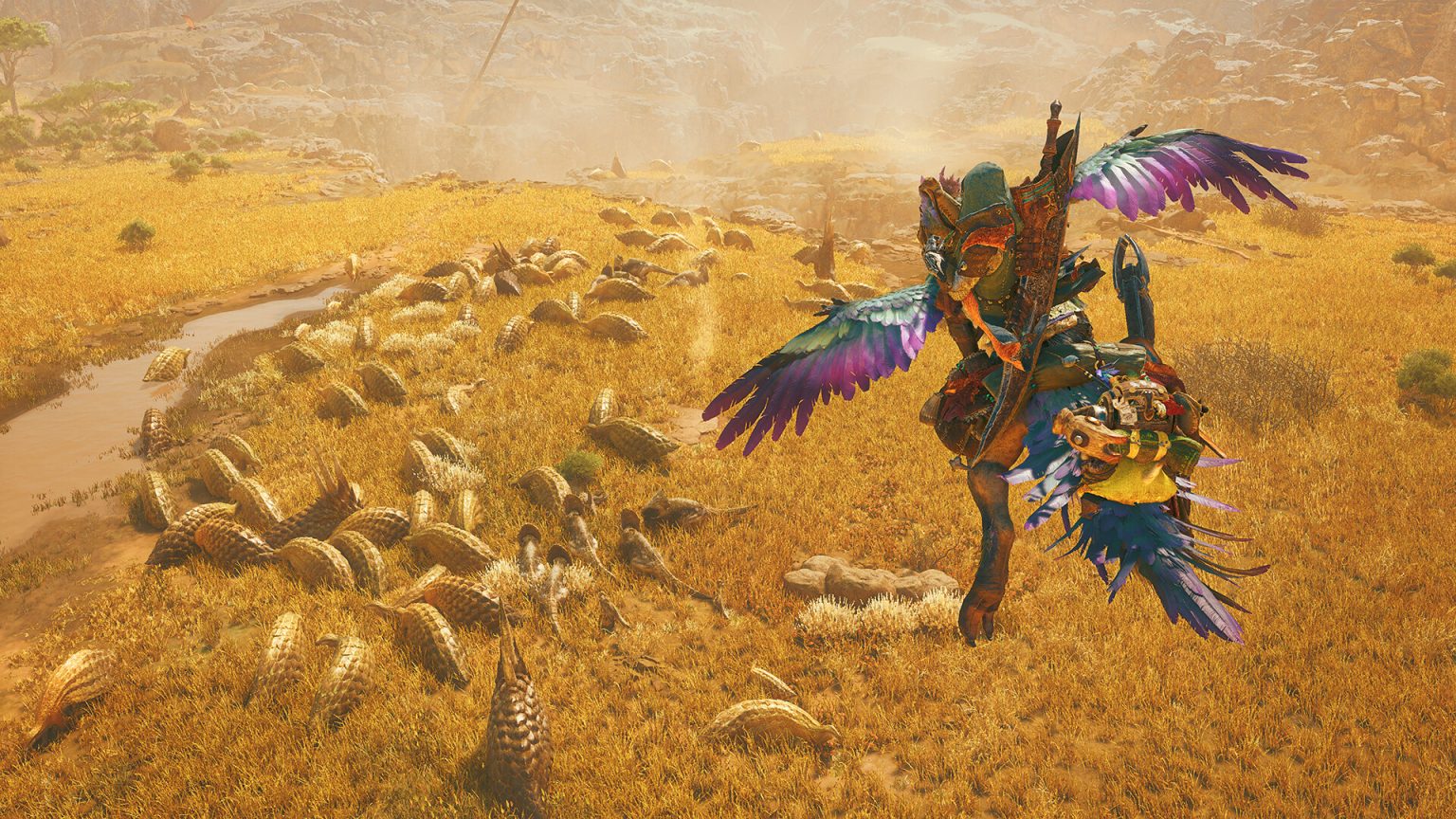
Fields shift between harsh and abundant states, changing visibility, monster behaviour and available resources. Weather is not only a visual filter; it helps define when creatures move, where conflicts emerge and how a familiar route feels. Herds and predators give the environment activity beyond the assigned target.
Seamless travel keeps the hunt from dissolving into loading screens. A monster can flee, another can enter the route and the player can pursue while managing supplies. The world feels like a system supporting the encounter rather than a lobby that launches it.
The story makes this continuity easier to understand, but it also interrupts the early rhythm. Guided movement and frequent dialogue can delay the moment when a player is free to choose a target and learn through action. Newcomers receive context; series veterans may feel the game explaining a loop they already understand.
Once the structure opens, repeat hunts support equipment goals and mastery. The pleasure is not simply obtaining a rarer material. It is noticing that a previously dangerous sequence now looks readable because positioning, weapon knowledge and preparation have improved.
Creature animation remains the real interface
Monster design communicates function through anatomy. Weight shifts before a charge, wings change available space and damaged parts alter the visual story of a fight. Good hunting games need those signals because the player is often committed to an animation before an attack arrives.
Wilds adds spectacular weather and large groups without entirely losing that clarity. Dust, lightning and debris can make scenes impressive, but they also increase visual load. Focus Mode and wound highlighting partly answer the problem by placing tactical contrast on the target.
Weapons carry distinct sound signatures, while monster vocalisations help experienced players recognise state changes without staring at the interface. The score rises during major confrontations but leaves enough room for environmental audio during tracking and preparation.
Character and armour customisation are detailed, and materials make equipment feel tied to the creatures that produced it. That craftsmanship supports the cosmetic appeal examined across our skins and visual-design coverage, though Wilds also monetises appearance far beyond what its premium price suggests.
PC performance and monetisation need scrutiny
The PC edition has carried a mixed overall user response on Steam, with performance a persistent part of the public discussion. Its official requirements are high, and dense environments place pressure on CPU and GPU resources. This zero-hour review cannot provide original benchmarks, so PC buyers should check current reports for their exact processor, graphics card and target resolution.
Console versions offer a more fixed hardware target, but display mode and performance expectations still matter. Cross-platform multiplayer is an important practical strength because it reduces the platform split for hunting groups.
Wilds is a full-price game with a very large catalogue of paid cosmetic DLC, including gestures, hairstyles, layered equipment, decorations and edit vouchers. These items do not replace the core hunt-to-craft progression, but their volume makes the storefront feel more like a service economy than a self-contained premium release.
Gameplay value remains strong for players who enjoy repeating hunts with different weapons and group compositions. Someone interested only in the main story will see a smaller portion of what the systems offer. The game is most convincing as a long-term mastery project, not a campaign consumed once.
Who should prepare for the next hunt
Wilds is designed for players who enjoy improving through observation. A new armour set matters, but recognising a monster’s shoulder movement or choosing the correct attack window matters more. Anyone seeking progression that automatically overpowers every target may find the later loop demanding.
Newcomers benefit from clearer aiming, guided story material and convenient travel. They should still choose one weapon and learn its commitments before judging the entire system. Constantly switching among all 14 options can make the game appear shallower because none receives enough practice.
Co-op groups receive the strongest social value, especially with cross-platform support. Solo hunters still have a complete structure, but group play introduces role decisions, rescues and target coordination that the ecosystem is well equipped to support.
PC buyers should treat performance research as part of preparation. Compare reports from the current build using the same CPU, GPU and resolution, not only a similar graphics card. Console players should also check preferred performance modes. No review score can make unstable frame delivery irrelevant to a timing-heavy weapon.
Verdict
Monster Hunter Wilds improves the journey into and through a hunt. Focus Mode clarifies intention, the Seikret reduces dead travel and changing fields make repeated targets feel embedded in a larger ecosystem.
The PC caveat is too important to hide beneath those achievements, and the cosmetic catalogue is difficult to reconcile with the base price. Streamlining also removes some preparation friction that veteran hunters considered meaningful.
Score: 7.5/10. This research-based score carries zero independent hands-on hours and no original benchmark claim. The combat design remains easy to recommend with qualifications; PC players in particular should verify the current build on comparable hardware before buying.
Sources: Capcom official Steam and release materials, checked August 6, 2026.
Editorial note
This research-based editorial assessment uses official release information and public gameplay. Kaizensclan logged zero first-hand playtest hours.
This article was reviewed on August 6, 2026.

Related stories
Minishoot’ Adventures review: exploration under fire
This Minishoot Adventures review finds a small ship leaving its village to free captured friends and confront corrupted machines. SoulGame Studio combines an.

Mouthwashing review: horror after the crash
This Mouthwashing review enters the Tulpar after a crash leaves five crew members with dwindling supplies and no credible rescue. Wrong Organ shifts between.

Thank Goodness You’re Here review: slapstick with purpose
This Thank Goodness You’re Here review follows a traveling salesman who arrives early for a mayoral appointment and becomes free labor for Barnsworth. Coal.
Community channel
Join the discussion
Start a thoughtful, specific conversation about this story.
Verified readers only
Continue with Google to comment.
Your Google account creates a reader-only Kaizensclan profile. Your first comment is reviewed before publication.